


Phenotypic differences in hiPSC NPCs derived from patients with schizophrenia
- PMID: 24686136
- PMCID: PMC4182344
- DOI: 10.1038/mp.2014.22
Phenotypic differences in hiPSC NPCs derived from patients with schizophrenia
Abstract
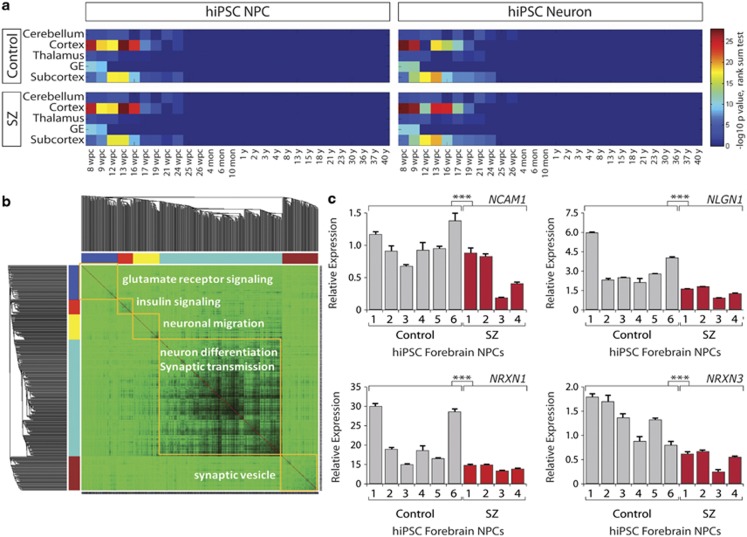
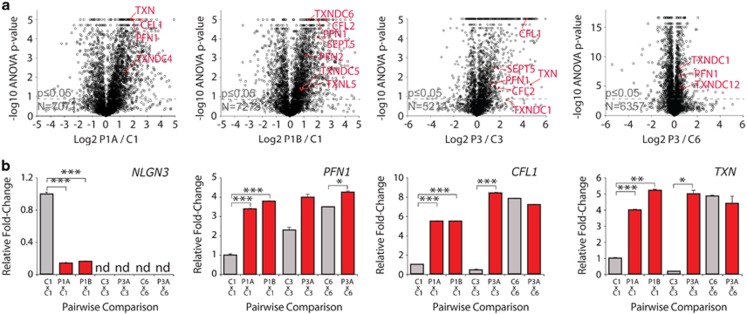
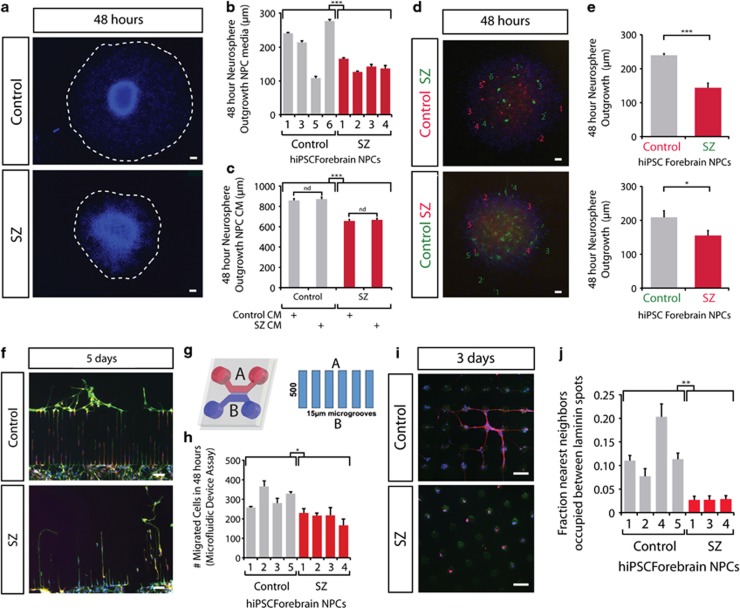
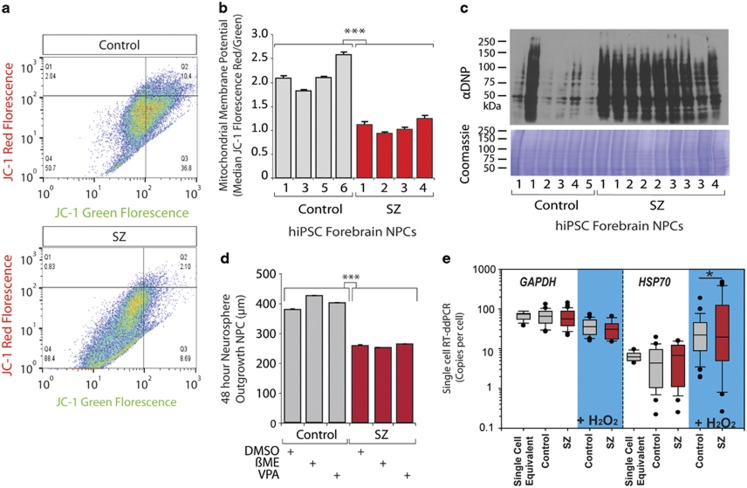
Consistent with recent reports indicating that neurons differentiated in vitro from human-induced pluripotent stem cells (hiPSCs) are immature relative to those in the human brain, gene expression comparisons of our hiPSC-derived neurons to the Allen BrainSpan Atlas indicate that they most resemble fetal brain tissue. This finding suggests that, rather than modeling the late features of schizophrenia (SZ), hiPSC-based models may be better suited for the study of disease predisposition. We now report that a significant fraction of the gene signature of SZ hiPSC-derived neurons is conserved in SZ hiPSC neural progenitor cells (NPCs). We used two independent discovery-based approaches-microarray gene expression and stable isotope labeling by amino acids in cell culture (SILAC) quantitative proteomic mass spectrometry analyses-to identify cellular phenotypes in SZ hiPSC NPCs from four SZ patients. From our findings that SZ hiPSC NPCs show abnormal gene expression and protein levels related to cytoskeletal remodeling and oxidative stress, we predicted, and subsequently observed, aberrant migration and increased oxidative stress in SZ hiPSC NPCs. These reproducible NPC phenotypes were identified through scalable assays that can be applied to expanded cohorts of SZ patients, making them a potentially valuable tool with which to study the developmental mechanisms contributing to SZ.
Figures
References
-
- Weinberger DR. Implications of normal brain development for the pathogenesis of schizophrenia. Arch Gen Psychiatry. 1987;44:660–669. - PubMed
-
- White T, Anjum A, Schulz SC. The schizophrenia prodrome. Am J Psychiatry. 2006;163:376–380. - PubMed
-
- Wong AH, Van Tol HH. Schizophrenia: from phenomenology to neurobiology. Neurosci Biobehav Rev. 2003;27:269–306. - PubMed
Publication types
MeSH terms
Substances
Grants and funding
- P41 GM103533/GM/NIGMS NIH HHS/United States
- R01 MH067880/MH/NIMH NIH HHS/United States
- R01 NS014841/NS/NINDS NIH HHS/United States
- R21 MH097156/MH/NIMH NIH HHS/United States
- U01AI111598-01/AI/NIAID NIH HHS/United States
- U01 AG046170/AG/NIA NIH HHS/United States
- R37 DA023999/DA/NIDA NIH HHS/United States
- R01 MH100175/MH/NIMH NIH HHS/United States
- R01 MH068770/MH/NIMH NIH HHS/United States
- R01 AG046170/AG/NIA NIH HHS/United States
- R01 MH101454/MH/NIMH NIH HHS/United States
- R01MH100175/MH/NIMH NIH HHS/United States
- R21 MH097156-01A1/MH/NIMH NIH HHS/United States
- R00 AA018387/AA/NIAAA NIH HHS/United States
- U01 AI111598/AI/NIAID NIH HHS/United States
- F32 AG039127/AG/NIA NIH HHS/United States
- R01 CA163772/CA/NCI NIH HHS/United States
- R01 DA023999/DA/NIDA NIH HHS/United States
LinkOut - more resources
Full Text Sources
Other Literature Sources
Medical
Molecular Biology Databases
