


Clinical management of food protein-induced enterocolitis syndrome
- PMID: 24686275
- PMCID: PMC4011628
- DOI: 10.1097/ACI.0000000000000058
Clinical management of food protein-induced enterocolitis syndrome
Abstract
Purpose of review: The article discusses the clinical management of patients affected by food protein-induced enterocolitis syndrome (FPIES), focusing on established therapeutic choices and future options.
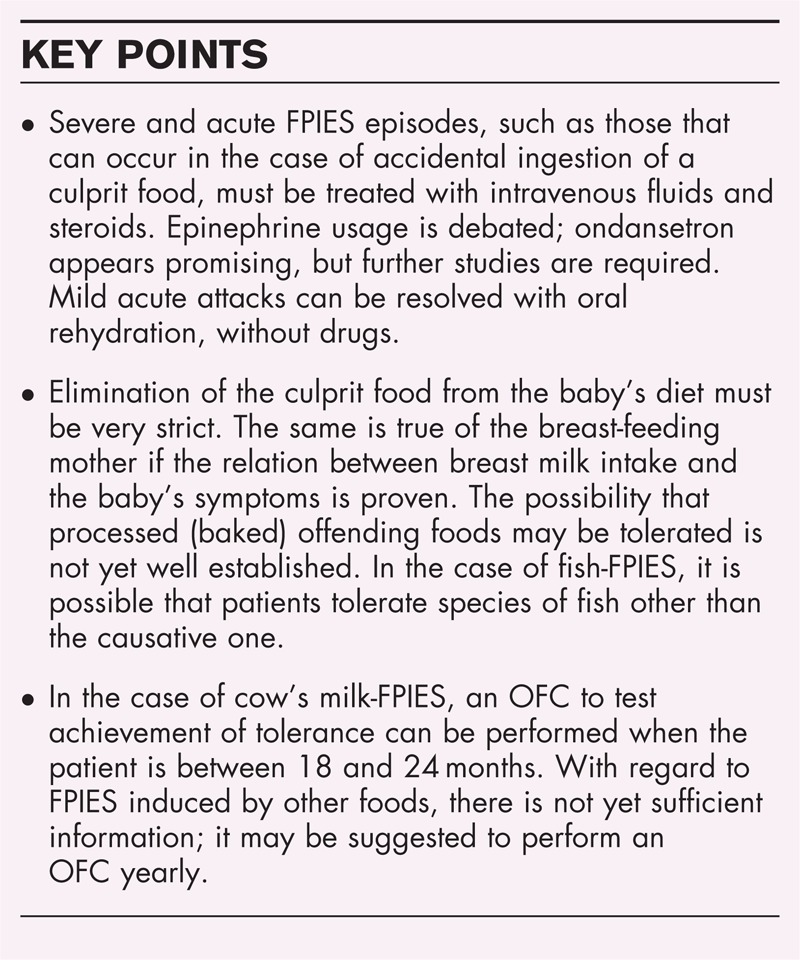
Recent findings: After FPIES has been diagnosed and avoidance of the culprit food prescribed, the most important management needs are as follows. First, recurrence of acute FPIES episodes due to accidental ingestion of culprit food. It may be useful to give patients' families an action plan. The principal suggested treatments are intravenous fluids and steroids, whereas the use of epinephrine and ondansetron requires further study. In mild-to-moderate cases, oral rehydration should be sufficient. Second, dietary introduction of at-risk foods. In children with FPIES, in addition to that/those identified as culprit(s), some foods may not be tolerated (typically cow's milk, legumes, cereals, poultry). It has been suggested to avoid introducing these foods during the baby's first year. Otherwise, they may be given for the first time in hospital, performing an oral food challenge. Third, acquisition of tolerance. Children affected by cow's milk-FPIES have a good chance of acquiring tolerance by the time they reach age 18-24 months. For other culprit foods, insufficient data are available to indicate the appropriate time, so that it is suggested that an oral food challenge be performed about 1 year after the last acute episode.
Summary: Future clinical management of FPIES must take into account, among other factors, improved understanding of pathogenesis, possible detection of different phenotypes, and the introduction of more effective therapies for acute episodes. These factors will undoubtedly influence management decisions, which will become more diversified and effective.
Similar articles
-
A multicentre retrospective study of 66 Italian children with food protein-induced enterocolitis syndrome: different management for different phenotypes.Clin Exp Allergy. 2012 Aug;42(8):1257-65. doi: 10.1111/j.1365-2222.2012.04027.x. Clin Exp Allergy. 2012. PMID: 22805473
-
[Food protein-induced enterocolitis syndrome (FPIES) in 14 children].Arch Pediatr. 2017 Apr;24(4):310-316. doi: 10.1016/j.arcped.2017.01.011. Epub 2017 Feb 21. Arch Pediatr. 2017. PMID: 28233719 French.
-
Food protein-induced enterocolitis syndrome caused by solid food proteins.Pediatrics. 2003 Apr;111(4 Pt 1):829-35. doi: 10.1542/peds.111.4.829. Pediatrics. 2003. PMID: 12671120
-
Food protein-induced enterocolitis syndrome (FPIES): current management strategies and review of the literature.J Allergy Clin Immunol Pract. 2013 Jul-Aug;1(4):317-22. doi: 10.1016/j.jaip.2013.04.004. Epub 2013 May 31. J Allergy Clin Immunol Pract. 2013. PMID: 24565536 Review.
-
New insights into food protein-induced enterocolitis in children.Minerva Pediatr. 2020 Oct;72(5):416-423. doi: 10.23736/S0026-4946.20.05976-9. Epub 2020 Jul 20. Minerva Pediatr. 2020. PMID: 32686925 Review.
Cited by
-
Food protein-induced enterocolitis syndrome - a review of the literature with focus on clinical management.J Asthma Allergy. 2017 Jun 27;10:197-207. doi: 10.2147/JAA.S100379. eCollection 2017. J Asthma Allergy. 2017. PMID: 28721077 Free PMC article. Review.
-
Nutrition and Avoidance Diets in Children With Food Allergy.Front Pediatr. 2020 Sep 4;8:518. doi: 10.3389/fped.2020.00518. eCollection 2020. Front Pediatr. 2020. PMID: 33014926 Free PMC article. Review.
-
FPIES: Reviewing the Management of Food Protein-Induced Enterocolitis Syndrome.Case Rep Pediatr. 2016;2016:1621827. doi: 10.1155/2016/1621827. Epub 2016 Mar 8. Case Rep Pediatr. 2016. PMID: 27051548 Free PMC article.
-
Food Protein-Induced Enterocolitis Syndrome: a Comprehensive Review.Clin Rev Allergy Immunol. 2019 Oct;57(2):261-271. doi: 10.1007/s12016-018-8722-z. Clin Rev Allergy Immunol. 2019. PMID: 30734159 Review.
-
Unmet needs in food protein-induced enterocolitis syndrome.Curr Opin Allergy Clin Immunol. 2014 Jun;14(3):206-7. doi: 10.1097/ACI.0000000000000063. Curr Opin Allergy Clin Immunol. 2014. PMID: 24755920 Free PMC article. No abstract available.
References
-
- Sicherer SH. Food protein-induced enterocolitis syndrome: case presentations and management lessons. J Allergy Clin Immunol 2005; 115:149–156 - PubMed
-
- Leonard SA, Nowak-Węgrzyn A. Clinical diagnosis and management of food protein-induced enterocolitis syndrome. Curr Opin Pediatr 2012; 24:739–745 - PubMed
-
- Järvinen KM, Nowak-Wegrzyn A. Food protein-induced enterocolitis syndrome (FPIES): current management strategies and review of the literature. J Allergy Clin Immunol Pract 2013; 1:317–322 - PubMed
-
A very comprehensive review and an excellent update on various aspects of FPIES. The authors have a great experience with this and pass it very well.
-
- Miceli Sopo S, Greco M, Monaco S, et al. Food protein-induced enterocolitis syndrome, from practice to theory. Expert Rev Clin Immunol 2013; 9:707–715 - PubMed
-
This review addresses also management aspects that are not yet fully resolved. Its interesting feature is to exemplify the management aspects with many clinical cases.
-
- Holbrook T, Keet CA, Frischmeyer-Guerrerio PA, Wood RA. Use of ondansetron for food protein-induced enterocolitis syndrome. J Allergy Clin Immunol 2013; 132:1219–1220 - PubMed
-
In this small experience, the authors propose a pharmacological treatment for acute episodes of FPIES, which looks very promising.
Publication types
MeSH terms
Substances
LinkOut - more resources
Full Text Sources
Other Literature Sources
Medical
Research Materials
