


Changes in memory before and after stroke differ by age and sex, but not by race
- PMID: 24686293
- PMCID: PMC4347666
- DOI: 10.1159/000357557
Changes in memory before and after stroke differ by age and sex, but not by race
Abstract
Background: Post-stroke memory impairment is more common among older adults, women and blacks. It is unclear whether post-stroke differences reflect differential effects of stroke per se or differences in prestroke functioning. We compare memory trajectories before and after stroke by age, sex and race.
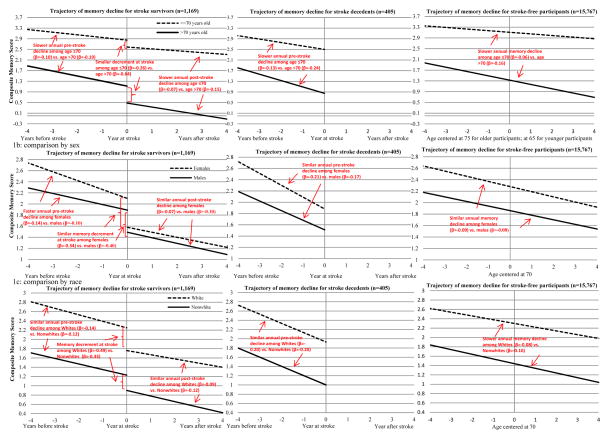
Methods: Health and Retirement Study participants aged ≥50 years (n = 17,341), with no stroke history at baseline, were interviewed biennially up to 10 years for first self- or proxy-reported stroke (n = 1,574). Segmented linear regression models were used to compare annual rates of memory change before and after stroke among 1,169 stroke survivors, 405 stroke decedents and 15,767 stroke-free participants. Effect modification was evaluated with analyses stratified by baseline age (≤70 vs. >70), sex and race (white vs. nonwhite), and using interaction terms between age/sex/race indicators and annual memory change.
Results: Older (>70 years) adults experienced a faster memory decline before stroke (-0.19 vs. -0.10 points/year for survivors, -0.24 vs. -0.13 points/year for decedents, p < 0.001 for both interactions), and among stroke survivors, larger memory decrements (-0.64 vs. -0.26 points, p < 0.001) at stroke and faster memory decline (-0.15 vs. -0.07 points/year, p = 0.003) after stroke onset, compared to younger adults. Female stroke survivors experienced a faster prestroke memory decline than male stroke survivors (-0.14 vs. -0.10 points/year, p < 0.001). However, no sex differences were seen for other contrasts. Although whites had higher post-stroke memory scores than nonwhites, race was not associated with rate of memory decline during any period of time; i.e. race did not significantly modify the rate of decline before or after stroke or the immediate effect of stroke on memory.
Conclusions: Older age predicted worse memory change before, at and after stroke onset. Sex and race differences in post-stroke memory outcomes might be attributable to prestroke disparities, which may be unrelated to cerebrovascular disease.
© 2014 S. Karger AG, Basel.
Figures
References
-
- Elias MF, Sullivan LM, D’Agostino RB, et al. Framingham stroke risk profile and lowered cognitive performance. Stroke. 2004 Feb;35(2):404–409. - PubMed
-
- Linden T, Skoog I, Fagerberg B, Steen B, Blomstrand C. Cognitive impairment and dementia 20 months after stroke. Neuroepidemiology. 2004 Jan-Apr;23(1–2):45–52. - PubMed
-
- Bejot Y, Aboa-Eboule C, Durier J, et al. Prevalence of early dementia after first-ever stroke: a 24-year population-based study. Stroke. Mar;42(3):607–612. - PubMed
-
- Srikanth VK, Anderson JF, Donnan GA, et al. Progressive dementia after first-ever stroke: a community-based follow-up study. Neurology. 2004 Sep 14;63(5):785–792. - PubMed
