


Bacillus thuringiensis subsp. israelensis and its dipteran-specific toxins
- PMID: 24686769
- PMCID: PMC4014730
- DOI: 10.3390/toxins6041222
Bacillus thuringiensis subsp. israelensis and its dipteran-specific toxins
Abstract
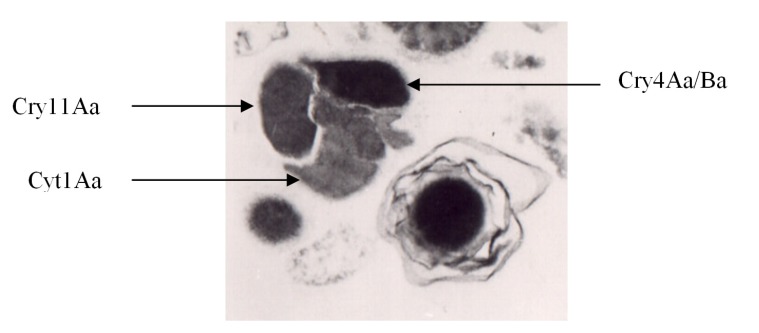
Bacillus thuringiensis subsp. israelensis (Bti) is the first Bacillus thuringiensis to be found and used as an effective biological control agent against larvae of many mosquito and black fly species around the world. Its larvicidal activity resides in four major (of 134, 128, 72 and 27 kDa) and at least two minor (of 78 and 29 kDa) polypeptides encoded respectively by cry4Aa, cry4Ba, cry11Aa, cyt1Aa, cry10Aa and cyt2Ba, all mapped on the 128 kb plasmid known as pBtoxis. These six δ-endotoxins form a complex parasporal crystalline body with remarkably high, specific and different toxicities to Aedes, Culex and Anopheles larvae. Cry toxins are composed of three domains (perforating domain I and receptor binding II and III) and create cation-selective channels, whereas Cyts are composed of one domain that acts as well as a detergent-like membrane perforator. Despite the low toxicities of Cyt1Aa and Cyt2Ba alone against exposed larvae, they are highly synergistic with the Cry toxins and hence their combinations prevent emergence of resistance in the targets. The lack of significant levels of resistance in field mosquito populations treated for decades with Bti-bioinsecticide suggests that this bacterium will be an effective biocontrol agent for years to come.
Figures
References
-
- Service M.W. Medical Entomology for Students. 3rd ed. Cambridge University Press; Cambridge, UK: 2004.
-
- Gyapong J.O., Twum-Danso N.A.Y. Editorial: Global elimination of lymphatic filariasis: Fact or fantasy? Trop. Med. Int. Health. 2006;11:125–128. - PubMed
-
- World Health Organization . WHO; Geneva, Switzland: 2012. World Malaria Report 2012.
Publication types
MeSH terms
Substances
LinkOut - more resources
Full Text Sources
Other Literature Sources
Medical
