. 2014 May;46(5):482-6.
doi: 10.1038/ng.2941. Epub 2014 Mar 30.

Rare missense variants in POT1 predispose to familial cutaneous malignant melanoma

Affiliations

Rare missense variants in POT1 predispose to familial cutaneous malignant melanoma

Jianxin Shi et al. Nat Genet. 2014 May.

Abstract

Although CDKN2A is the most frequent high-risk melanoma susceptibility gene, the underlying genetic factors for most melanoma-prone families remain unknown. Using whole-exome sequencing, we identified a rare variant that arose as a founder mutation in the telomere shelterin gene POT1 (chromosome 7, g.124493086C>T; p.Ser270Asn) in five unrelated melanoma-prone families from Romagna, Italy. Carriers of this variant had increased telomere lengths and numbers of fragile telomeres, suggesting that this variant perturbs telomere maintenance. Two additional rare POT1 variants were identified in all cases sequenced in two separate Italian families, one variant per family, yielding a frequency for POT1 variants comparable to that for CDKN2A mutations in this population. These variants were not found in public databases or in 2,038 genotyped Italian controls. We also identified two rare recurrent POT1 variants in US and French familial melanoma cases. Our findings suggest that POT1 is a major susceptibility gene for familial melanoma in several populations.


Figures
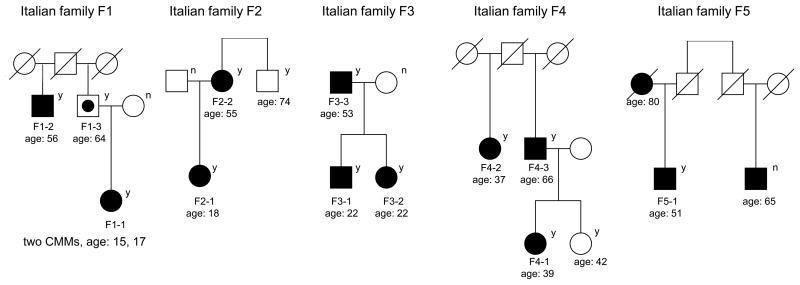
Figure 1
Figure 1. Pedigrees of cutaneous malignant melanoma (CMM)-prone families with the Ser270Asn variant (g.7:124493086 C>T) in POT1
Solid squares and circles: CMM cases; Circle with a dot in the center: obligate gene carrier; Circles: females; Squares: males. “y” indicates a variant carrier and “n” indicates a non-carrier. “age” is the age at diagnosis for CMM cases and age at exam for unaffected family members.
Figure 2
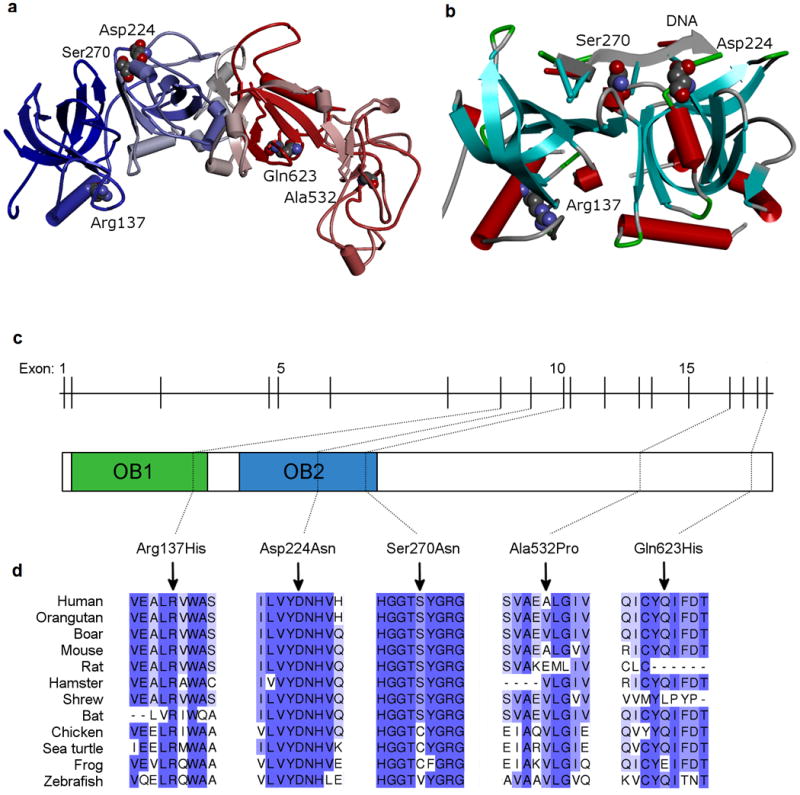
Figure 2. Structural illustrations of rare variants in POT1
(a) Homology-based 3D model of hPOT1 (UniProt; Q9NUX5, POTE1_HUMAN) constructed using Phyre2,. Secondary structural domains are schematically shown as cylinders (alpha helix), arrows (beta-sheet) and tubes (loop regions). The top templates used for modeling are 1XJV_A, 1ph4_A, 1jb7_A, and 1k8g_C,-. The N-terminal sequence end (blue) is the same as the experimentally derived structure (1XJV_A) and the C-terminal end regions (red) are highly similar to the telomere binding proteins 1ph4 and 1jb7. (b) Schematic representation of the N-terminal region (OB1 and OB2 domains) of hPOT1 protein (Research Collaboratory for Structural Bioinformatics (RCSB) Protein Data Bank (PDB) ID, 1XJV). Helical motifs are shown as cylinders (red) and beta-sheets as arrows pointing in the direction of C-terminus. The coil and the turn region segments are displayed as tubes. The three residues in the OB1/OB2 domains containing missense variants are shown in Corey-Pauling-Koltun (CPK) mode. The two affected amino acids (Ser270Asn and Asp224Asn) are in close proximity to the bound telomeric single-stranded DNA (ssDNA) decamer. Discovery Studio (v. 3.5, Accelrys Inc.) was used for visualization and display. (c) Schematic of POT1 genomic structure and conserved OB domains. POT1 is composed of 19 exons spanning approximately 108,000 bases of genomic sequence on chromosome 7q31.33. (d) Amino acid conservation among POT1 homologs. Higher percent identity at a given amino acid position is indicated by a deeper purple color. The positions of the variants identified in this study are indicated relative to NP_056265.
Figure 3
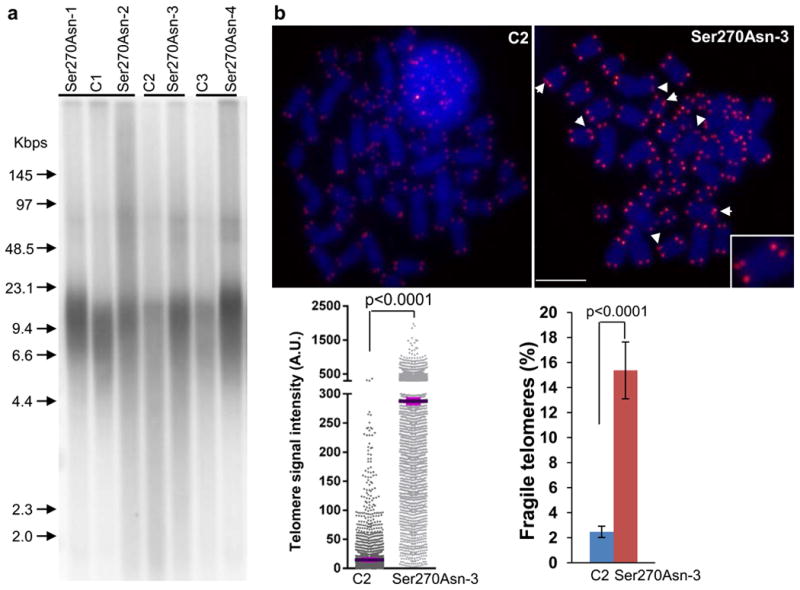
Figure 3. Telomere length in PBMC from individuals with POT1-Ser270Asn variant
(a) telomere restriction fragment (TRF) analysis of PBMC. A representative blot shows telomere restriction fragments in each POT1 variant carrier (n=4) and the age-matched control (C, melanoma cases without POT1 variants, n=3). A labeled molecular weight marker (shown in kilobases) is used to determine telomere length. DNA was separated in a CHEF DR-II pulsed-field apparatus at 5 V/cm at an angle of 120° with switching times ramped from 1 to 15 s for 15 hours. Telomere length and heterogeneity are demonstrated by telomere signal intensities at higher and lower molecular weight. (b) Q-FISH analysis of ex vivo stimulated PBMC. Representative metaphase spreads of age-matched control and POT1 variant carrier showing DAPI staining (blue) and telomere fluorescence signals (red). Arrows: fragile telomeres (enlarged view demonstrated in the box). Left panel: quantitative measurement of telomere signal intensity in a jitter plot displaying complete distribution of telomeres with diverse signal intensity. Purple bars denote mean telomere signal intensity in a single control (C2) and a single Ser270Asn carrier (Ser270Asn-3). Additional variant carriers are described in Supplementary Fig. 6. Telomere signal intensity is depicted in arbitrary units (A.U). Right panel: Percentage of fragile telomeres in C2 and Ser270Asn-3. At least 30 metaphases / sample were counted. Error bars indicate standard deviation. P values were obtained from the Wilcoxon rank-sum test. The experiments were repeated three times on each sample.

Comment in

References

    1. Goldstein AM, Tucker MA. Genetic epidemiology of cutaneous melanoma: a global perspective. Arch Dermatol. 2001;137:1493–6. - PubMed
    1. Cannon-Albright LA, et al. Assignment of a locus for familial melanoma, MLM, to chromosome 9p13-p22. Science. 1992;258:1148–52. - PubMed
    1. Hussussian CJ, et al. Germline p16 mutations in familial melanoma. Nat Genet. 1994;8:15–21. - PubMed
    1. Gruis NA, et al. Homozygotes for CDKN2 (p16) germline mutation in Dutch familial melanoma kindreds. Nat Genet. 1995;10:351–3. - PubMed
    1. Goldstein AM. Familial melanoma, pancreatic cancer and germline CDKN2A mutations. Hum Mutat. 2004;23:630. - PubMed

Publication types

MeSH terms