


Adiponectin is sufficient, but not required, for exercise-induced increases in the expression of skeletal muscle mitochondrial enzymes
- PMID: 24687585
- PMCID: PMC4080944
- DOI: 10.1113/jphysiol.2014.273680
Adiponectin is sufficient, but not required, for exercise-induced increases in the expression of skeletal muscle mitochondrial enzymes
Abstract
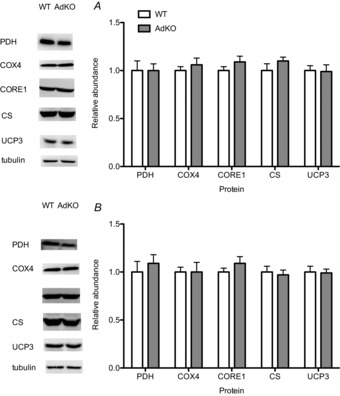
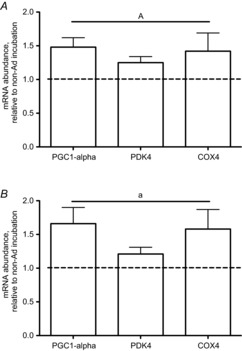
Adiponectin (Ad) has been proposed to be a regulator of mitochondrial biogenesis in skeletal muscle, and necessary for exercise-induced increases in mitochondrial content. We first confirmed that Ad could acutely increase the expression of mitochondrial proteins during a 10 h incubation in isolated soleus and extensor digitorum longus (EDL) muscles. Next, we further examined the role of Ad as a regulator of mitochondrial content using Ad knockout (AdKO) mice. The AdKO animals showed no differences in resting VO2, respiratory exchange ratio, or in time to exhaustion during exercise when compared to wild-type (WT) mice. There was a reduction in resting palmitate oxidation in isolated soleus from AdKO animals (-23%, P < 0.05) but not EDL, and 5-aminoimidazole-4-carboxamide (AICAR)-stimulated palmitate oxidation was similar in both genotypes regardless of muscle. There were no differences in protein markers of mitochondrial content (COX4, CORE1, CS, PDHE1α) in red and white gastrocnemius between WT and AdKO animals. A single bout of treadmill running increased the phosphorylation of AMP-activated protein kinase (AMPK) and the mRNA expression of mitochondrial proteins in red and white gastrocnemius in both WT and AdKO animals, with no differences between genotypes. Finally, 8 weeks of chronic exercise training increased the protein content of mitochondrial markers similarly (∼25-35%) in red gastrocnemius from both WT and AdKO mice. Collectively, our results demonstrate that the absence of Ad is not accompanied by reductions in mitochondrial protein content, or a reduction in aerobic exercise capacity. We conclude that Ad is not required for the maintenance of mitochondrial content, or for exercise-induced increases in skeletal muscle mitochondrial proteins.
© 2014 The Authors. The Journal of Physiology © 2014 The Physiological Society.
Figures





References
-
- Bruce CR, Mertz VA, Heigenhauser GJ, Dyck DJ. The stimulatory effect of globular adiponectin on insulin-stimulated glucose uptake and fatty acid oxidation is impaired in skeletal muscle from obese subjects. Diabetes. 2005;54:3154–3160. - PubMed
-
- Chlouverakis C, White PA. Obesity and insulin resistance in the obese-hyperglycemic mouse (obob) Metabolism. 1969;18:998–1006. - PubMed
-
- Fitts RH, Booth FW, Winder WW, Holloszy JO. Skeletal muscle respiratory capacity, endurance, and glycogen utilization. Am J Physiol. 1975;228:1029–1033. - PubMed
-
- Frier BC, Williams DB, Wright DC. The effects of apelin treatment on skeletal muscle mitochondrial content. Am J Physiol Regul Integr Comp Physiol. 2009;297:R1761–1768. - PubMed
Publication types
MeSH terms
Substances
LinkOut - more resources
Full Text Sources
Other Literature Sources
Molecular Biology Databases
