


SPINK1 protein expression and prostate cancer progression
- PMID: 24687926
- PMCID: PMC4167171
- DOI: 10.1158/1078-0432.CCR-13-1341
SPINK1 protein expression and prostate cancer progression
Abstract
Purpose: SPINK1 overexpression has been described in prostate cancer and is linked with poor prognosis in many cancers. The objective of this study was to characterize the association between SPINK1 overexpression and prostate cancer-specific survival.
Experimental design: The study included 879 participants in the U.S. Physicians' Health Study and Health Professionals Follow-Up Study, diagnosed with prostate cancer (1983-2004) and treated by radical prostatectomy. Protein tumor expression of SPINK1 was evaluated by immunohistochemistry on tumor tissue microarrays.
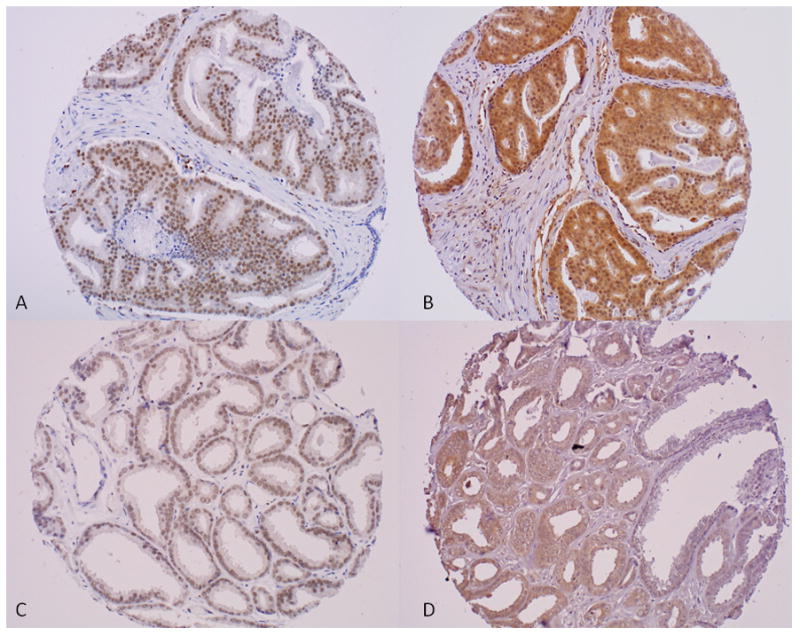
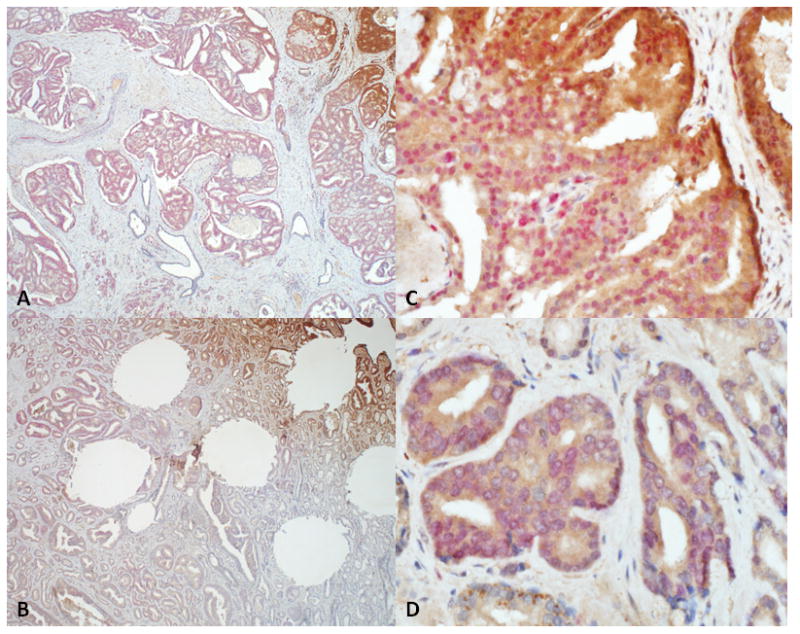
Results: Seventy-four of 879 (8%) prostate cancer tumors were SPINK1 positive. Immunohistochemical data were available for PTEN, p-Akt, pS6, stathmin, androgen receptor (AR), and ERG (as a measure of the TMPRSS2:ERG translocation). Compared with SPINK1-negative tumors, SPINK1-positive tumors showed higher PTEN and stathmin expression, and lower expression of AR (P < 0.01). SPINK1 overexpression was seen in 47 of 427 (11%) ERG-negative samples and in 19 of 427 (4%) ERG-positive cases (P = 0.0003). We found no significant associations between SPINK1 status and Gleason grade or tumor stage. There was no association between SPINK1 expression and biochemical recurrence (P = 0.56). Moreover, there was no association between SPINK1 expression and prostate cancer mortality (there were 75 lethal cases of prostate cancer during a mean of 13.5 years follow-up; HR = 0.71; 95% confidence interval, 0.29-1.76).
Conclusions: Our results suggest that SPINK1 protein expression may not be a predictor of recurrence or lethal prostate cancer amongst men treated by radical prostatectomy. SPINK1 and ERG protein expression do not seem to be entirely mutually exclusive, as some previous studies have suggested.
©2014 American Association for Cancer Research.
Conflict of interest statement
Figures
References
-
- Paju A, Hotakainen K, Cao Y, Laurila T, Gadaleanu V, Hemminki A, et al. Increased expression of tumor-associated trypsin inhibitor, TATI, in prostate cancer and in androgen-independent 22Rv1 cells. Eur Urol. 2007;52:1670–9. - PubMed
-
- Leinonen KA, Tolonen TT, Bracken H, Stenman UH, Tammela TL, Saramäki OR, et al. Association of SPINK1 expression and TMPRSS2:ERG fusion with prognosis in endocrine-treated prostate cancer. Clin Cancer Res. 2010;16:2845–51. - PubMed
Publication types
MeSH terms
Substances
Grants and funding
- P50 CA090381/CA/NCI NIH HHS/United States
- CA34944/CA/NCI NIH HHS/United States
- P01 CA055075/CA/NCI NIH HHS/United States
- CA141298/CA/NCI NIH HHS/United States
- CA55075/CA/NCI NIH HHS/United States
- HL3595/HL/NHLBI NIH HHS/United States
- P50 CA090578/CA/NCI NIH HHS/United States
- R01 HL026490/HL/NHLBI NIH HHS/United States
- U01 CA113913/CA/NCI NIH HHS/United States
- T32 CA009001/CA/NCI NIH HHS/United States
- P01 CA089021/CA/NCI NIH HHS/United States
- P50 CA127003/CA/NCI NIH HHS/United States
- 5P50CA090381-08/CA/NCI NIH HHS/United States
- CA097193/CA/NCI NIH HHS/United States
- R01 CA040360/CA/NCI NIH HHS/United States
- R01 CA136578/CA/NCI NIH HHS/United States
- R01 CA097193/CA/NCI NIH HHS/United States
- CA40360/CA/NCI NIH HHS/United States
- R01 CA034944/CA/NCI NIH HHS/United States
- CA13389/CA/NCI NIH HHS/United States
- R01 CA141298/CA/NCI NIH HHS/United States
LinkOut - more resources
Full Text Sources
Other Literature Sources
Medical
Research Materials
