. 2013 Nov 1;16(11):418-423.
doi: 10.1016/j.mattod.2013.11.001.

Mimicking the nanostructure of bone matrix to regenerate bone

Affiliations

Mimicking the nanostructure of bone matrix to regenerate bone

Robert Kane et al. Mater Today (Kidlington). .

Abstract

Key features of bone tissue structure and composition are capable of directing cellular behavior towards the generation of new bone tissue. Bone tissue, as well as materials derived from bone, have a long and successful history of use as bone grafting materials. Recent developments in design and processing of synthetic scaffolding systems has allowed the replication of the bone's desirable biological activity in easy to fabricate polymeric materials with nano-scale features exposed on the surface. The biological response to these new tissue-engineering scaffold materials oftentimes exceeds that seen on scaffolds produced using biological materials.

Keywords: Biomimetic; Bone tissue engineering; Nanofiber; Scaffold; Thermally induced phase separation.


Figures
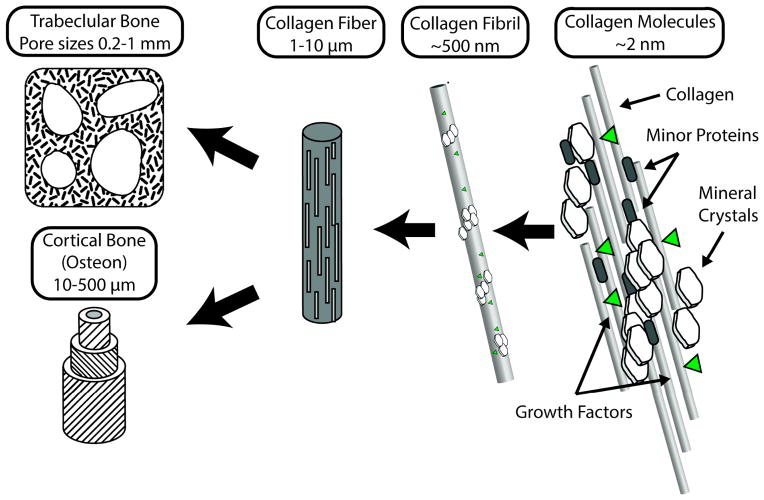
Figure 1
Figure 1
Organization of bone tissue from its smallest components (right) to whole tissues (left). Bone is a composite of collagen fibers reinforced with calcium phosphate nanocrystals arranged in a semi-regular pattern. Other components include minor proteins and growth factors. Mineralized collagen is aggregated into small fibrils, which further combine to form fibers a few microns in diameter and several mm long. In trabecular (spongy) bone the mineralized fibers are semi-randomly laid out in struts forming an open cell foam. Cortical bone is composed of circular osteons which feature aligned sheets of mineralized fibers wrapped around a central hollow core.
Figure 2
Figure 2
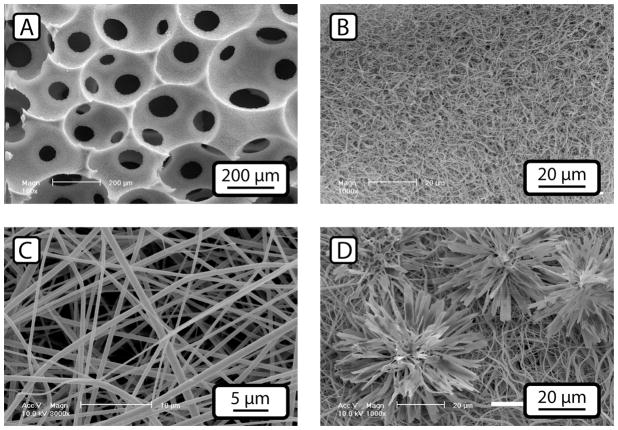
Different types of nano-fibrous scaffolding materials. Phase separated poly-lactic acid scaffolds (A and B) can be produced as open-cell foams whose surface is a mat of fibers approximately 100 nm in diameter. Electrospun materials (C) typically form loose meshes of fibers ~1 micron in diameter. Both types of nano-fiber materials can be enhanced with the addition of calcium phosphate minerals. (D) shows a phase-separated scaffold surface treated with an electrodeposition process, resulting in flower-shaped mineral deposits while still leaving the nano-fibers exposed. Figures 2a and 2b adapted from Wei et al., 2009, permission for re-use obtained from Elsevier Publishing. Figs. 2c and 2d adapted from He at al. 2010, permission for re-use obtained from John Wiley and Sons.
Figure 3
Figure 3
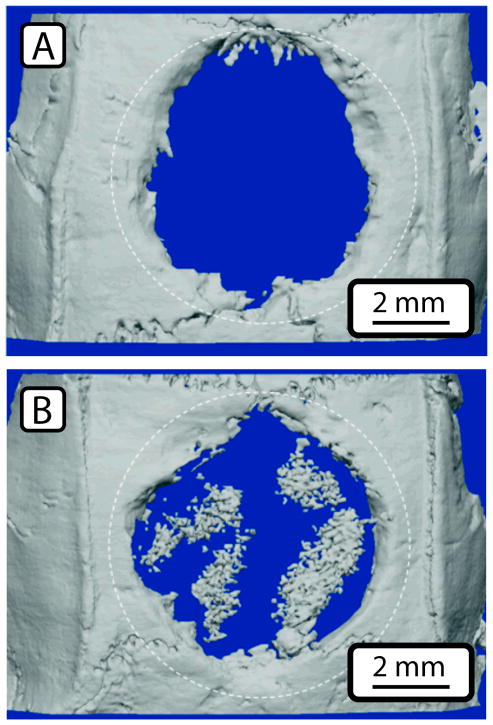
Repair of calvarial (skull) defect in mice using a PLLA scaffold with a smooth pore surface (A) or a phase-separated scaffold with nanofibrous structure (B). Dotted lines show the extent of the original defect. By 6 weeks bone has grown into both scaffolds, but the nano-fiber scaffold (B) shows extensive bone growth in the center of the scaffold. Figure adapted from Woo et al., 2009, permission obtained from Mary-Ann Liebert Inc.
Figure 4
Figure 4
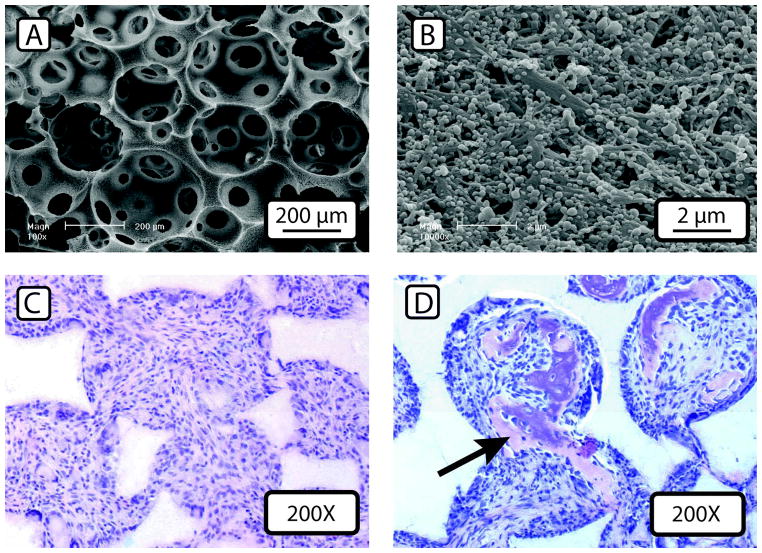
Nanofibrous scaffold loaded with BMP-containing microspheres at low (A) and (B) high magnification. Microsphere addition does not change scaffold morphology, even at very high loading levels. (C) and (D) show histological sections of scaffolds subcutaneously implanted in the backs of mice for 3 weeks. BMP-soaked scaffolds (C) show minimal bone tissue formation, but using delayed-release microspheres results substantially more bone tissue formation, as indicated by a black arrow (D). Figures adapted from Wei et al., 2007, permission obtained from Elsevier Publishing.

References

    1. Weiner S, Wagner HD. Ann Rev of Mat Sci. 1998;28:271–98.
    1. Rho JY, Kuhn-Spearing L, Zioupos P. Med Eng & Phys. 1998;20:92–102. - PubMed
    1. Di Lullo GA, et al. J Bio Chem. 2002;277:4223–31. - PubMed
    1. Hauschka PV, Wians FH. Anatomical Record. 1989;224:180–8. - PubMed
    1. Bolander ME, et al. Proc Nat Acad Sci. 1988;85:2919–23. - PMC - PubMed

LinkOut - more resources