Review
. 2012 Sep 28:2:e201209002.
doi: 10.5936/csbj.201209002. eCollection 2012.

Computational approaches for rational design of proteins with novel functionalities

Affiliations
Review

Computational approaches for rational design of proteins with novel functionalities

Manish Kumar Tiwari et al. Comput Struct Biotechnol J. .

Abstract

Proteins are the most multifaceted macromolecules in living systems and have various important functions, including structural, catalytic, sensory, and regulatory functions. Rational design of enzymes is a great challenge to our understanding of protein structure and physical chemistry and has numerous potential applications. Protein design algorithms have been applied to design or engineer proteins that fold, fold faster, catalyze, catalyze faster, signal, and adopt preferred conformational states. The field of de novo protein design, although only a few decades old, is beginning to produce exciting results. Developments in this field are already having a significant impact on biotechnology and chemical biology. The application of powerful computational methods for functional protein designing has recently succeeded at engineering target activities. Here, we review recently reported de novo functional proteins that were developed using various protein design approaches, including rational design, computational optimization, and selection from combinatorial libraries, highlighting recent advances and successes.

Keywords: DEZYMER; De novo protein design; K* algorithm; ORBIT; ROSETTA; computational protein design; designed therapeutic proteins; metalloproteins.


Figures
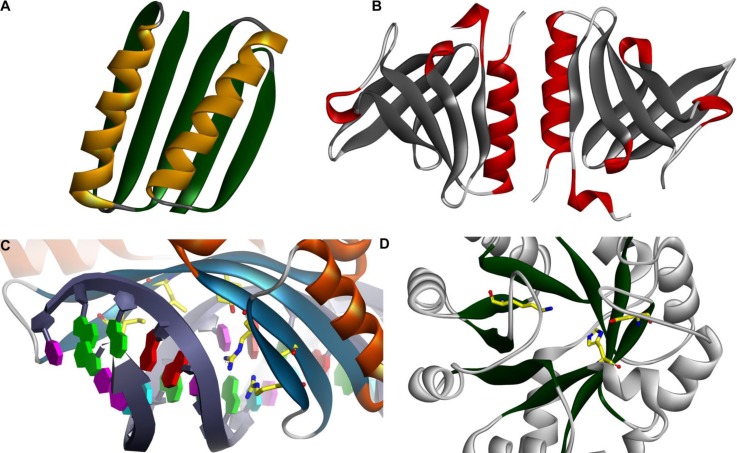
Figure 1
Figure 1
Computationally designed structures and enzymes. (A) A novel Top7 globular protein fold with atomic-level accuracy [34]. (B) Designed SspB adaptor protein [15]. (C) Redesigned endonuclease DNA binding [17]. The redesigned enzyme binds and cleaves the redesigned recognition site ∼10,000 times more effectively than does the wild-type enzyme, with a level of target discrimination comparable to the original endonuclease. (D) A novel retro-aldol enzyme designed within a TIM-barrel scaffold [20].
Figure 2
Figure 2
Computational design of an organophosphate hydrolase. Engineered zinc-containing mouse adenosine deaminase PT3.1 design crystal structure, with catalytic residues in yellow [49].
Figure 3
Figure 3
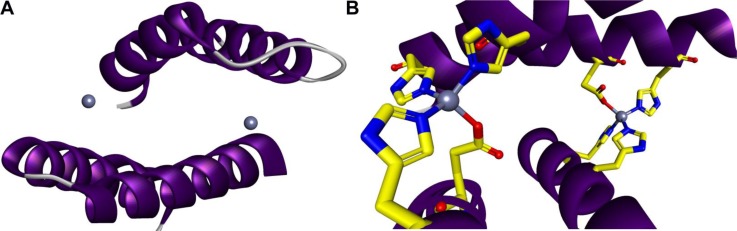
Computationally designed protein-protein interactions with high affinity and desired orientation. (A) The symmetric homodimer design with two interface zinc sites each coordinated by four histidines at i, i + 4 positions on each helix [112]. A Rosetta-based approach for the rational design of a protein monomer to form a zinc-mediated, symmetric homodimer. Incorporating metal-binding sites at the target interface may be one approach for increasing affinity and specifying the binding mode. (B) Metal interface design, named MID1 (NESG target ID OR37), forms a tight dimer in the presence of zinc (MID1-zinc) with a dissociation constant <30 nM.
Figure 4
Figure 4
Design of novel binding proteins. (A) Crystal structure of HB36.3-SC1918/H1 complex . (B) Close up view of SC1918 HA-HB36.3 interface [52].

References

    1. Margulies M, Egholm M, Altman WE, Attiya S, Bader JS, et al. (2005) Genome sequencing in microfabricated high-density picolitre reactors. Nature 437: 376–380 - PMC - PubMed
    1. Todd AE, Marsden RL, Thornton JM, Orengo CA (2005) Progress of structural genomics initiatives: an analysis of solved target structures. J Mol Biol 348: 1235–1260 - PubMed
    1. George RA, Spriggs RV, Bartlett GJ, Gutteridge A, MacArthur MW, et al. (2005) Effective function annotation through catalytic residue conservation. Proc Natl Acad Sci U S A 102: 12299–12304 - PMC - PubMed
    1. Sillitoe I, Dibley M, Bray J, Addou S, Orengo C (2005) Assessing strategies for improved superfamily recognition. Protein Sci 14: 1800–1810 - PMC - PubMed
    1. Lee D, Redfern O, Orengo C (2007) Predicting protein function from sequence and structure. Nat Rev Mol Cell Biol 8: 995–1005 - PubMed

LinkOut - more resources