


Adherence to Long-Term Therapies and Beliefs about Medications
- PMID: 24688792
- PMCID: PMC3943193
- DOI: 10.1155/2014/479596
Adherence to Long-Term Therapies and Beliefs about Medications
Abstract
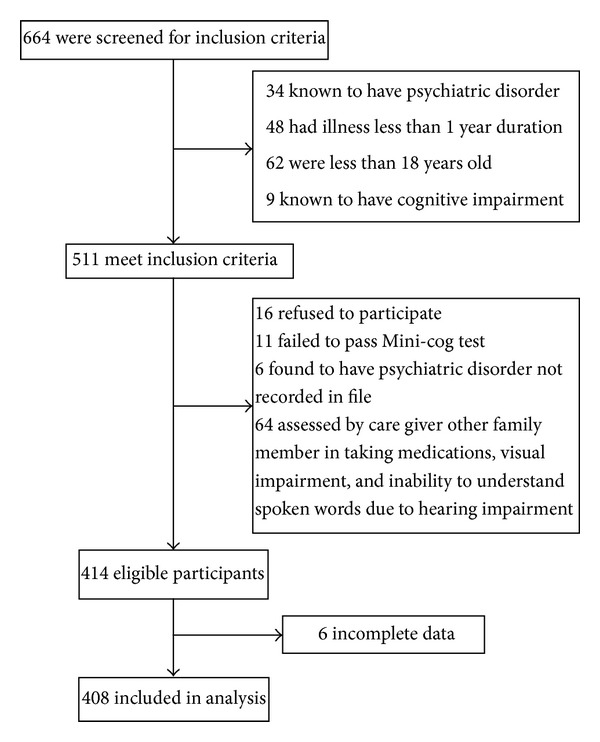
Objectives. To assess adherence to long-term medications among patients in family medicine clinics and to evaluate relationship between adherence, beliefs about medications, medication information adequacy, and other factors. Methods. Interviewer assisted survey was conducted to assess adherence using the 8-item Morisky Medication Adherence Scale (MMAS-8), beliefs about medications using beliefs about medicine questionnaire (BMQ), and the patients' perception of medication information adequacy. Results. Of the 408 participants, 56.9% reported low adherence. Pearson's bivariate correlation showed positive association between MMAS-8 score and BMQ-specific necessity (r = 0.526 P < 0.001) and the perceived information adequacy (r = 0.568 P < 0.001), and there was negative association between adherence score and BMQ specific concerns, general overuse, and harm (r = -0.647, -0.466, and -0.663, resp.) (P < 0.001). Multivariable analysis revealed that age, number of medications, number of medical conditions, specific necessity and concerns beliefs, general harm beliefs, and perceived adequacy of medication information were independent predictor of adherence. Furthermore, specific beliefs explain 27.7% of the variance in adherence, while medication information adequacy explains 32.3% of the variance in adherence. Conclusion. The prevalence of low adherence among patients on long-term medications is high and it is related to negative beliefs about medications and to inadequate information given to patients about their medications.
Figures
References
-
- Osterberg L, Blaschke T. Adherence to medication. The New England Journal of Medicine. 2005;353(5):487–497. - PubMed
-
- Sabaté E. Adherence to Long-Term Therapies: Evidence for Action. Geneva, Switzerland: World Health Organization; 2003.
-
- Sackett DL, Haynes RB, Gibson ES, Taylor DW, Roberts RS, Johnson AL. Patient compliance with antihypertensive regimens. Patient Counselling and Health Education. 1978;1(1):18–21. - PubMed
-
- DiMatteo MR. Variations in patients’ adherence to medical recommendations: a quantitative review of 50 years of research. Medical Care. 2004;42(3):200–209. - PubMed
-
- Bosworth HB. Medical treatment adherence. In: Morris Weinberger EZO, Bosworth HB, editors. Patient Treatment Adherence: Concepts, Interventions and Measurement. Boca Raton, Fla, USA: Taylor & Francis; 2005.
LinkOut - more resources
Full Text Sources
Other Literature Sources
