Review
. 2014 Jun;71(6):608-17.
doi: 10.1111/aji.12244. Epub 2014 Apr 1.

Interactions between HIV-1 and mucosal cells in the female reproductive tract

Affiliations
Review

Interactions between HIV-1 and mucosal cells in the female reproductive tract

Ruizhong Shen et al. Am J Reprod Immunol. 2014 Jun.

Abstract

Worldwide, the heterosexual route is the prevalent mode of HIV-1 transmission, and the female reproductive tract accounts for approximately 40% of all HIV-1 transmissions. HIV-1 infection in the female reproductive tract involves three major events: entry through the mucosal epithelium, productive infection in subepithelial mononuclear cells, and delivery to lymph nodes to initiate systemic infection. Here, we provide a focused review of the interaction between HIV-1 and mucosal epithelial cells, lymphocytes, macrophages, and dendritic cells in female genital mucosa. Increased understanding of these interactions could illuminate new approaches for interdicting HIV-1 heterosexual transmission.

Keywords: Dendritic cells; entry; epithelial cells; lymphocytes; macrophages; replication.


Figures

Fig. 1
Fig. 1
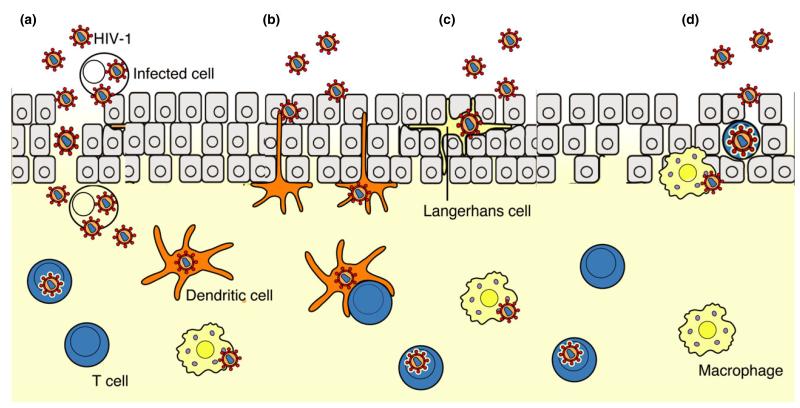
Pathways of HIV-1 entry in the vaginal and ectocervical mucosae. HIV-1 enters the vaginal and ectocervical mucosae by four potential routes. (a) Disruption of vaginal and ectocervical mucosae induced by trauma or infection-associated mucosal inflammation, ulceration, and erosion provides cell-free and cell-associated HIV-1 direct access to target cells in the stratified squamous epithelium, the lamina propria, and local lymphatic and blood vessels (vessels not shown). (b) Dendritic cells at the epithelial/lamina propria interface capture virus, migrate into the lamina propria or further to the draining lymph nodes, and trans-infect target mononuclear cells. (c) Langerhans’ cells may take up virions that enter the porous stratified epithelium. (d) HIV-1 infects directly CD4+ T cells and macrophages within the squamous epithelium. [Modified from ref. .]
Fig. 2
Fig. 2
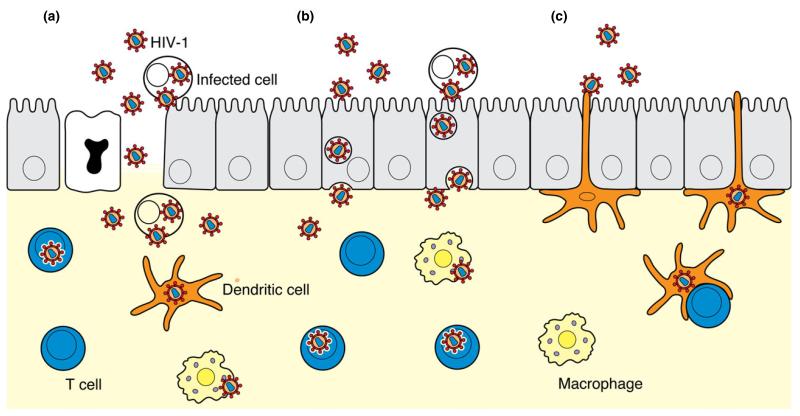
Pathways of HIV-1 entry in the mucosae of the endocervix, uterus, and possibly Fallopian tubes. HIV-1 enters the columnar epithelium by three potential routes. (a) Disruption of the mucosae of the endocervix, uterus, and Fallopian tubes induced by trauma or sexually transmitted infection provides cell-free and cell-associated HIV-1 direct access to target cells in the lamina propria and to local lymphatic and blood vessels (vessels not shown). (b) Columnar epithelial cells endocytose cell-free and cell-associated viruses and transcytose virus across epithelium into the lamina propria. (c) Dendritic cells in the lamina propria extend processes between epithelial cells, capture virus, migrate into the lamina propria or to the lymph nodes, and trans-infect target mononuclear cells. [Modified from ref. ].

References

    1. Royce RA, Sena A, Cates W, Jr, Cohen MS. Sexual transmission of HIV. N Engl J Med. 1997;336:1072–1078. - PubMed
    1. Shattock RJ, Moore JP. Inhibiting sexual transmission of HIV-1 infection. Nat Rev Microbiol. 2003;1:25–34. - PubMed
    1. Hladik F, McElrath MJ. Setting the stage: host invasion by HIV. Nat Rev Immunol. 2008;8:447–457. - PMC - PubMed
    1. Boily MC, Baggaley RF, Wang L, Masse B, White RG, Hayes RJ, Alary M. Heterosexual risk of HIV-1 infection per sexual act: systematic review and meta-analysis of observational studies. Lancet Infect Dis. 2009;9:118–129. - PMC - PubMed
    1. Arien KK, Jespers V, Vanham G. HIV sexual transmission and microbicides. Rev Med Virol. 2011;21:110–133. - PubMed

Publication types