Review
. 2014 Jul;7(4):315-31.
doi: 10.1111/1751-7915.12124. Epub 2014 Apr 1.

Synthesis of novel bioactive lactose-derived oligosaccharides by microbial glycoside hydrolases

Affiliations
Review

Synthesis of novel bioactive lactose-derived oligosaccharides by microbial glycoside hydrolases

Marina Díez-Municio et al. Microb Biotechnol. 2014 Jul.

Abstract

Prebiotic oligosaccharides are increasingly demanded within the Food Science domain because of the interesting healthy properties that these compounds may induce to the organism, thanks to their beneficial intestinal microbiota growth promotion ability. In this regard, the development of new efficient, convenient and affordable methods to obtain this class of compounds might expand even further their use as functional ingredients. This review presents an overview on the most recent interesting approaches to synthesize lactose-derived oligosaccharides with potential prebiotic activity paying special focus on the microbial glycoside hydrolases that can be effectively employed to obtain these prebiotic compounds. The most notable advantages of using lactose-derived carbohydrates such as lactosucrose, galactooligosaccharides from lactulose, lactulosucrose and 2-α-glucosyl-lactose are also described and commented.


Figures

Fig. 1
Fig. 1
A. Stereo view of Kluyveromyces lactis β-galactosidase monomer in cartoon representation. Domains are represented in different colours. N-terminal region (cyan), domain 1 (blue), domain 2 (green), domain 3 (yellow), domain 4 (orange), linker (magenta) and domain 5 (red). B. Surface representation of the monomer with coloured domains following the same scheme. C. Zoomed view of the catalytic pocket entrance. Residues from domains 1, 5 and, mostly, 3 are building up the pocket entrance. A galactose bound to the active site is shown in stick representation. Reprinted with permission from Pereira-Rodríguez et al. Copyright (2012) Elsevier.
Fig. 2
Fig. 2
Overall structure of Lactobacillus reuteri 180 GTF180-ΔN glucansucrase.A. Crystal structure of GTF180-ΔN, the N- and the C-terminal ends of the polypeptide chain are indicated, the Ca2+ ion is shown as a magenta sphere.B. Schematic presentation of the ‘U-shaped’ course of the polypeptide chain. Domains A, B, C, IV and V are coloured in blue, green, magenta, yellow and red, respectively, with dark and light colours for the N- and C-terminal stretches of the peptide chain. Reprinted with permission from Vujičić-Žagar et al. Copyright (2010) The National Academy of Sciences.
Fig. 3
Fig. 3
General scheme for the catalytic mechanism of β-galactosidase and a lactose molecule. Reprinted with permission from Brás et al. Copyright (2010) American Chemical Society.
Fig. 4
Fig. 4
Schematic representation of the reaction sequences occurring in the active site of fructansucrase enzymes (FSs). The donor and acceptor subsites of FSs enzymes are mapped out based on the available three-dimensional structural information (Meng and Fütterer, ; Martínez-Fleites et al., ; Ozimek et al., 2006).A. Binding of sucrose to subsites −1 and +1 results in cleavage of the glycosidic bond (glucose released, shown in grey), and formation of a (putative) covalent intermediate at subsite −1 (indicated by a grey line). Depending on the acceptor substrate used, hydrolysis (by water) (B) or transglycosylation (C) reaction may occur [with oligosaccharides or the growing polymer chain, resulting in the synthesis of FOS (n + 1) or fructan polymer (n + 1), respectively]. Reprinted with permission from Ozimek et al. Copyright (2006) Society for General Microbiology.
Fig. 5
Fig. 5
General scheme of transgalactosylation and hydrolytic processes involving lactulose and β-galactosidase to produce GOS-Lu, galactobioses and galactosyl-fructoses.
Fig. 6
Fig. 6
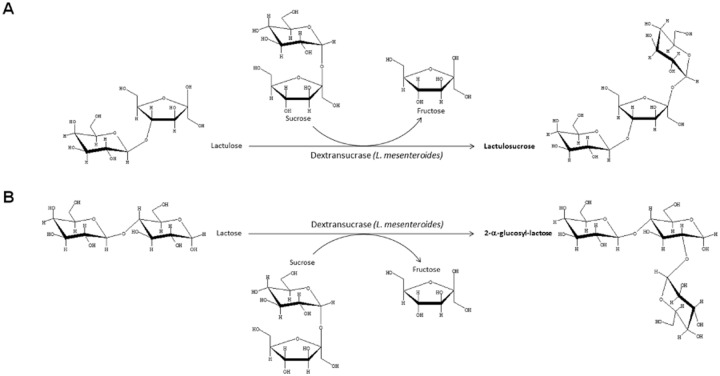
Process scheme for the synthesis of (A) lactulosucrose and (B) 2-α-glucosyl-lactose by transglucosylation of lactulose and lactose, respectively, catalyzed by a dextransucrase from Leuconostoc mesenteroides B-512F.

References

    1. André I, Potocki-Véronèse G, Morel S, Monsan P, Remaud-Simeon M. Sucrose-utilizing transglucosidases for biocatalysis. Top Curr Chem. 2010;294:25–48. - PubMed
    1. Avigad G. Enzymatic synthesis and characterization of a new trisaccharide, α-lactosyl-β-fructofuranoside. J Biol Chem. 1957;229:121–129. - PubMed
    1. Bircher J, Müller J, Guggenheim P, Haemmerli UP. Treatment of chronic portal-systemic encephalopathy with lactulose. Lancet. 1966;1:890–892. - PubMed
    1. Brás NF, Fernandes PA, Ramos MJ. QM/MM studies on the β-galactosidase catalytic mechanism: hydrolysis and transglycosylation reactions. J Chem Theory Comput. 2010;6:421–433. - PubMed
    1. Brison Y, Pijning T, Malbert Y, Fabre É, Mourey L, Morel S, et al. Functional and structural characterization of α-(1–2) branching sucrase derived from DSR-E glucansucrase. J Biol Chem. 2012;287:7915–7924. - PMC - PubMed

Publication types

MeSH terms

LinkOut - more resources