Regional changes in charcoal-burning suicide rates in East/Southeast Asia from 1995 to 2011: a time trend analysis
- PMID: 24691071
- PMCID: PMC3972087
- DOI: 10.1371/journal.pmed.1001622
Regional changes in charcoal-burning suicide rates in East/Southeast Asia from 1995 to 2011: a time trend analysis
Abstract
Background: Suicides by carbon monoxide poisoning resulting from burning barbecue charcoal reached epidemic levels in Hong Kong and Taiwan within 5 y of the first reported cases in the early 2000s. The objectives of this analysis were to investigate (i) time trends and regional patterns of charcoal-burning suicide throughout East/Southeast Asia during the time period 1995-2011 and (ii) whether any rises in use of this method were associated with increases in overall suicide rates. Sex- and age-specific trends over time were also examined to identify the demographic groups showing the greatest increases in charcoal-burning suicide rates across different countries.
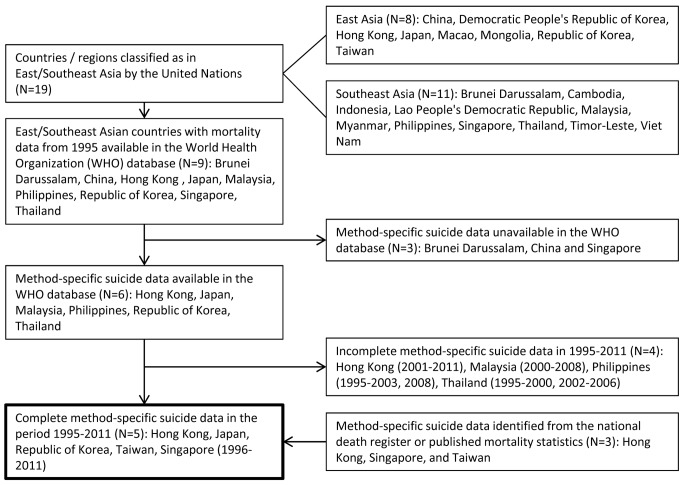
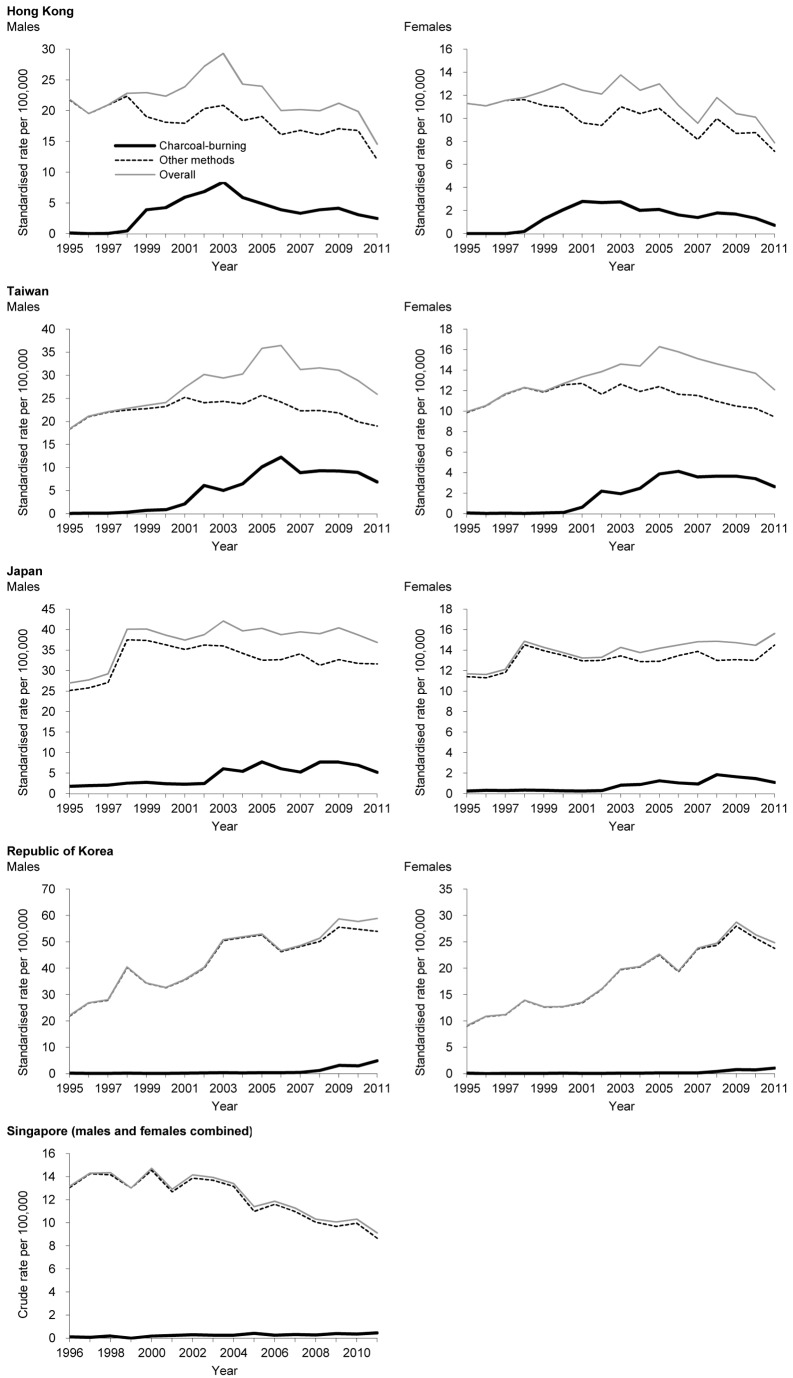
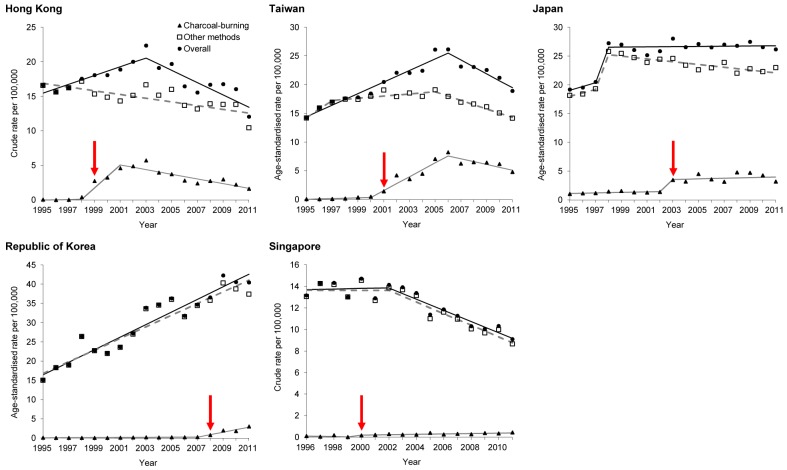
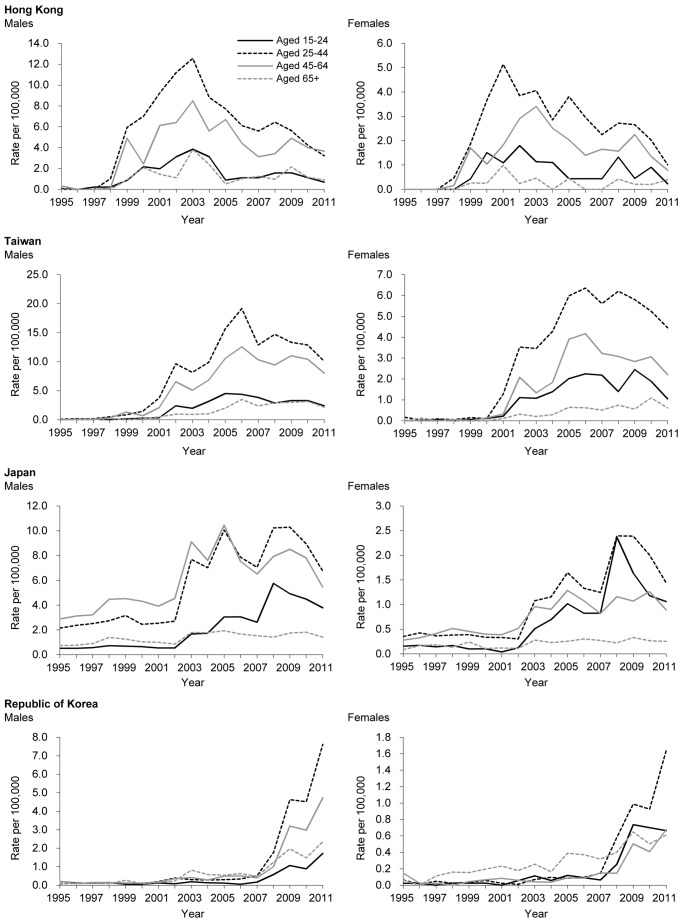
Methods and findings: We used data on suicides by gases other than domestic gas for Hong Kong, Japan, the Republic of Korea, Taiwan, and Singapore in the years 1995/1996-2011. Similar data for Malaysia, the Philippines, and Thailand were also extracted but were incomplete. Graphical and joinpoint regression analyses were used to examine time trends in suicide, and negative binomial regression analysis to study sex- and age-specific patterns. In 1995/1996, charcoal-burning suicides accounted for <1% of all suicides in all study countries, except in Japan (5%), but they increased to account for 13%, 24%, 10%, 7%, and 5% of all suicides in Hong Kong, Taiwan, Japan, the Republic of Korea, and Singapore, respectively, in 2011. Rises were first seen in Hong Kong after 1998 (95% CI 1997-1999), followed by Singapore in 1999 (95% CI 1998-2001), Taiwan in 2000 (95% CI 1999-2001), Japan in 2002 (95% CI 1999-2003), and the Republic of Korea in 2007 (95% CI 2006-2008). No marked increases were seen in Malaysia, the Philippines, or Thailand. There was some evidence that charcoal-burning suicides were associated with an increase in overall suicide rates in Hong Kong, Taiwan, and Japan (for females), but not in Japan (for males), the Republic of Korea, and Singapore. Rates of change in charcoal-burning suicide rate did not differ by sex/age group in Taiwan and Hong Kong but appeared to be greatest in people aged 15-24 y in Japan and people aged 25-64 y in the Republic of Korea. The lack of specific codes for charcoal-burning suicide in the International Classification of Diseases and variations in coding practice in different countries are potential limitations of this study.
Conclusions: Charcoal-burning suicides increased markedly in some East/Southeast Asian countries (Hong Kong, Taiwan, Japan, the Republic of Korea, and Singapore) in the first decade of the 21st century, but such rises were not experienced by all countries in the region. In countries with a rise in charcoal-burning suicide rates, the timing, scale, and sex/age pattern of increases varied by country. Factors underlying these variations require further investigation, but may include differences in culture or in media portrayals of the method. Please see later in the article for the Editors' Summary.
Conflict of interest statement
The authors have declared that no competing interests exist.
Figures
References
-
- Hawton K, van Heeringen K (2009) Suicide. Lancet 373: 1372–1381. - PubMed
Publication types
MeSH terms
Substances
Grants and funding
LinkOut - more resources
Full Text Sources
Other Literature Sources
Medical