Livestock and food security: vulnerability to population growth and climate change
- PMID: 24692268
- PMCID: PMC4282280
- DOI: 10.1111/gcb.12589
Livestock and food security: vulnerability to population growth and climate change
Abstract
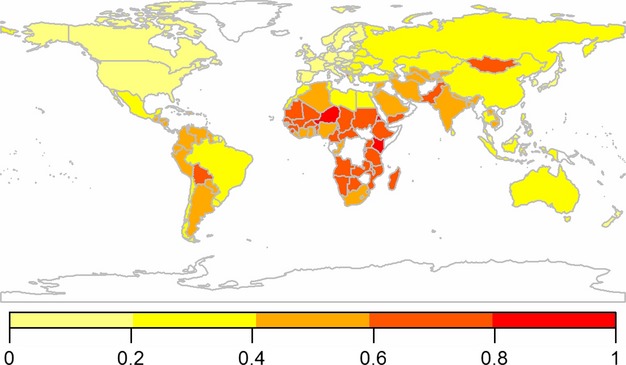
Livestock production is an important contributor to sustainable food security for many nations, particularly in low-income areas and marginal habitats that are unsuitable for crop production. Animal products account for approximately one-third of global human protein consumption. Here, a range of indicators, derived from FAOSTAT and World Bank statistics, are used to model the relative vulnerability of nations at the global scale to predicted climate and population changes, which are likely to impact on their use of grazing livestock for food. Vulnerability analysis has been widely used in global change science to predict impacts on food security and famine. It is a tool that is useful to inform policy decision making and direct the targeting of interventions. The model developed shows that nations within sub-Saharan Africa, particularly in the Sahel region, and some Asian nations are likely to be the most vulnerable. Livestock-based food security is already compromised in many areas on these continents and suffers constraints from current climate in addition to the lack of economic and technical support allowing mitigation of predicted climate change impacts. Governance is shown to be a highly influential factor and, paradoxically, it is suggested that current self-sufficiency may increase future potential vulnerability because trade networks are poorly developed. This may be relieved through freer trade of food products, which is also associated with improved governance. Policy decisions, support and interventions will need to be targeted at the most vulnerable nations, but given the strong influence of governance, to be effective, any implementation will require considerable care in the management of underlying structural reform.
Keywords: climate change; food security; livestock; population growth; vulnerability.
© 2014 The Authors. Global Change Biology Published by John Wiley & Sons Ltd.
Figures
References
-
- Adger WN. Social and ecological resilience: are they related? Progress in Human Geography. 2000;24:347–364.
-
- Allison EH, Perry AL, Badjeck MC, et al. Vulnerability of national economies to the impacts of climate change on fisheries. Fish and Fisheries. 2009;10:173–196.
-
- Baylis M, Githeko AK. The Effects of Climate Change on Infectious Diseases of Animals. UK Foresight Project, Infectious Diseases: Preparing for the Future. London: Office of Science and Innovation; 2006.
-
- Chilonda P, Otte J. Indicators to monitor trends in livestock production at national, regional and international levels. Livestock Research for Rural Development. 2006;18:117. Available at: http://lrrd.cipav.org.co/lrrd18/8/chil18117.htm (accessed 9 May 2013)
-
- Devendra C. Small ruminants: imperatives for productivity enhancement, improved livelihoods and rural growth – a review. Asian-Australasian Journal of Animal Science. 2001;14:1483–1496.
Publication types
MeSH terms
Grants and funding
LinkOut - more resources
Full Text Sources
Other Literature Sources
Medical