


British randomised controlled trial of AV and VV optimization ("BRAVO") study: rationale, design, and endpoints
- PMID: 24693953
- PMCID: PMC3992145
- DOI: 10.1186/1471-2261-14-42
British randomised controlled trial of AV and VV optimization ("BRAVO") study: rationale, design, and endpoints
Abstract
Background: Echocardiographic optimization of pacemaker settings is the current standard of care for patients treated with cardiac resynchronization therapy. However, the process requires considerable time of expert staff. The BRAVO study is a non-inferiority trial comparing echocardiographic optimization of atrioventricular (AV) and interventricular (VV) delay with an alternative method using non-invasive blood pressure monitoring that can be automated to consume less staff resources.
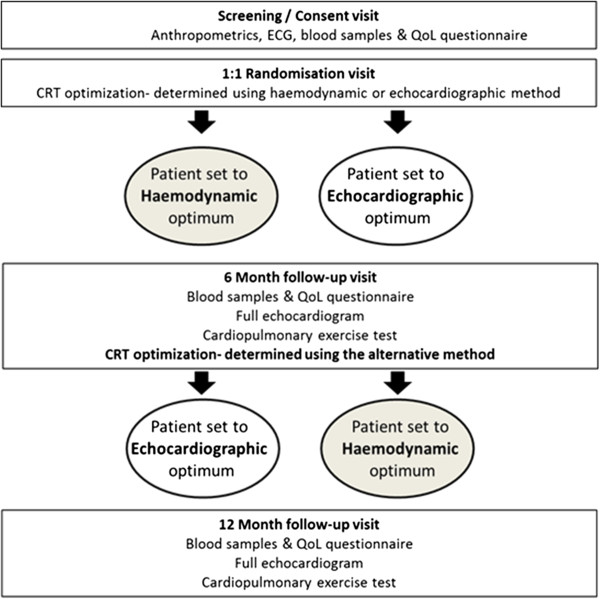
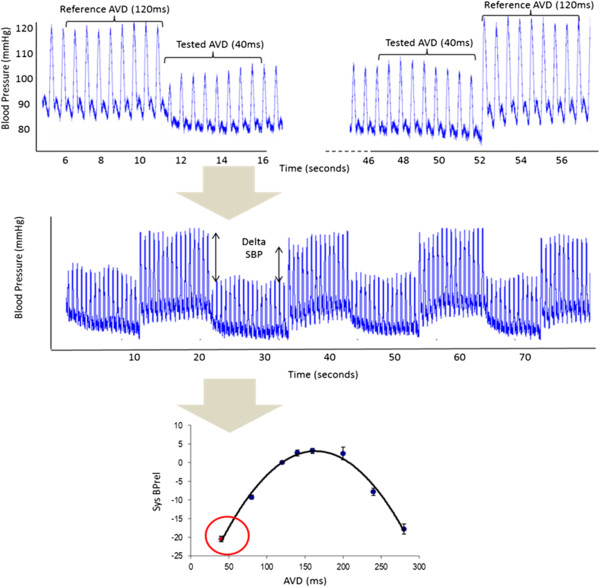
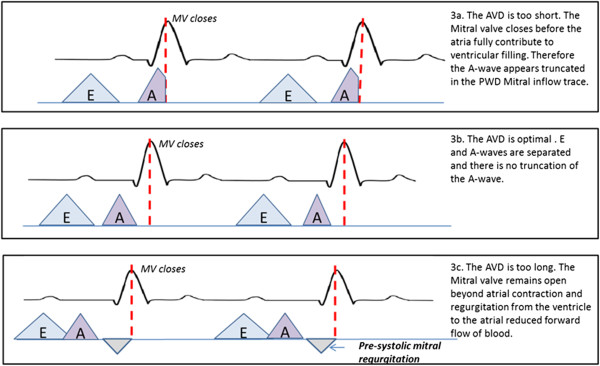
Methods/design: BRAVO is a multi-centre, randomized, cross-over, non-inferiority trial of 400 patients with a previously implanted cardiac resynchronization device. Patients are randomly allocated to six months in each arm. In the echocardiographic arm, AV delay is optimized using the iterative method and VV delay by maximizing LVOT VTI. In the haemodynamic arm AV and VV delay are optimized using non-invasive blood pressure measured using finger photoplethysmography. At the end of each six month arm, patients undergo the primary outcome measure of objective exercise capacity, quantified as peak oxygen uptake (VO2) on a cardiopulmonary exercise test. Secondary outcome measures are echocardiographic measurement of left ventricular remodelling, quality of life score and N-terminal pro B-type Natriuretic Peptide (NT-pro BNP). The study is scheduled to complete recruitment in December 2013 and to complete follow up in December 2014.
Discussion: If exercise capacity is non-inferior with haemodynamic optimization compared with echocardiographic optimization, it would be proof of concept that haemodynamic optimization is an acceptable alternative which has the potential to be more easily implemented.
Trial registration: Clinicaltrials.gov NCT01258829.
Figures
References
-
- Auricchio A, Stellbrink C, Block M, Sack S, Vogt J, Bakker P, Klein H, Kramer A, Ding J, Salo R, Tockman B, Pochet T, Spinelli J. The Pacing Therapies for Congestive Heart Failure Study Group. The Guidant Congestive Heart Failure Research Group. Effect of pacing chamber and atrioventricular delay on acute systolic function of paced patients with congestive heart failure. Circulation. 1999;99:2993–3001. doi: 10.1161/01.CIR.99.23.2993. - DOI - PubMed
-
- Breithardt O-A, Stellbrink C, Franke A, Balta O, Diem BH, Bakker P, Sack S, Auricchio A, Pochet T, Salo R. Acute effects of cardiac resynchronization therapy on left ventricular Doppler indices in patients with congestive heart failure. Am Heart J. 2002;143:34–44. doi: 10.1067/mhj.2002.119616. - DOI - PubMed
-
- Nelson GS, Berger RD, Fetics BJ, Talbot M, Spinelli JC, Hare JM, Kass DA. Left ventricular or biventricular pacing improves cardiac function at diminished energy cost in patients with dilated cardiomyopathy and left bundle-branch block. Circulation. 2000;102:3053–3059. doi: 10.1161/01.CIR.102.25.3053. - DOI - PubMed
Publication types
MeSH terms
Substances
Associated data
Grants and funding
LinkOut - more resources
Full Text Sources
Other Literature Sources
Medical
Research Materials
