


The impact of search engine selection and sorting criteria on vaccination beliefs and attitudes: two experiments manipulating Google output
- PMID: 24694866
- PMCID: PMC4004139
- DOI: 10.2196/jmir.2642
The impact of search engine selection and sorting criteria on vaccination beliefs and attitudes: two experiments manipulating Google output
Abstract
Background: During the past 2 decades, the Internet has evolved to become a necessity in our daily lives. The selection and sorting algorithms of search engines exert tremendous influence over the global spread of information and other communication processes.
Objective: This study is concerned with demonstrating the influence of selection and sorting/ranking criteria operating in search engines on users' knowledge, beliefs, and attitudes of websites about vaccination. In particular, it is to compare the effects of search engines that deliver websites emphasizing on the pro side of vaccination with those focusing on the con side and with normal Google as a control group.
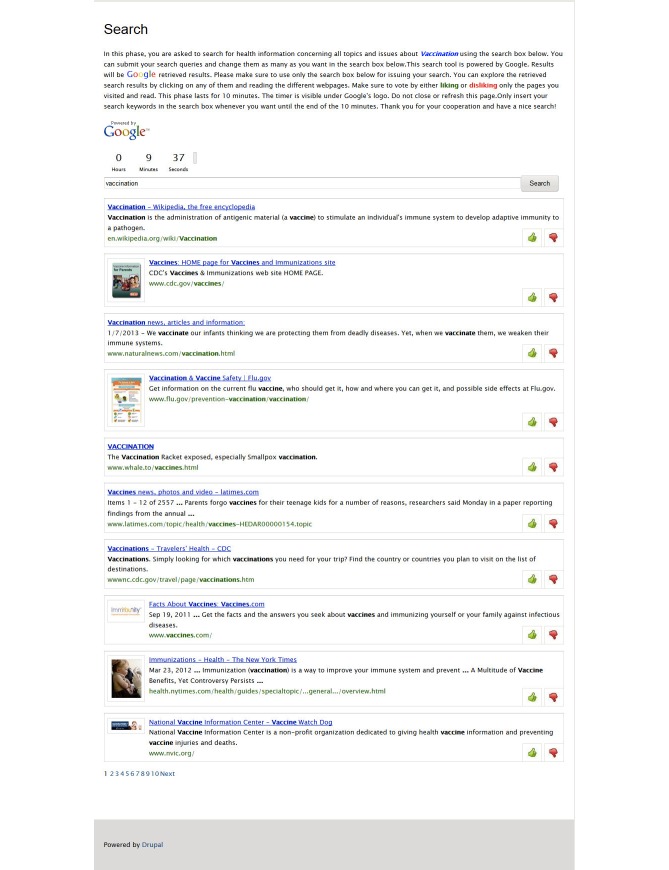
Method: We conducted 2 online experiments using manipulated search engines. A pilot study was to verify the existence of dangerous health literacy in connection with searching and using health information on the Internet by exploring the effect of 2 manipulated search engines that yielded either pro or con vaccination sites only, with a group receiving normal Google as control. A pre-post test design was used; participants were American marketing students enrolled in a study-abroad program in Lugano, Switzerland. The second experiment manipulated the search engine by applying different ratios of con versus pro vaccination webpages displayed in the search results. Participants were recruited from Amazon's Mechanical Turk platform where it was published as a human intelligence task (HIT).
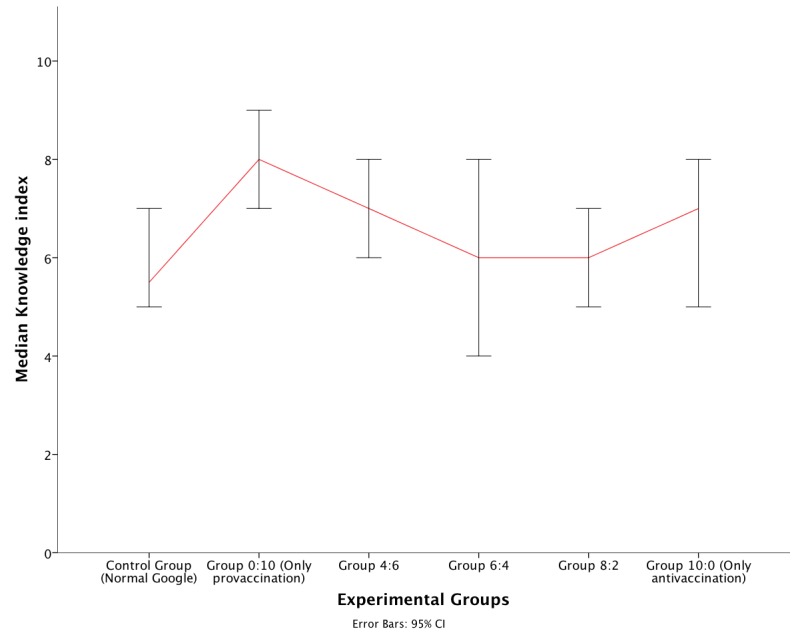
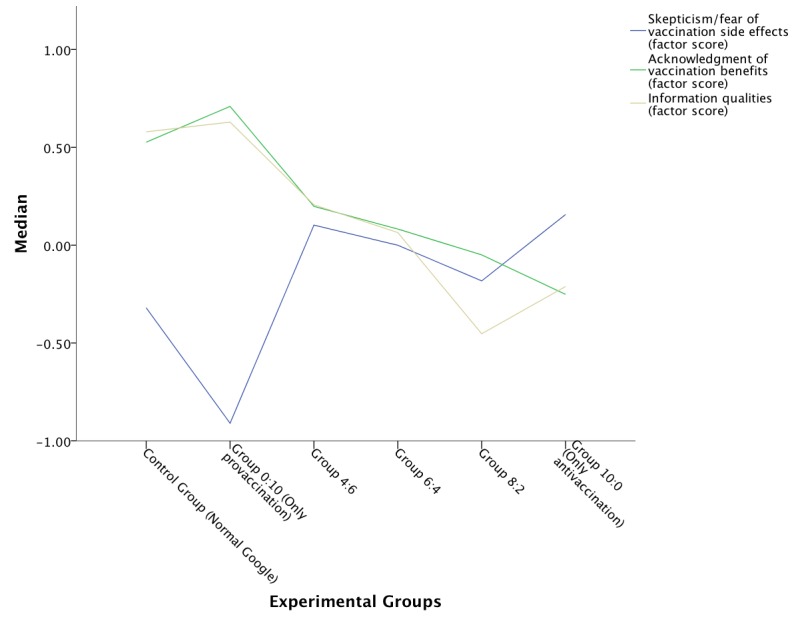
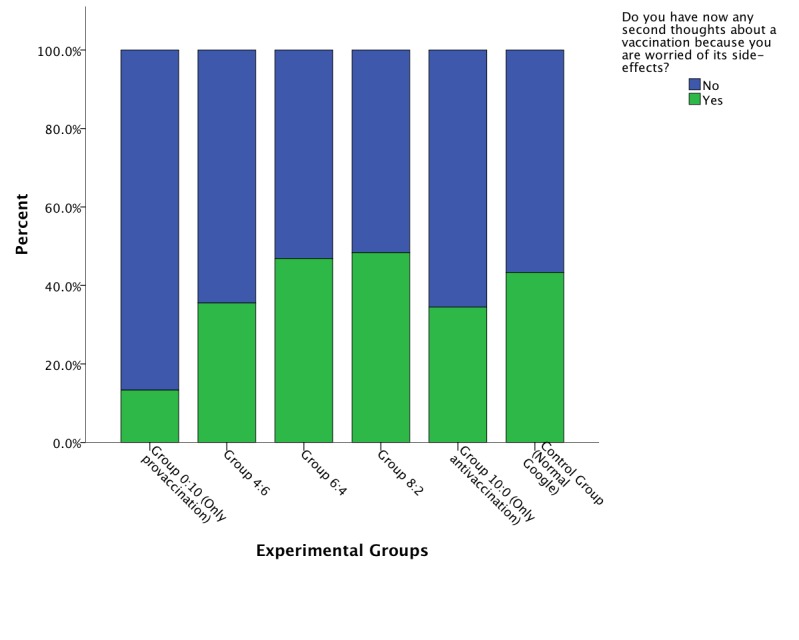
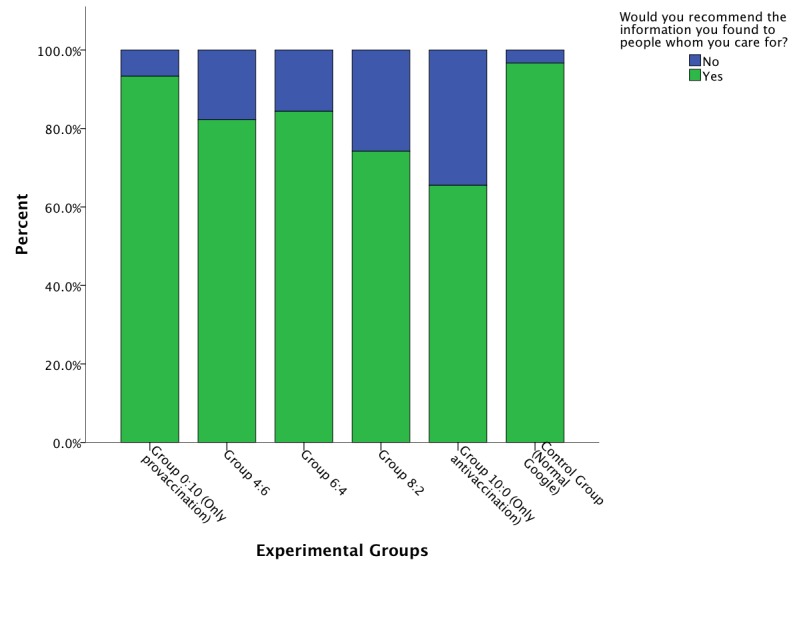
Results: Both experiments showed knowledge highest in the group offered only pro vaccination sites (Z=-2.088, P=.03; Kruskal-Wallis H test [H₅]=11.30, P=.04). They acknowledged the importance/benefits (Z=-2.326, P=.02; H5=11.34, P=.04) and effectiveness (Z=-2.230, P=.03) of vaccination more, whereas groups offered antivaccination sites only showed increased concern about effects (Z=-2.582, P=.01; H₅=16.88, P=.005) and harmful health outcomes (Z=-2.200, P=.02) of vaccination. Normal Google users perceived information quality to be positive despite a small effect on knowledge and a negative effect on their beliefs and attitudes toward vaccination and willingness to recommend the information (χ²₅=14.1, P=.01). More exposure to antivaccination websites lowered participants' knowledge (J=4783.5, z=-2.142, P=.03) increased their fear of side effects (J=6496, z=2.724, P=.006), and lowered their acknowledgment of benefits (J=4805, z=-2.067, P=.03).
Conclusion: The selection and sorting/ranking criteria of search engines play a vital role in online health information seeking. Search engines delivering websites containing credible and evidence-based medical information impact positively Internet users seeking health information. Whereas sites retrieved by biased search engines create some opinion change in users. These effects are apparently independent of users' site credibility and evaluation judgments. Users are affected beneficially or detrimentally but are unaware, suggesting they are not consciously perceptive of indicators that steer them toward the credible sources or away from the dangerous ones. In this sense, the online health information seeker is flying blind.
Keywords: Internet; consumer health information; health communication; information storage and retrieval; online systems; public health informatics; search engine; searching behavior; vaccination.
Figures
References
-
- Internet World Stats. 2012. [2013-03-10]. Internet Users in the World http://www.internetworldstats.com/stats.htm.
-
- Fox S, Duggan M. Health Online 2013. Washington, DC: Pew Internet & American Life Project; 2013. Jan 15, [2013-07-23]. http://pewinternet.org/Reports/2013/Health-online.aspx.
-
- Dutton WH, Blank G. Oxford Internet Survey 2011 Report. Oxford: Oxford Internet Institute, University of Oxford; 2011. [2013-07-23]. Next Generation Users: The Internet in Britain http://microsites.oii.ox.ac.uk/oxis/
-
- Hesse BW, Nelson DE, Kreps GL, Croyle RT, Arora NK, Rimer BK, Viswanath K. Trust and sources of health information: the impact of the Internet and its implications for health care providers: findings from the first Health Information National Trends Survey. Arch Intern Med. 2005;165(22):2618–24. doi: 10.1001/archinte.165.22.2618. - DOI - PubMed
Publication types
MeSH terms
LinkOut - more resources
Full Text Sources
Other Literature Sources
Medical
Miscellaneous
