. 2014 Jul 1;112(1):81-94.
doi: 10.1152/jn.00484.2013. Epub 2014 Apr 2.

Development of neural responsivity to vocal sounds in higher level auditory cortex of songbirds

Affiliations

Development of neural responsivity to vocal sounds in higher level auditory cortex of songbirds

Vanessa C Miller-Sims et al. J Neurophysiol. .

Abstract

Like humans, songbirds learn vocal sounds from "tutors" during a sensitive period of development. Vocal learning in songbirds therefore provides a powerful model system for investigating neural mechanisms by which memories of learned vocal sounds are stored. This study examined whether NCM (caudo-medial nidopallium), a region of higher level auditory cortex in songbirds, serves as a locus where a neural memory of tutor sounds is acquired during early stages of vocal learning. NCM neurons respond well to complex auditory stimuli, and evoked activity in many NCM neurons habituates such that the response to a stimulus that is heard repeatedly decreases to approximately one-half its original level (stimulus-specific adaptation). The rate of neural habituation serves as an index of familiarity, being low for familiar sounds, but high for novel sounds. We found that response strength across different song stimuli was higher in NCM neurons of adult zebra finches than in juveniles, and that only adult NCM responded selectively to tutor song. The rate of habituation across both tutor song and novel conspecific songs was lower in adult than in juvenile NCM, indicating higher familiarity and a more persistent response to song stimuli in adults. In juvenile birds that have memorized tutor vocal sounds, neural habituation was higher for tutor song than for a familiar conspecific song. This unexpected result suggests that the response to tutor song in NCM at this age may be subject to top-down influences that maintain the tutor song as a salient stimulus, despite its high level of familiarity.

Keywords: auditory cortex; neural habituation; songbird; stimulus-specific adaptation; vocal learning.


Figures

Fig. 1.
Fig. 1.
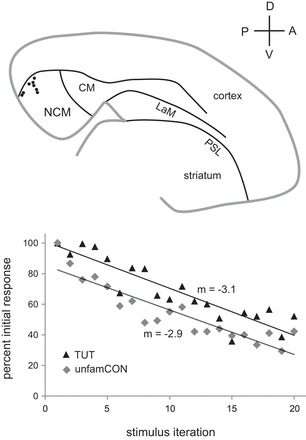
Top: parasagittal schematic at ∼0.5 mm lateral to midline showing location of caudo-medial nidopallium (NCM) in caudal telencephalon. Black dots represent the location of 8 representative recording sites (n = three adults, three 35-day-old and two 20-day-old birds) in a small area encompassing the most dorso-caudal region of NCM; all recording sites within this region showed robust habituation to song playback. CM, caudal mesopallium; LaM, mesopallial lamina; PSL, pallial-subpallial lamina; D, dorsal; V, ventral; P, posterior; A, anterior. Bottom: response habituation for a single recording site in NCM. Examples from an adult bird of response strength during 20 iterations of tutor song (TUT; triangles) and unfamiliar conspecific song (unfamCON; diamonds), normalized to the first trial, are shown. The slope of the linear regression of these normalized functions was used as a measure of the rate of habituation that could be compared across birds and song types.
Fig. 2.
Fig. 2.
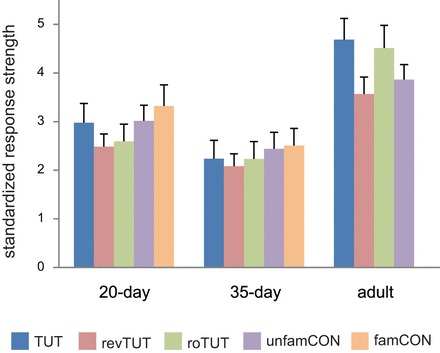
Standardized response strength in dorso-caudal NCM as a function of age and song type. Standardized response strength in each age group averaged over 20 iterations of each song stimulus [TUT; reversed tutor song (revTUT); reverse-order tutor song (roTUT); unfamCON; familiar conspecific song (famCON)]. famCON for juvenile birds were from birds in the breeding aviary in which they were housed up until they were tested; adult birds were removed from their breeding aviary at least 1 mo prior to being tested, and thus there was no comparable famCON song for adults. All values are means + SE.
Fig. 3.
Fig. 3.
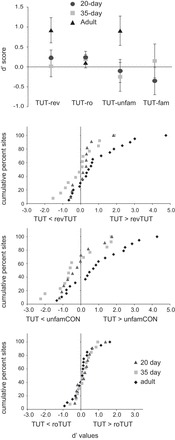
d′ measures of TUT selectivity. Top: mean d′ scores for tutor vs. revTUT, roTUT, unfamCON, and famCON. Bottom: cumulative distributions of individual d′ scores including TUT vs. revTUT; TUT vs. unfamCON; TUT vs. roTUT.
Fig. 4.
Fig. 4.
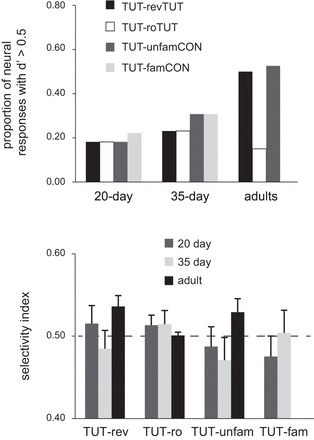
Top: proportion of recording sites with d′ score >0.5 for tutor vs. other songs. Bottom: mean selectivity scores for tutor vs. other songs. See results.
Fig. 5.
Fig. 5.
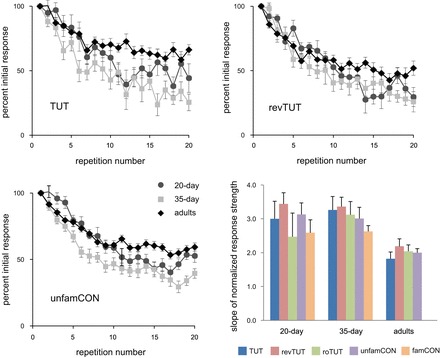
Rate of habituation to different song types as a function of age. Top right and left and bottom left: mean ± SE normalized response strength for each stimulus iteration for TUT, revTUT, and unfamCON, respectively. Bottom right: mean + SE slope of linear regression between normalized response strength and iteration number for each song type in each age group.
Fig. 6.
Fig. 6.
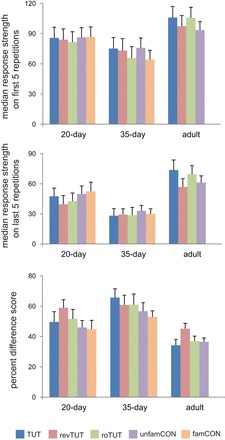
Raw response strength in dorso-caudal NCM on the first five vs. the last five stimulus iterations. Top and middle: median raw response strength of the first five (top) and last five (middle) stimulus repetitions of each song type. Bottom: normalized difference score showing the percent decrease between the first five and the last five stimulus repetitions for each song type. All values are means + SE.
Fig. 7.
Fig. 7.
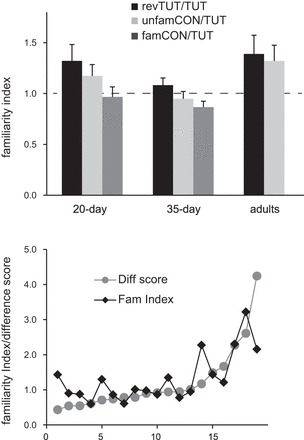
Measures comparing rate of habituation for control songs relative to TUT. Top: familiarity index represents the ratio of the habituation slopes for a given control song to TUT for each age group (mean + SE). See results. Bottom: comparison of familiarity index with a score based on the difference between the normalized median response strength for the first five vs. the last five stimulus iterations; scores are presented as cumulative distributions for individual adult birds (n = 19), so that the two types of score can be compared for each bird.
Fig. 8.
Fig. 8.
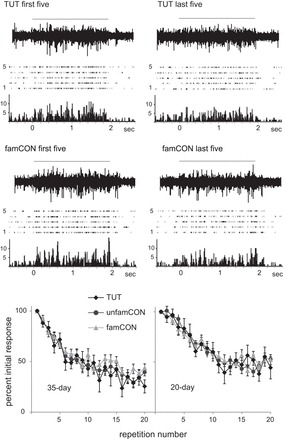
Comparison of habituation to TUT vs. famCON in NCM of a 35-day-old bird. Top: each panel shows, from top to bottom, an example of a raw trace, a raster of 5 trials, and a peristimulus time histogram (PSTH). Top two panels show decrease in response strength from first five to last five repetitions for TUT; middle two panels show decrease in response strength from first five to last five repetitions for familiar CON song. Gray lines at top show timing of song playback; duration of both TUT and famCON was 2 s; bin size for PSTHs was 12.5 ms. Bottom: rate of habituation to TUT, famCON, and unfamCON in 35- (left) and 20-day-old (right) birds. Values are means ± SE normalized response strength for each stimulus iteration.

References

    1. Achiro JM, Bottjer SW. Neural representation of a target auditory memory in a cortico-basal ganglia pathway. J Neurosci 33: 14475–14488, 2013. - PMC - PubMed
    1. Adret P, Meliza CD, Margoliash D. Song tutoring in presinging zebra finch juveniles biases a small population of higher-order song-selective neurons toward the tutor song. J Neurophysiol 108: 1977–1987, 2012. - PMC - PubMed
    1. Amin N, Doupe A, Theunissen FE. Development of selectivity for natural sounds in the songbird auditory forebrain. J Neurophysiol 97: 3517–3531, 2007. - PubMed
    1. Ayala YA, Malmierca MS. Stimulus-specific adaptation and deviance detection in the inferior colliculus. Front Neural circuits 6: 89, 2012. - PMC - PubMed
    1. Bao S, Chan VT, Merzenich MM. Cortical remodelling induced by activity of ventral tegmental dopamine neurons. Nature 412: 79–83, 2001. - PubMed

LinkOut - more resources