. 2014 Apr;19(4):046002.
doi: 10.1117/1.JBO.19.4.046002.

Numerical simulation of x-ray luminescence optical tomography for small-animal imaging

Affiliations

Numerical simulation of x-ray luminescence optical tomography for small-animal imaging

Changqing Li et al. J Biomed Opt. 2014 Apr.

Abstract

X-ray luminescence optical tomography (XLOT) is an emerging hybrid imaging modality in which x-ray excitable particles (phosphor particles) emit optical photons when stimulated with a collimated x-ray beam. XLOT can potentially combine the high sensitivity of optical imaging with the high spatial resolution of x-ray imaging. For reconstruction of XLOT data, we compared two reconstruction algorithms, conventional filtered backprojection (FBP) and a new algorithm, x-ray luminescence optical tomography with excitation priors (XLOT-EP), in which photon propagation is modeled with the diffusion equation and the x-ray beam positions are used as reconstruction priors. Numerical simulations based on dose calculations were used to validate the proposed XLOT imaging system and the reconstruction algorithms. Simulation results showed nanoparticle concentrations reconstructed with XLOT-EP are much less dependent on scan depth than those obtained with FBP. Measurements at just two orthogonal projections are sufficient for XLOT-EP to reconstruct an XLOT image for simple source distributions. The heterogeneity of x-ray energy deposition is included in the XLOT-EP reconstruction and improves the reconstruction accuracy, suggesting that there is a need to calculate the x-ray energy distribution for experimental XLOT imaging.


Figures

Fig. 1
Fig. 1
Schematic drawing of the prototype x-ray luminescence optical tomography (XLOT) imaging system that was simulated.
Fig. 2
Fig. 2
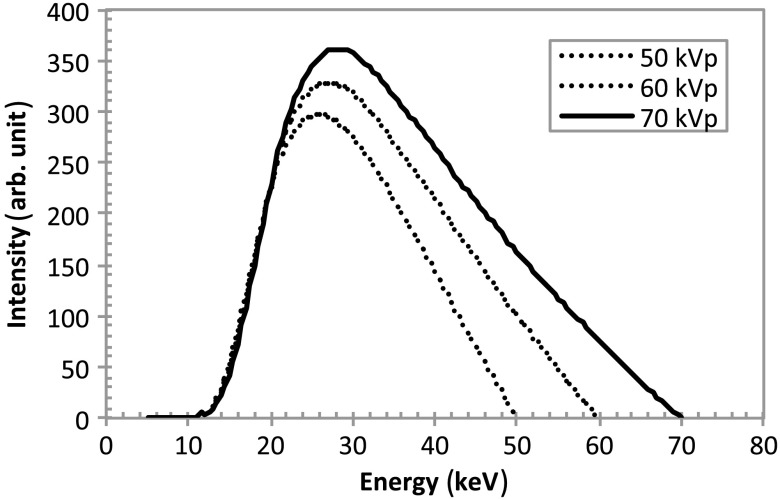
Simulated x-ray photon energy spectra. The 70 kVp spectrum (solid line) was used for the simulations presented in this paper.
Fig. 3
Fig. 3
Dose distribution (sum of all linear steps) for different projection angles at a target concentration of 10  mg/ml. Color indicates the normalized x-ray dose in arbitrary units.
Fig. 4
Fig. 4
CT images reconstructed with filtered backprojection (FBP) for target concentrations of 10, 1, 0.1, and 0.01  mg/ml. Because of the relative insensitivity of x-ray contrast, only the higher concentrations can be detected. All images are scaled to a common maximum intensity corresponds to reconstructed pixel values in arbitrary units.
Fig. 5.
Fig. 5.
The XLOT sinogram (integration of optical photons reaching top surface of phantom for each x-ray beam position) for a target with a concentration of 1  mg/ml and for a scan depth of 5 mm. Top row (no scattering) and bottom row (including x-ray scattering). The intensities on the right are shown on a logarithmic scale to allow the effects of x-ray scattering to be better appreciated.
Fig. 6
Fig. 6
XLOT images reconstructed with FBP for a target concentration of 1  mg/ml at the depths of 5 mm (a), 10 mm (b), and 20 mm (c). X-ray scattering is included in the simulation.
Fig. 7
Fig. 7
For target concentrations of 1  mg/ml and 5 mm irradiation depth, images reconstructed with XLOT-EP using 36 angular projections (a, b), two orthogonal projections (c, d) and one projection (e, f). Left column images (a, c, e) assume a uniform dose distribution and right column images (b, d, f) include the dose heterogeneity in the reconstruction. X-ray scattering is included in the simulations.
Fig. 8
Fig. 8
Reconstructed concentration (normalized) versus actual target concentration for 5-mm scan depth for the two reconstruction methods and for different number of projection angles for XLOT-EP reconstruction. Panel (a) assumes homogeneous dose distribution. XLOT-EP reconstruction in panel (b) considers dose heterogeneity. X-ray scattering is included in both plots. Plots are on a logarithmic scale.
Fig. 9
Fig. 9
Reconstructed concentration versus scan depth (normalized to results at 5-mm scan depth). XLOT-EP reconstruction in panel (a) assumes homogeneous dose distribution. Panel (b) considers dose heterogeneity.

References

    1. Cherry S. R., “Multimodality in vivo imaging systems: twice the power or double the trouble?,” Annu. Rev. Biomed. Eng. 8, 35–62 (2006). 10.1146/annurev.bioeng.8.061505.095728 - DOI - PubMed
    1. Townsend D. W., “Multimodality imaging of structure and function,” Phys. Med. Biol. 53(4), R1–R39 (2008). 10.1088/0031-9155/53/4/R01 - DOI - PubMed
    1. Liang H., et al. , “A microPET/CT system for in vivo small animal imaging,” Phys. Med. Biol. 52(13), 3881 (2007). 10.1088/0031-9155/52/13/015 - DOI - PubMed
    1. Catana C., et al. , “Simultaneous in vivo positron emission tomography and magnetic resonance imaging,” Proc. Natl. Acad. Sci. U. S. A. 105(10), 3705–3710 (2008). 10.1073/pnas.0711622105 - DOI - PMC - PubMed
    1. Ntziachristos V., et al. , “Concurrent MRI and diffuse optical tomography of breast after indocyanine green enhancement,” Proc. Natl. Acad. Sci. U. S. A. 97(6), 2767–2772 (2000). 10.1073/pnas.040570597 - DOI - PMC - PubMed

Publication types

MeSH terms