Patient impression and satisfaction of a self-administered, automated medical history-taking device in the Emergency Department
- PMID: 24695871
- PMCID: PMC3952887
- DOI: 10.5811/westjem.2013.2.11498
Patient impression and satisfaction of a self-administered, automated medical history-taking device in the Emergency Department
Abstract
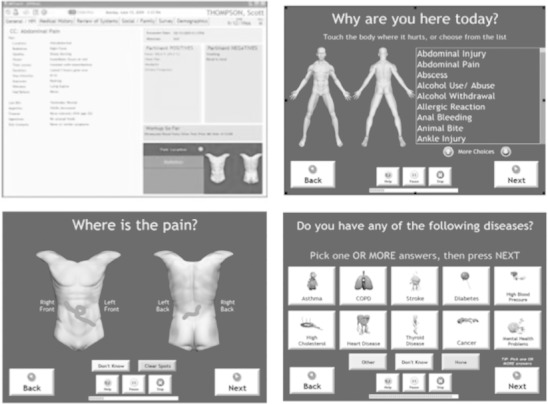
Introduction: We evaluated patient impressions and satisfaction of an innovative self-administered, hand-held touch-screen tablet to gather detailed medical information from emergency department (ED) patients in the waiting room prior to physician contact.
Methods: Adult, medically stable patients presenting to the ED at Los Angeles County Hospital used the PatientTouch™ system to answer a series of questions about their current history of present illness and past medical/surgical histories in English or Spanish. Patients then completed a survey rating their experience.
Results: Among 173 participants, opinion of PatientTouch™ was strongly positive; 93.6% (95%CI 90.0-97.3%) felt the physical product was easy to hold and handle, and 97.1% (94.6-99.6%) felt the questions were detailed enough for them to fully describe their condition; 97.8% (95.4-100.0%) felt using PatientTouch™ would help them organize their thoughts and communicate better with their physician, 94.8% (91.4-98.1%) thought it would improve the quality of their care, and 97.1% (94.6-99.6%) expressed desire to use the product again in the future.
Conclusion: The study was conducted at a largely Hispanic county ED, and only patients with 1 of 6 pre-determined chief complaints participated. We did not include a control group to assess if perceived improvements in communication translated to measurable differences. In this pilot study, patients were highly satisfied with all aspects of the PatientTouch™ self-administered, hand-held, touch-screen tablet. Importantly, subjects felt it would help them better communicate with their doctor, would improve their overall quality of care and overwhelmingly expressed a desire to use it in the future.
Conflict of interest statement
Figures
References
-
- Orient JM. Sapira's art and science of bedside diagnosis. Baltimore (MD): Lippincott Williams and Wilkins; 2005. p. 47. p.
-
- Barsky Forgetting, fabricating, and telescoping: the instability of the medical history. Arch Intern Med. 2002;162(9):981–984. - PubMed
-
- James TL, Feldman J, Mehta SD. Physician variability in history taking when evaluating patients presenting with chest pain in the emergency department. Acad Emerg Med. 2006;13(2):147–152. - PubMed
MeSH terms
LinkOut - more resources
Full Text Sources
Other Literature Sources
Medical
Miscellaneous