. 2014 Jul;38(7):1451-9.
doi: 10.1007/s00264-014-2327-9. Epub 2014 Apr 4.

The amount of humeral head impaction of proximal humeral fractures fixed with the Humerusblock device

Affiliations

The amount of humeral head impaction of proximal humeral fractures fixed with the Humerusblock device

Stefano Carbone et al. Int Orthop. 2014 Jul.

Abstract

Purpose: The Humerusblock is a minimally invasive device allowing fixation of proximal humeral fractures. A drawback of the device is possible K-wire perforation of the head with the need for early removal of the implant. We assessed the amount of humeral head impaction and its role in the postoperative varus/valgus deviation of the humeral head in fractures of the upper humerus treated with Humerusblock.

Methods: Fractures were classified according to the Codman-Lego system. The length of the posteromedial metaphyseal extension and integrity of medial hinge were measured; metaphyseal comminution was assessed. Accuracy of fracture reduction was classified as excellent to poor. An original method of measurement of amount of postoperative impaction of the humeral head was developed. The impaction and varus/valgus inclination of the heads were measured comparing postoperative and three-month follow-up radiographs. Constant score and its relation to sintering was calculated at 12-month follow-up.

Results: Forty-three fractures were available for follow-up. The amount of humeral head impaction was 3.9 mm on average and was directly correlated with patient's age, sex, Codman-Lego classification, varus inclination and mataphyseal comminution. The postoperative cervico-diaphyseal angle was restored in 35 cases, with 81 % good results. The Humerusblock was removed in 41 % of cases because of K-wire perforation of the humeral head. A negative correlation was found between impaction and Constant score.

Conclusions: The amount of humeral head impaction is related to patients' age, sex, and fracture patterns, being the most prone to compaction those with metaphyseal comminution. Humeral head impaction negatively affects final Constant score.


Figures
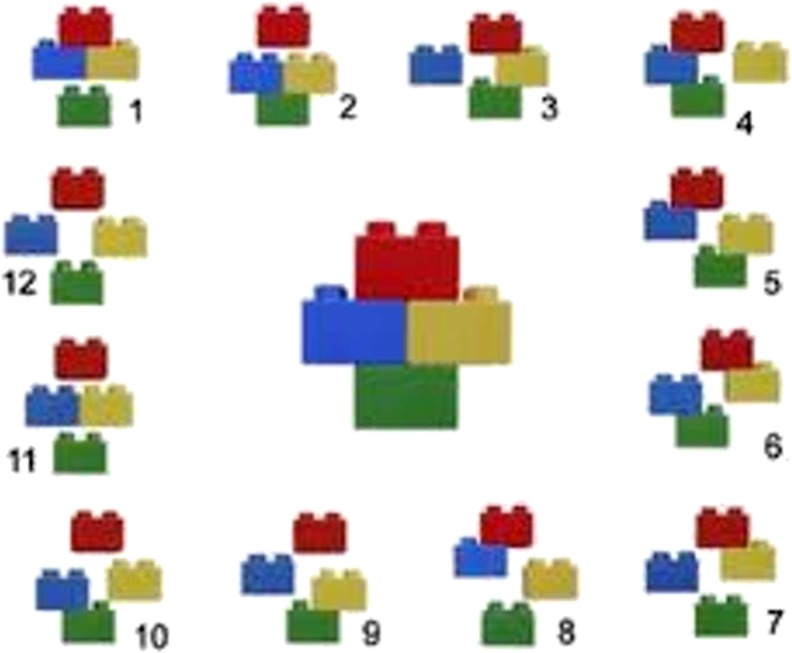
Fig. 1
Fig. 1
The binary system (LEGO system) developed by Hertel et al. [19] represents the four parts of the proximal humerus (head, greater tuberosity, lesser tuberosity, shaft) using the LEGO blocks. The absence of a bond between any of the four parts locates the fracture plane. A number is then assigned to each fracture pattern (Reprinted with permission from Hertel R, Hempfing A, Stiehler M, Leunig M (2004). Predictors of humeral head ischemia after intracapsular fracture of the proximal humerus. J Shoulder Elbow Surg.; 13: 427–33. doi:10.1016/j.jse.2004.01.034)
Fig. 2
Fig. 2
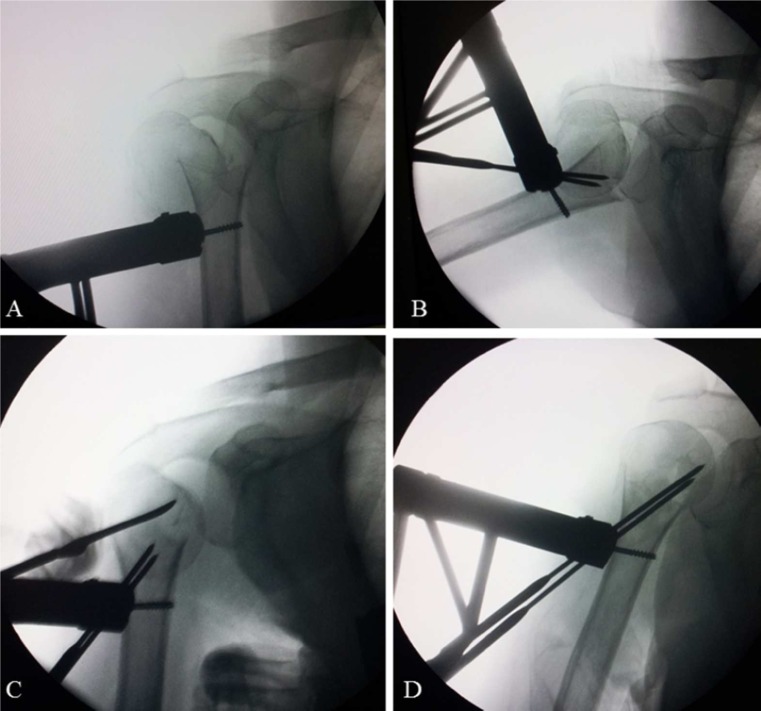
The operative steps to implant the Humerusblock. a The block is fixed to the proximal third of the humeral diaphysis with a cannulated 4-mm screw. b The two 2.5-mm K-wires passing through the block are pulled to the fracture line. c The varus/valgus deviation of the humeral head is corrected using a blunt elevator introduced percutaneously to push the head as much as possible laterally or medially. d The K-wires are pulled to the subchondral bone
Fig. 3
Fig. 3
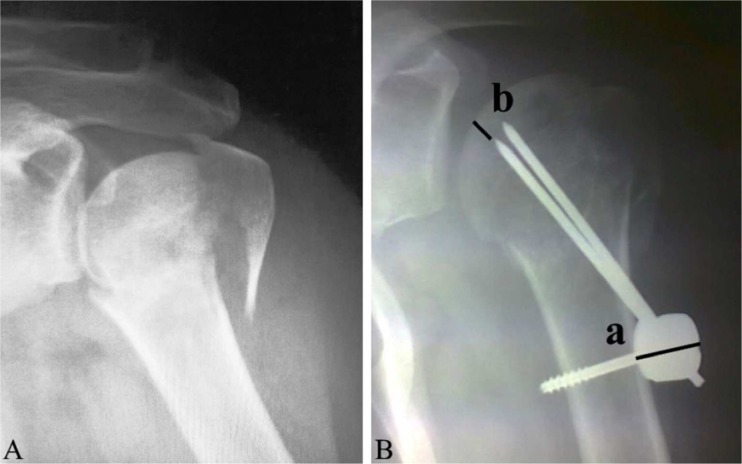
Measurement of the amount of humeral head impaction. Three-part fracture before (A) and after reduction (B). On the postoperative radiograph, the distance between the tip of the most cranial K-wire and the humeral articular surface is measured by a line that continues the direction of the K-wire. [Measured width of the Humerusblock (mm): 12 mm (real width of the Humerusblock) = Measured distance of the K-wire tip from the articular surface (mm): X]. a Width of the Humerusblock. b Distance of the K-wire tip from the articular surface
Fig. 4
Fig. 4
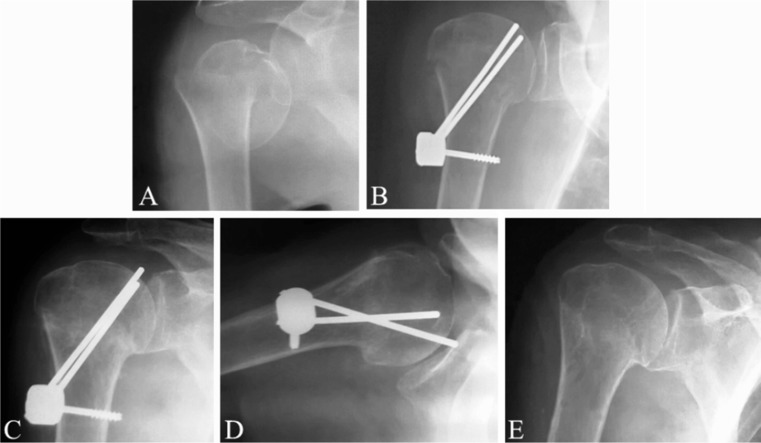
An 88-year-old female patient with a type 7 fracture (Codman-Lego classification) showing severe impaction, with perforation of the humeral head, without significant change in varus/valgus inclination. a Pre-operative radiograph. b Immediate postoperative radiograph showing an excellent reduction. c and d Anteroposterior and axial radiographs obtained one month after surgery. e Radiograph taken four months after surgery, after removal of the Humerusblock. The final radiographic result was rated as good
Fig. 5
Fig. 5
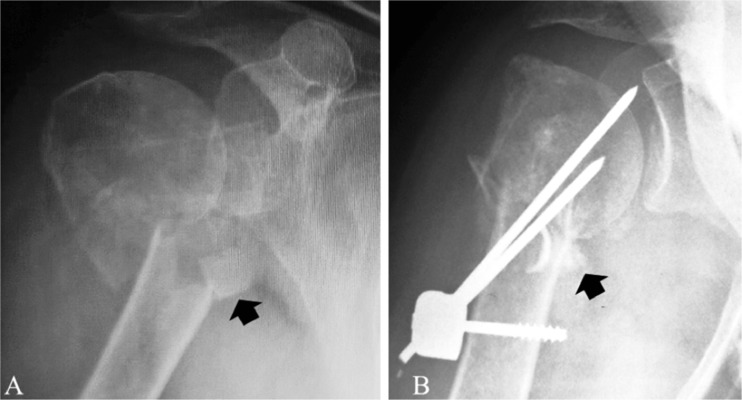
An 83-year-old female with a type 12 fracture (Codman-Lego classification) with metaphyseal comminution and complete calcar separation from head and diaphysis, indicated by the arrow (a). Two months after surgery (b) the head exhibits severe impaction, perforation of humeral articular surface by K-wires and varus angulation, with fair final result

References

    1. Roux A, Decroocq L, El BAtti S, Bonnevialle N, Moineau G, Trojani C, Boileau P, de Peretti F. Epidemiology of proximal humerus fractures managed in a trauma center. Orthop Traumatol Surg Res. 2012;98:715–719. doi: 10.1016/j.otsr.2012.05.013. - DOI - PubMed
    1. Fankhauser F, Boldin C, Schippinger G, Haunschmid C, Szyszkowitz R. A new locking plate for unstable fractures of the proximal humerus. Clin Orthop Relat Res. 2005;430:176–181. doi: 10.1097/01.blo.0000137554.91189.a9. - DOI - PubMed
    1. Rouleau DM, Laflamme GY, Berry GK, Harvey EJ, Delisle J, Girard J. Proximal humerus fractures treated by percutaneous locking plate internal fixation. Orthop Traumatol Surg Res. 2009;95:56–62. doi: 10.1016/j.otsr.2008.09.003. - DOI - PubMed
    1. Spross C, Platz A, Erschbamer M, Lattmann T, Dietrich M. Surgical treatment of Neer Group VI proximal humeral fractures: retrospective comparison of PHILOS® and hemiarthroplasty. Clin Orthop Relat Res. 2012;470:2035–2042. doi: 10.1007/s11999-011-2207-1. - DOI - PMC - PubMed
    1. Bogner R, Hubner C, Matis N, Auffarth A, Lederer S, Resch H. Minimally-invasive treatment of three- and four-part fractures of the proximal humerus in elderly patients. J Bone Joint Surg (Br) 2008;90:1602–1607. doi: 10.1302/0301-620X.90B12.20269. - DOI - PubMed

LinkOut - more resources