. 2014 Jun;88(12):6729-42.
doi: 10.1128/JVI.00541-14. Epub 2014 Apr 2.

Live attenuated tetravalent dengue virus host range vaccine is immunogenic in African green monkeys following a single vaccination

Affiliations

Live attenuated tetravalent dengue virus host range vaccine is immunogenic in African green monkeys following a single vaccination

Caitlin M Briggs et al. J Virol. 2014 Jun.

Abstract

The causative agent of dengue fever, dengue virus (DENV), is transmitted by mosquitoes, and as distribution of these insects has expanded, so has dengue-related disease. DENV is a member of the Flaviviridae family and has 4 distinct serotypes (DENV-1, -2, -3, and -4). No lasting cross protection is afforded to heterologous serotypes following infection by any one of the individual serotypes. The presence of nonneutralizing antibodies to one serotype can facilitate the occurrence of more-severe dengue hemorrhagic fever through immune enhancement upon infection with a second serotype. For this reason, the development of a safe, tetravalent vaccine to produce a balanced immune response to all four serotypes is critical. We have developed a novel approach to produce safe and effective live-attenuated vaccines for DENV and other insect-borne viruses. Host range (HR) mutants of each DENV serotype were created by truncating transmembrane domain 1 of the E protein and selecting for strains of DENV that replicated well in insect cells but not mammalian cells. These vaccine strains were tested for immunogenicity in African green monkeys (AGMs). No vaccine-related adverse events occurred. The vaccine strains were confirmed to be attenuated in vivo by infectious center assay (ICA). Analysis by 50% plaque reduction neutralization test (PRNT50) established that by day 62 postvaccination, 100% of animals seroconverted to DENV-1, -2, -3, and -4. Additionally, the DENV HR tetravalent vaccine (HR-Tet) showed a tetravalent anamnestic immune response in 100% (16/16) of AGMs after challenge with wild-type (WT) DENV strains.

Importance: We have generated a live attenuated viral (LAV) vaccine capable of eliciting a strong immune response in African green monkeys (AGMs) in a single dose. This vaccine is delivered by injecting one of four attenuated serotypes into each limb of the animal. 100% of animals given the vaccine generated antibodies against all 4 serotypes, and this response was found to be balanced in nature. This is also one of the first studies of dengue in AGMs, and our study suggests that viremia and antibody response in AGMs may be similar to those seen in DENV infection in humans.


Figures

FIG 1
FIG 1
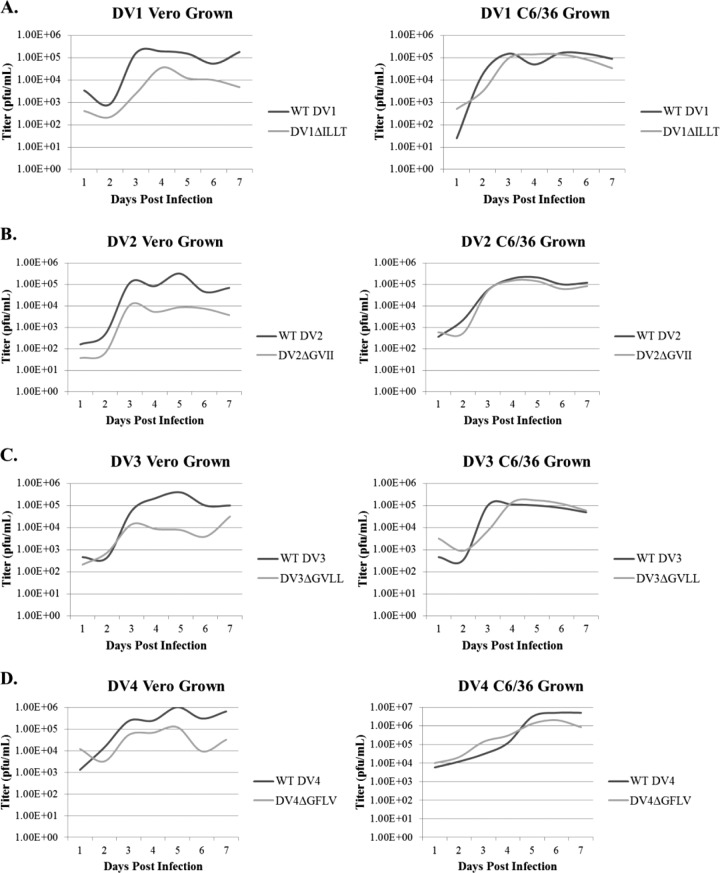
Growth of HR-Tet vaccine viruses and their parental wild-type viruses in mammalian and insect cells. Each of the four vaccine serotypes and their corresponding parental wild-type viruses were grown in mammalian (Vero) and insect (C6/36) cells for a 7-day time course. Cells were infected with an intial MOI of 0.03 PFU/cell, and infection was allowed to progress for 7 days. Starting at 1 day postinfection, cell supernatant was harvested and a plaque assay done to determine virus titers. As shown, DV1ΔILLT (A), DV2ΔGVII (B), DV3ΔGVLL (C), and DV4ΔGFLV (D) all had ∼1-log reduction in growth in Vero cells compared to their parental WT viruses. In contrast, there was no difference in viral titer between the vaccine viruses and the parental WT viruses when grown in C6/36 cells.
FIG 2
FIG 2
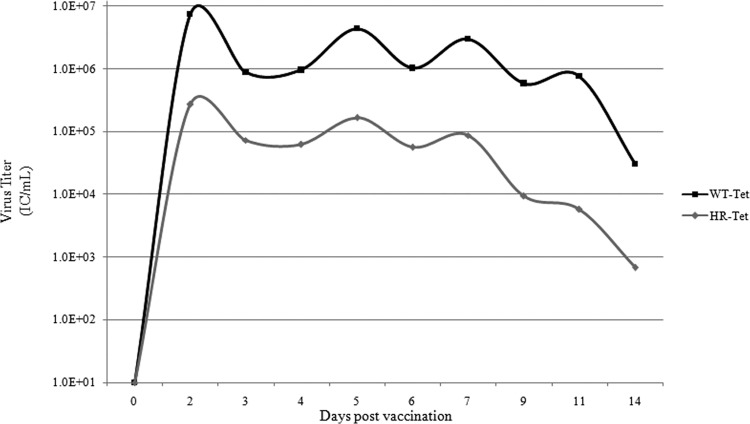
Viremia following vaccination. The amount of viremia in serum was measured daily out to 14 days postvaccination by ICA. Animals were given either 4 × 10⁶ IC (total) of the 4 parental serotypes (WT-Tet) or 4 × 10⁶ IC (total) of 4 host range mutant serotypes (HR-Tet). Titers from HR-Tet animals were significantly lower than titers from WT-Tet animals on days 2 (P < 0.004), 3, (P < 0.02), 4 (P < 0.03), 5 (P < 0.02), 6 (P < 0.01), 7 (P < 0.007), 9 (P < 0.02), and 14 (P < 0.03) by the Mann-Whitney test.
FIG 3
FIG 3
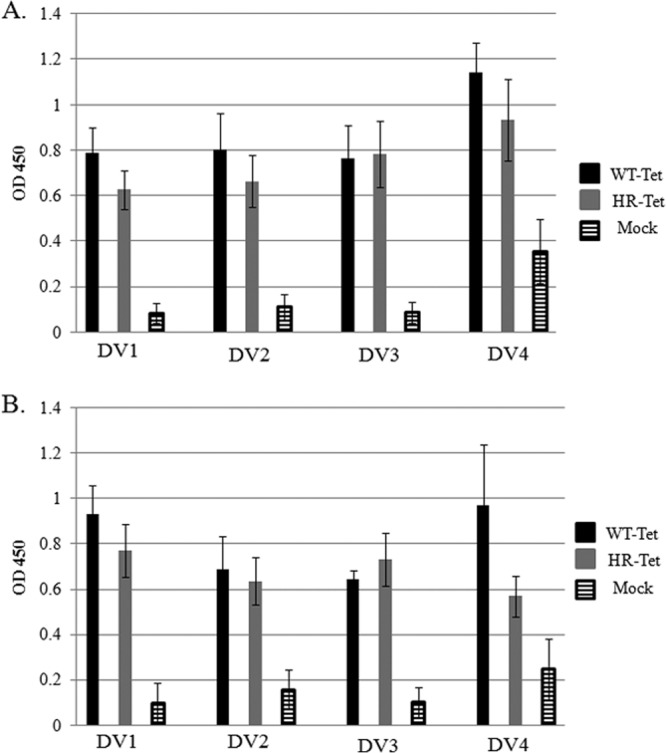
ELISA on postvaccination samples. At 30 (A) and 62 (B) days postvaccination, an ELISA to measure IgG in AGMs was done as described in Materials and Methods. For day 30 (A), WT-Tet and HR-Tet samples are statistically significantly different from mock samples for all DENV serotypes (DV) tested (DV1, WT-Tet versus Mock and HR-Tet versus mock, P < 0.001; DV2, WT-Tet versus mock and HR-Tet versus mock, P < 0.001; DV3, WT-Tet versus mock, P < 0.01, and HR-Tet versus mock, P < 0.001; DV4, WT-Tet versus mock and HR-Tet versus mock, P < 0.001). For day 62 (B), there were significant differences in OD between samples (DV1, WT-Tet versus mock, P < 0.01, and HR-Tet versus mock, P < 0.001; DV2, WT-Tet versus mock, P < 0.01, and HR-Tet versus mock, P < 0.001; DV3, WT-Tet versus mock, not significant, and HR-Tet versus mock, P < 0.001; DV4, WT-Tet versus mock, P < 0.001, and HR-Tet versus mock, P < 0.001). Statistics were performed using the Kruskal-Wallis test with Dunn's posttest.
FIG 4
FIG 4
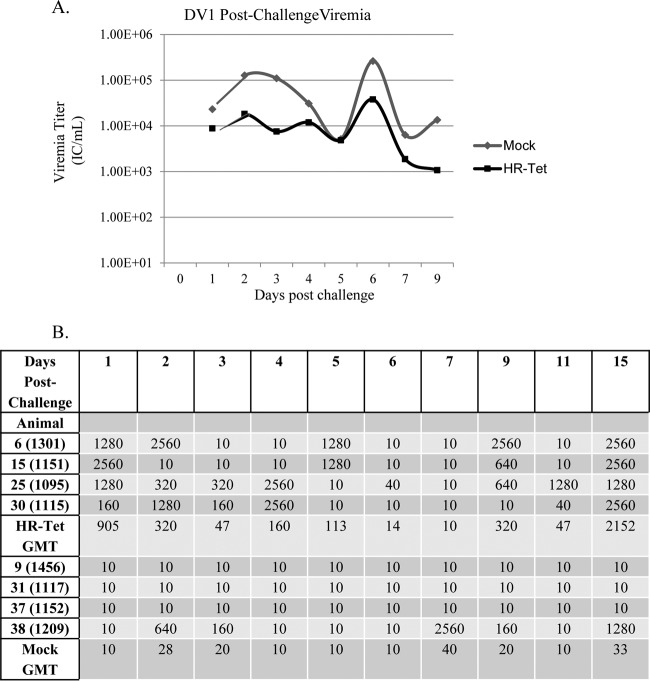
Viremia and neutralizing antibody titers following challenge with DENV-1 (DV1). (A) HR-Tet animals challenged with DV1 HI had on average 1 log less viremia following challenge compared to mock-vaccinated animals challenged with the same dose of DV1 HI. A significant difference in viremia between the groups was noted on days 2, 3, 6, and 9 (P < 0.02). Graphed titers are averages from four animals challenged with DV1 HI. (B) There was also a large difference in neutralizing antibody titer in mock-vaccinated animals compared to HR-Tet animals following challenge. All animals given HR-TET had high neutralizing antibody titers following challenge with DV1 HI. However, only 25% of mock-vaccinated animals developed neutralizing antibody titers following challenge with DV1 HI.
FIG 5
FIG 5
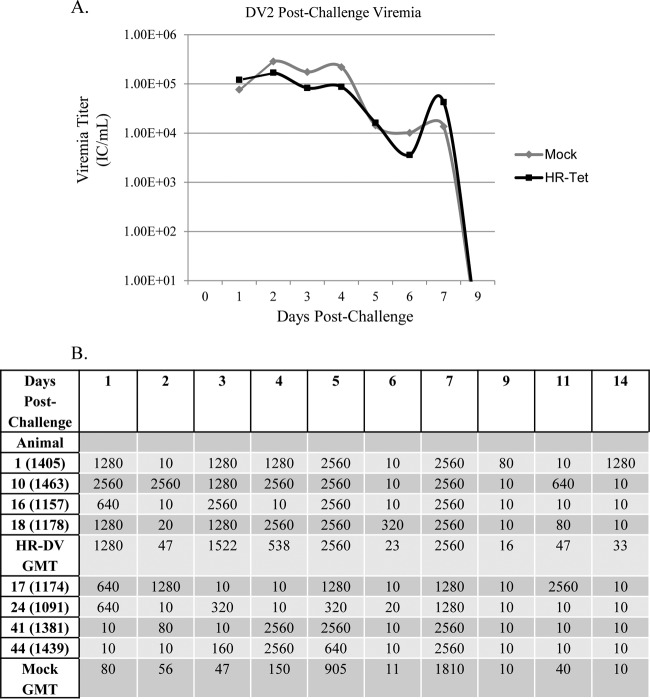
Viremia and neutralizing antibody titers following challenge with DENV-2 (DV2). (A) HR-Tet animals challenged with DV2 S16803 had noticeably lower viremia following challenge than did mock-vaccinated animals challenged with the same dose of DV2 S16803. Graphed titers are averages from four animals challenged with DV2 S16803. (B) There was also a large difference in neutralizing antibody titer in mock-vaccinated animals compared to HR-Tet animals following challenge. Animals given HR-Tet prior to challenge had much faster, stronger, and more-sustained neutralizing antibody production than did mock-vaccinated animals challenged with DV2 S16803.
FIG 6
FIG 6
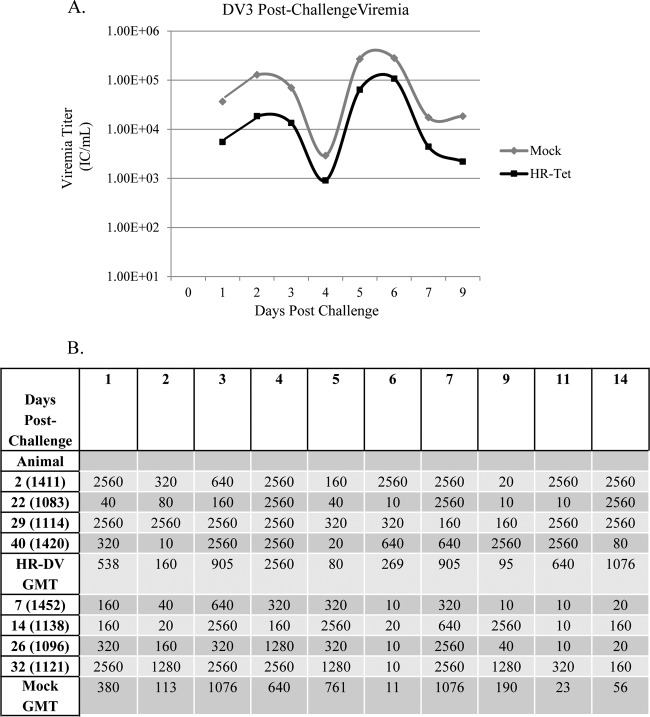
Viremia and neutralizing antibody titers following challenge with DENV-3 (DV3). (A) HR-Tet animals challenged with DV3 H87 had viremia on average 1 log lower in titer following challenge than mock-vaccinated animals challenged with the same dose of DV3 H87. A significant difference in titer between the two groups was noted on days 2, 3, 5, 6, and 9 (P < 0.02). Graphed titers are averages from four animals challenged with DV3 H87. (B) There was also a difference in neutralizing antibody titer in mock-vaccinated animals compared to HR-Tet animals following challenge. Animals given HR-Tet prior to challenge had much faster, stronger, and more-sustained neutralizing antibody production than did mock-vaccinated animals challenged with DV3 H87.
FIG 7
FIG 7
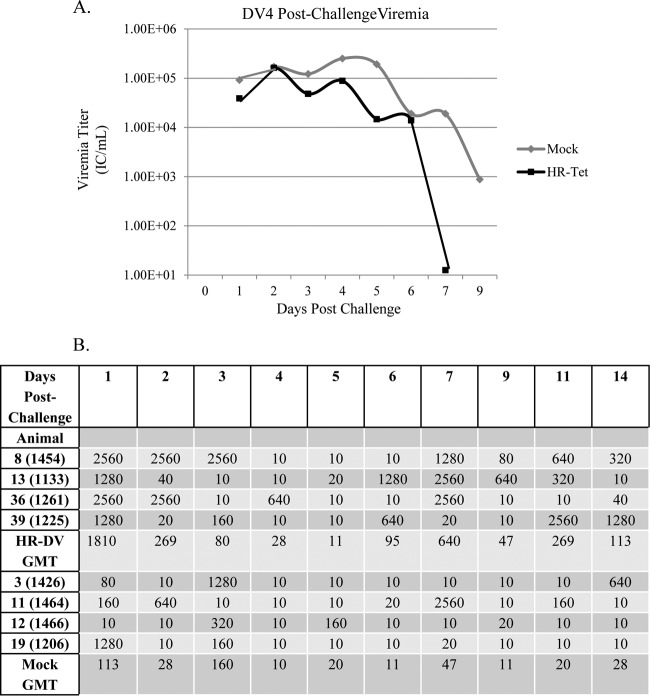
Viremia and neutralizing antibody postchallenge with DENV-4 (DV4). (A) HR-Tet animals challenged with DV4 H241 had lower viremia, which was cleared more quickly, than mock-vaccinated animals challenged with the same dose of DV4 H241. A significant difference in titers between the two groups was noted on days 3, 4, and 5 (P < 0.02). Graphed titers are averages from four animals challenged with DV4 H241. (B) There was also a difference in neutralizing antibody titers in mock-vaccinated animals compared to HR-Tet animals following challenge. Animals given HR-Tet prior to challenge had much faster, stronger, and more-sustained neutralizing antibody production than mock-vaccinated animals challenged with DV4 H241.
FIG 8
FIG 8
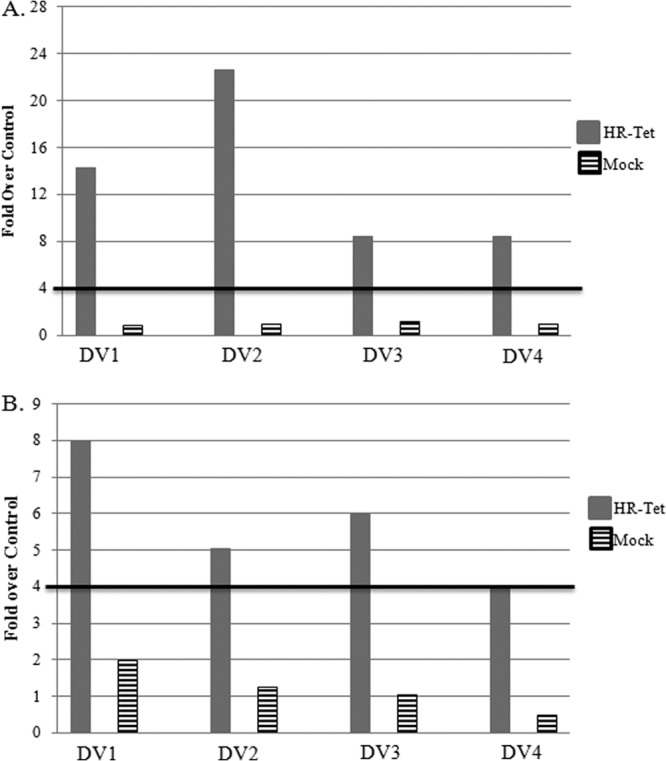
Anamnestic immune response following challenge. On days 71 (A) and 77 (B) postvaccination (days 9 and 15 postchallenge), we looked for evidence of a memory immune response by measuring the fold increase in IgG in animals given HR-Tet prior to challenge compared to IgG in mock-vaccinated animals. An anamnestic response was defined as any response ≥4-fold greater than that of the naive unchallenged control. Animals given HR-Tet prior to challenge with one of the four serotypes of DENV developed a memory immune response against all four serotypes starting at 9 days postchallenge (A, gray bars), and this memory response continued out to 15 days postchallenge (B, gray bars). No evidence of a memory response was seen in mock-vaccinated animals following challenge at either time point (A and B, hatched bars).

References

    1. WHO. 2014. Dengue and severe dengue. Fact sheet no. 17. WHO, Geneva, Switzerland: http://www.who.int/mediacentre/factsheets/fs117/en/
    1. Halstead SB. 1980. Immunological parameters of Togavirus disease syndromes, p 107–168 In Schlesinger RW. (ed), The togaviruses: biology, structure, replication. Academic Press, New York, NY
    1. Henchal EA, Putnak JR. 1990. The dengue viruses. Clin. Microbiol. Rev. 3:376–396 - PMC - PubMed
    1. Gubler DJ. 2006. Dengue/dengue haemorrhagic fever: history and current status. Novartis Found. Symp. 277:3–16, 16–22. 10.1002/0470058005.ch2 - DOI - PubMed
    1. WHO. 2012. Dengue/dengue haemorrhagic fever. WHO, Geneva, Switzerland: http://www.who.int/csr/disease/dengue/en/

Publication types

MeSH terms