. 2014 Jun;13(6):1495-509.
doi: 10.1074/mcp.M113.034173. Epub 2014 Apr 2.

Quantitative chemical proteomics identifies novel targets of the anti-cancer multi-kinase inhibitor E-3810

Affiliations

Quantitative chemical proteomics identifies novel targets of the anti-cancer multi-kinase inhibitor E-3810

Mara Colzani et al. Mol Cell Proteomics. 2014 Jun.

Abstract

Novel drugs are designed against specific molecular targets, but almost unavoidably they bind non-targets, which can cause additional biological effects that may result in increased activity or, more frequently, undesired toxicity. Chemical proteomics is an ideal approach for the systematic identification of drug targets and off-targets, allowing unbiased screening of candidate interactors in their natural context (tissue or cell extracts). E-3810 is a novel multi-kinase inhibitor currently in clinical trials for its anti-angiogenic and anti-tumor activity. In biochemical assays, E-3810 targets primarily vascular endothelial growth factor and fibroblast growth factor receptors. Interestingly, E-3810 appears to inhibit the growth of tumor cells with low to undetectable levels of these proteins in vitro, suggesting that additional relevant targets exist. We applied chemical proteomics to screen for E-3810 targets by immobilizing the drug on a resin and exploiting stable isotope labeling by amino acids in cell culture to design experiments that allowed the detection of novel interactors and the quantification of their dissociation constant (Kd imm) for the immobilized drug. In addition to the known target FGFR2 and PDGFRα, which has been described as a secondary E-3810 target based on in vitro assays, we identified six novel candidate kinase targets (DDR2, YES, LYN, CARDIAK, EPHA2, and CSBP). These kinases were validated in a biochemical assay and-in the case of the cell-surface receptor DDR2, for which activating mutations have been recently discovered in lung cancer-cellular assays. Taken together, the success of our strategy-which integrates large-scale target identification and quality-controlled target affinity measurements using quantitative mass spectrometry-in identifying novel E-3810 targets further supports the use of chemical proteomics to dissect the mechanism of action of novel drugs.


Figures

Fig. 1.
Fig. 1.
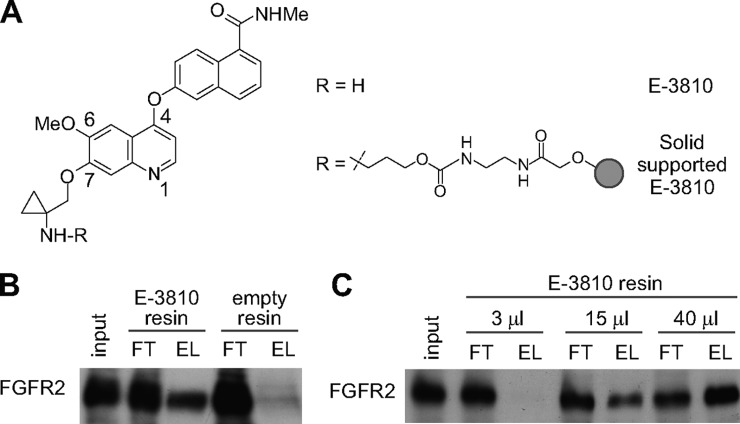
Characterization of immobilized E-3810. A, E-3810 structure, in free form and after immobilization on agarose resin. B, E-3810 maintains the ability to bind FGFR2 after immobilization on resin. Immunoblot analysis against FGFR2 in A2780 protein extract (input, IN), flow-through (FT), and eluates (EL) obtained by affinity chromatography with immobilized E-3810 (15 μl of resin slurry for 1 mg of extract). Non-derivatized agarose beads were used as a negative control (empty resin). FT contained proteins not retained by the E-3810 resin; EL contained proteins captured by the resin and subsequently eluted. C, increasing volumes of E-3810 resin captured increasing amounts of FGFR2. Immunoblot analysis against FGFR2 for IN, FT, and EL obtained from the affinity chromatography experiments performed by incubating 1 mg of protein extract with 3, 15, or 40 μl of E-3810 resin slurry.
Fig. 2.
Fig. 2.
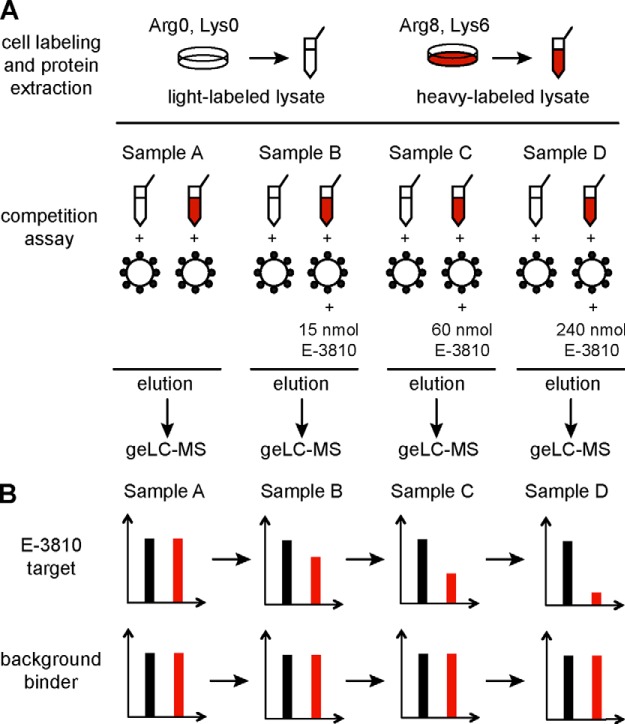
Identification of E-3810 targets via SILAC-based chemical proteomics competition assay. A, schematic view of the experimental design, in the forward SILAC setup. Light- and heavy-labeled samples are color-coded, respectively, in black and red. Cell extracts from SILAC-labeled A2780 cells were incubated with 40 μl of E-3810 resin slurry. Heavy lysates were co-incubated with increasing concentrations of E-3810, which competes for target binding; no competition was performed in sample A. After the incubation and washing steps, the resins of the light and heavy lysates were mixed to form four distinct SILAC samples. For each sample, eluted proteins were separated via SDS-PAGE, digested, and analyzed via LC-MS/MS. B, expected SILAC ratio readout in samples A–D for specific E-3810 interactors, as compared with unspecific background binders. In the forward experiment, specific interactors are expected to show a progressive H/L ratio decrease due to the competition with E-3810. Background binders are not competed by the drug and thus maintain a constant ratio value of about 1 throughout the serial competition. Heavy and light channels are swapped in the reverse experiment.
Fig. 3.
Fig. 3.
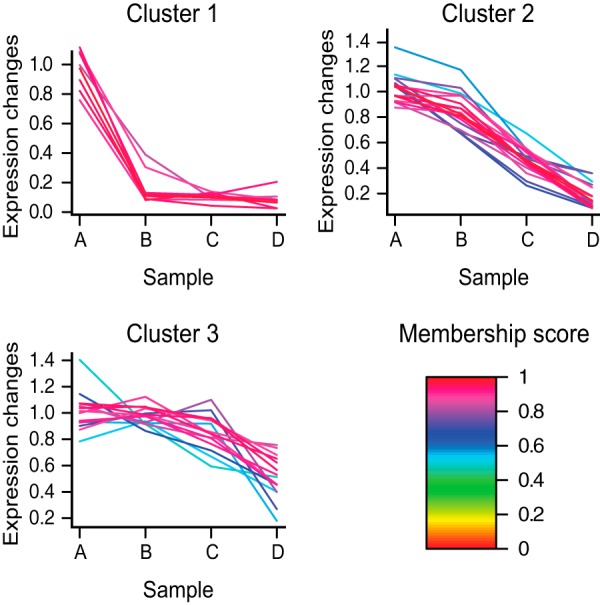
Unsupervised clustering analysis for the putative E-3810 targets selected through the competition assay. Proteins were grouped according to the trends of ratio modulation from sample A to sample D upon E-3810 competition. Cluster 1 contained proteins competed with the lowest concentration of E-3810, suggesting the highest affinity for the free form of the drug. Cluster 2 contained proteins competed at a medium concentration of E-3810, representing medium-affinity targets. Cluster 3 contained proteins competed only by the highest doses of free E-3810. Color-coded membership values, indicating the goodness of fit to the three clusters, are indicated in the legend. The members of each cluster are listed in supplemental Table S2.
Fig. 4.
Fig. 4.
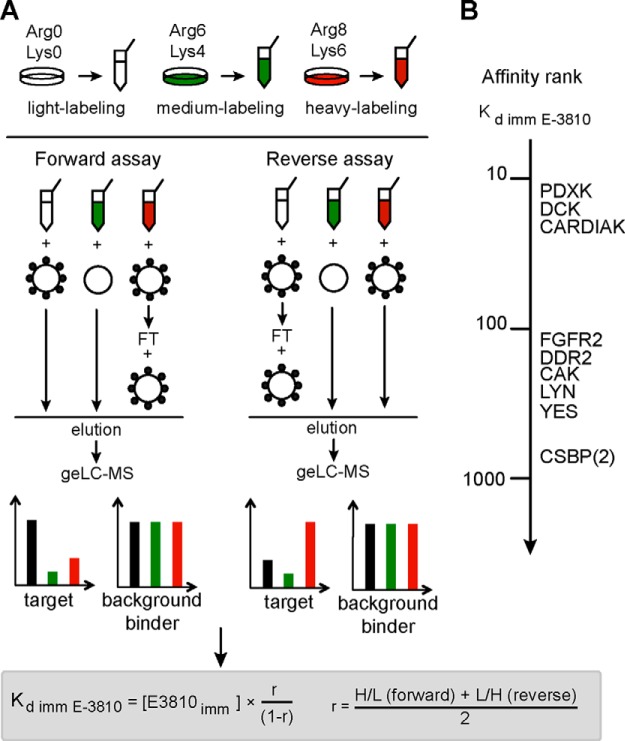
Kd chemoproteomic assay with immobilized E-3810. A, schematic view of the experimental design used to calculate the dissociation constant of candidate E-3810 targets for the immobilized drug (Kd imm). Light-, medium-, and heavy-labeled proteins are color-coded in black, green, and red, respectively. In the forward experiment, the light protein extract was incubated with E-3810 resin, the medium-labeled lysate was incubated with non-derivatized agarose resin, and the heavy extract was subjected to two subsequent rounds of incubation with the E-3810 resin. After the incubation and washing steps, the resins from the three experiments were mixed to generate light:medium:heavy SILAC triplets. Genuine E-3810 targets are expected to show specificity ratios (M/L in the forward experiment) < 1, whereas the affinity ratios (H/L in the forward experiment) are used to compute the value of Kd imm E-3810. B, affinity ranking of the putative kinases targeted by E-3810, based on Kd imm E-3810.
Fig. 5.
Fig. 5.
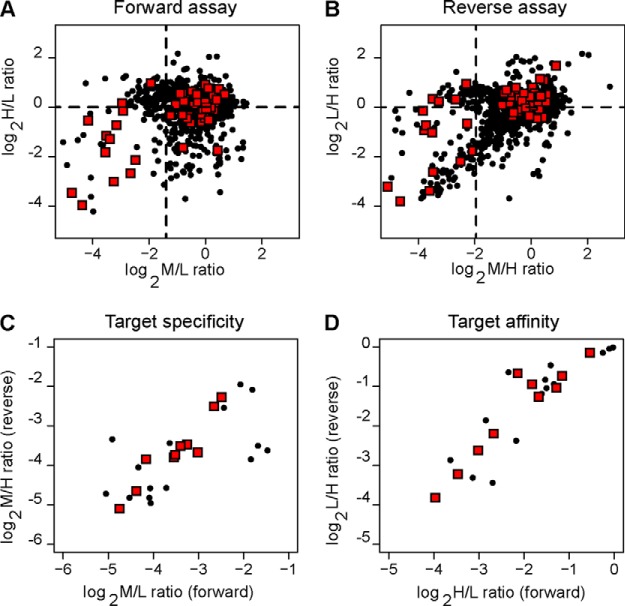
Scatterplot of protein ratios obtained from the Kd chemoproteomic assay. A, H/L and M/L ratios in the forward assay. B, corresponding L/H and M/H ratios in the reverse assay. C, Specificity ratio values for the 25 putative targets (M/L and corresponding M/H ratios in the forward and reverse assays, respectively). Lower values (M/L and M/H ≪ 1) indicate selective binding to immobilized E-3810 as compared with empty resin. D, affinity ratio values for the 25 putative targets (H/L and corresponding L/H from the forward and reverse assays, respectively). Lower protein ratio values (≪1) indicate strong affinity for the immobilized E-3810. Black dots represent the 1305 proteins identified and quantified in the chemical proteomics Kd assay; red diamonds indicate kinase proteins. Dotted lines specify the thresholds used for E-3810 target selection.
Fig. 6.
Fig. 6.
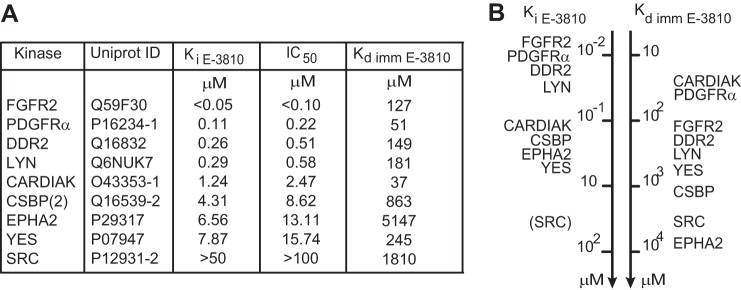
In vitro inhibition assay for selected E-3810 interactors. Eight kinase proteins were selected from among the candidate interactors identified in chemical proteomics experiments to assess whether E-3810 could inhibit their enzymatic activity; FGFR2 was included as a positive control. A, table showing inhibition constant (Ki E-3810) and half-maximal inhibitory concentration (IC50 E-3810) values calculated from the in vitro assay, with the corresponding dissociation constant calculated from the chemical proteomics assay (Kd imm E-3810). The value of Ki > 50 μm for SRC suggests that this kinase was not specifically inhibited by E-3810 at the concentrations tested in the assay. B, comparative ranking of the E-3810 targets based on Ki E-3810 and Kd imm E-3810 values, referring to the drug's efficacy and affinity, respectively.
Fig. 7.
Fig. 7.
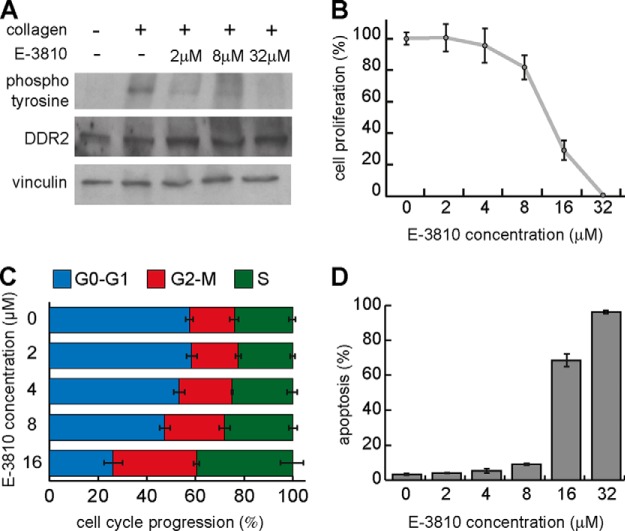
DDR2 is a novel target of E-3810. A, phosphorylation of DDR2 is inhibited by E-3810. In 293T cells overexpressing DDR2, collagen stimulation (20 μg/ml) induces activation of the receptor measured by the increase of its phosphorylated form, as shown by double immunoblot analysis using anti-DDR2 and anti-phosphotyrosine antibodies. Co-treatment with both collagen and E-3810 (2, 8, or 32 μm) for 120 min reduced DDR2 phosphorylation, confirming the inhibitory effect of the drug. Vinculin was used as a loading control. B, cell proliferation assay in HCC-366 cells. Treatment of HCC-366 cells with increasing concentrations of E-3810 (2, 4, 8, 16, and 32 μm) inhibited cell proliferation. C, cell cycle analysis of HCC-366 cells upon treatment with increasing doses of E-3810. D, percentage of apoptotic HCC-366 cells upon E-3810 treatment.

References

    1. Schirle M., Bantscheff M., Kuster B. (2012) Mass spectrometry-based proteomics in preclinical drug discovery. Chem. Biol. 19, 72–84 - PubMed
    1. Rix U., Superti-Furga G. (2009) Target profiling of small molecules by chemical proteomics. Nat. Chem. Biol. 5, 616–624 - PubMed
    1. Godl K., Wissing J., Kurtenbach A., Habenberger P., Blencke S., Gutbrod H., Salassidis K., Stein-Gerlach M., Missio A., Cotten M., Daub H. (2003) An efficient proteomics method to identify the cellular targets of protein kinase inhibitors. Proc. Natl. Acad. Sci. U.S.A. 100, 15434–15439 - PMC - PubMed
    1. Sharma K., Weber C., Bairlein M., Greff Z., Kéri G., Cox J., Olsen J. V., Daub H. (2009) Proteomics strategy for quantitative protein interaction profiling in cell extracts. Nat. Methods 6, 741–744 - PubMed
    1. Ong S. E., Schenone M., Margolin A. A., Li X., Do K., Doud M. K., Mani D. R., Kuai L., Wang X., Wood J. L., Tolliday N. J., Koehler A. N., Marcaurelle L. A., Golub T. R., Gould R. J., Schreiber S. L., Carr S. A. (2009) Identifying the proteins to which small-molecule probes and drugs bind in cells. Proc. Natl. Acad. Sci. U.S.A. 106, 4617–4622 - PMC - PubMed

Publication types

MeSH terms