


A brief history of macromolecular crystallography, illustrated by a family tree and its Nobel fruits
- PMID: 24698025
- PMCID: PMC6309182
- DOI: 10.1111/febs.12796
A brief history of macromolecular crystallography, illustrated by a family tree and its Nobel fruits
Abstract
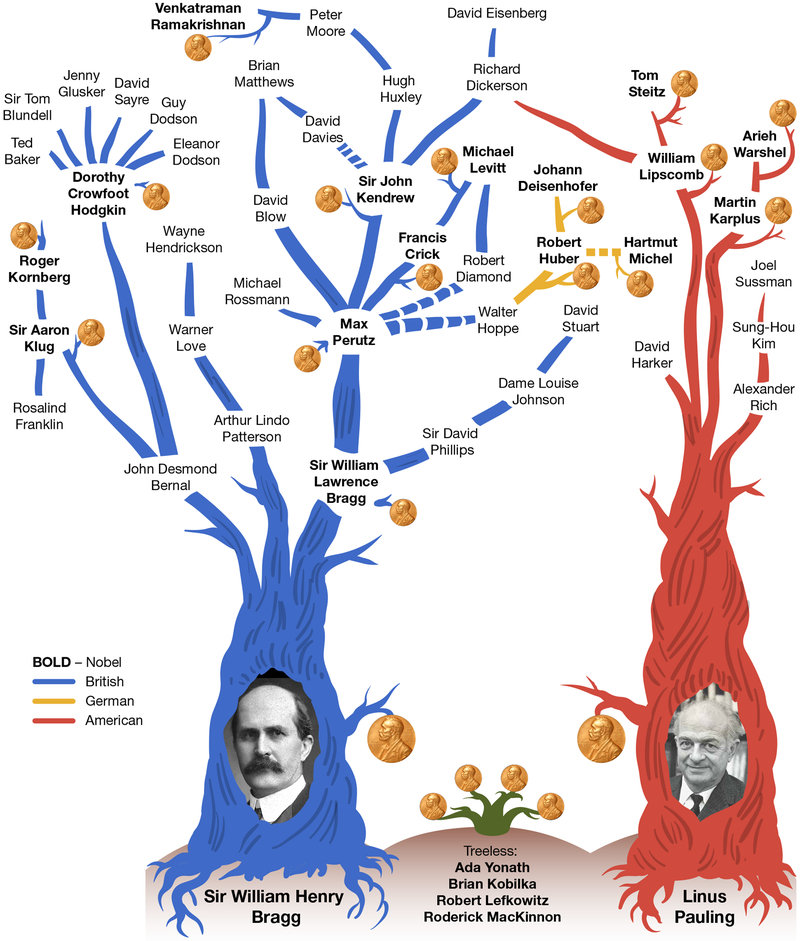
As a contribution to the celebration of the year 2014, declared by the United Nations to be 'The International Year of Crystallography', the FEBS Journal is dedicating this issue to papers showcasing the intimate union between macromolecular crystallography and structural biology, both in historical perspective and in current research. Instead of a formal editorial piece, by way of introduction, this review discusses the most important, often iconic, achievements of crystallographers that led to major advances in our understanding of the structure and function of biological macromolecules. We identified at least 42 scientists who received Nobel Prizes in Physics, Chemistry or Medicine for their contributions that included the use of X-rays or neutrons and crystallography, including 24 who made seminal discoveries in macromolecular sciences. Our spotlight is mostly, but not only, on the recipients of this most prestigious scientific honor, presented in approximately chronological order. As a summary of the review, we attempt to construct a genealogy tree of the principal lineages of protein crystallography, leading from the founding members to the present generation.
Keywords: history of crystallography; macromolecular crystallography; nobel prizes; structural biology; structural crystallography.
Published 2014. This article is a U.S. Government work and is in the public domain in the USA.
Figures
References
-
- Röntgen WC (1896) On a new kind of rays. Science 3, 227–231. - PubMed
-
- Röntgen WC (1896) A new form of radiation. Science 3, 726–729. - PubMed
-
- Friedrich W, Knipping P, & Laue M (1912) Interferenz-Erscheinungen bei Röntgenstrahlen. Sitz Bayer Akad Wiss 303–322.
-
- Bragg WL (1913) The diffraction of short electromagnetic waves by a crystal. Proc Cambridge Phil Soc 17, 43–57.
-
- Bragg WH (1912) X-rays and crystals. Nature 90, 219.
Publication types
MeSH terms
Substances
Grants and funding
LinkOut - more resources
Full Text Sources
Other Literature Sources
Research Materials
