


The PROMIS Physical Function item bank was calibrated to a standardized metric and shown to improve measurement efficiency
- PMID: 24698295
- PMCID: PMC4465404
- DOI: 10.1016/j.jclinepi.2013.10.024
The PROMIS Physical Function item bank was calibrated to a standardized metric and shown to improve measurement efficiency
Abstract
Objective: To document the development and psychometric evaluation of the Patient-Reported Outcomes Measurement Information System (PROMIS) Physical Function (PF) item bank and static instruments.
Study design and setting: The items were evaluated using qualitative and quantitative methods. A total of 16,065 adults answered item subsets (n>2,200/item) on the Internet, with oversampling of the chronically ill. Classical test and item response theory methods were used to evaluate 149 PROMIS PF items plus 10 Short Form-36 and 20 Health Assessment Questionnaire-Disability Index items. A graded response model was used to estimate item parameters, which were normed to a mean of 50 (standard deviation [SD]=10) in a US general population sample.
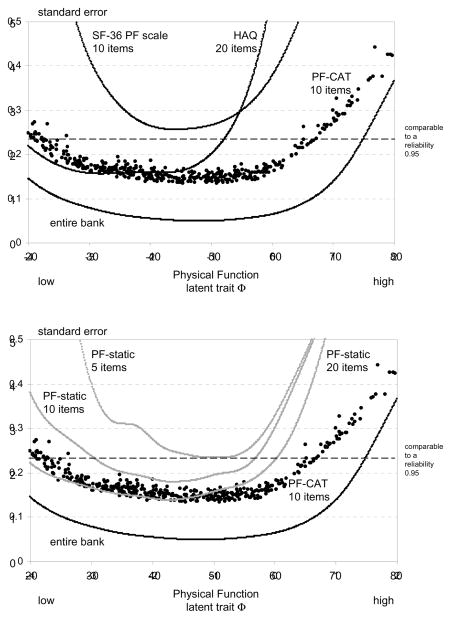
Results: The final bank consists of 124 PROMIS items covering upper, central, and lower extremity functions and instrumental activities of daily living. In simulations, a 10-item computerized adaptive test (CAT) eliminated floor and decreased ceiling effects, achieving higher measurement precision than any comparable length static tool across four SDs of the measurement range. Improved psychometric properties were transferred to the CAT's superior ability to identify differences between age and disease groups.
Conclusion: The item bank provides a common metric and can improve the measurement of PF by facilitating the standardization of patient-reported outcome measures and implementation of CATs for more efficient PF assessments over a larger range.
Keywords: Computerized adaptive test; Health status; Item response theory; Patient-reported outcomes; Physical function; Questionnaire.
Copyright © 2014. Published by Elsevier Inc.
Figures
References
-
- van der Linden WJ, Hambleton RK. Handbook of Modern Item Response Theory. Berlin: Springer; 1997.
-
- Wainer H, Dorans NJ, Eignor D, et al. Computerized Adaptive Testing: A primer. 2. Mahwah, NJ: Lawrence Erlbaum Associates; 2000.
-
- Ware JE, Jr, Bjorner JB, Kosinski M. Practical implications of item response theory and computerized adaptive testing: a brief summary of ongoing studies of widely used headache impact scales. Med Care. 2000;38:II73–II82. - PubMed
Publication types
MeSH terms
Grants and funding
- U01AR52155/AR/NIAMS NIH HHS/United States
- U01 AR052170/AR/NIAMS NIH HHS/United States
- U01 AR052181/AR/NIAMS NIH HHS/United States
- U01AR52170/AR/NIAMS NIH HHS/United States
- U01AR52158/AR/NIAMS NIH HHS/United States
- U01AR52171/AR/NIAMS NIH HHS/United States
- U01 AR052155/AR/NIAMS NIH HHS/United States
- U01AR52186/AR/NIAMS NIH HHS/United States
- U01 AR052171/AR/NIAMS NIH HHS/United States
- U01 AR052186/AR/NIAMS NIH HHS/United States
- U01 AR052177/AR/NIAMS NIH HHS/United States
- U01AR52177/AR/NIAMS NIH HHS/United States
- U01AR52181/AR/NIAMS NIH HHS/United States
- U01 AR052158/AR/NIAMS NIH HHS/United States
LinkOut - more resources
Full Text Sources
Other Literature Sources
Medical
Miscellaneous
