


Olfactory coding in the insect brain: data and conjectures
- PMID: 24698302
- PMCID: PMC4237541
- DOI: 10.1111/ejn.12558
Olfactory coding in the insect brain: data and conjectures
Abstract
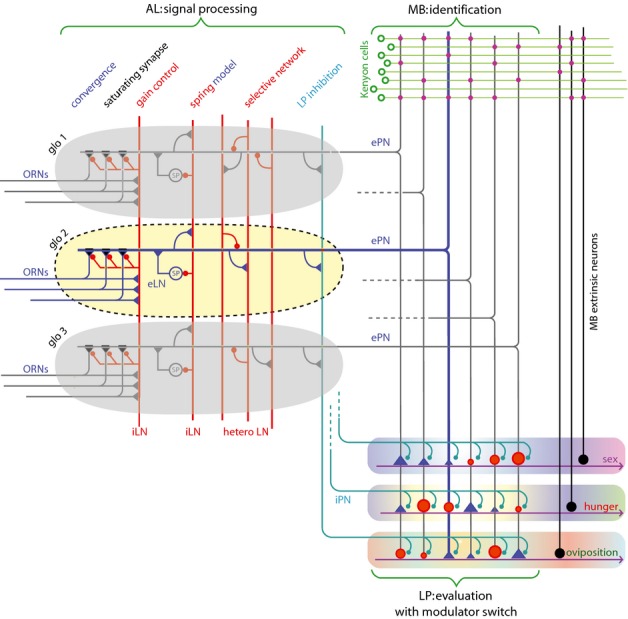
Much progress has been made recently in understanding how olfactory coding works in insect brains. Here, I propose a wiring diagram for the major steps from the first processing network (the antennal lobe) to behavioral readout. I argue that the sequence of lateral inhibition in the antennal lobe, non-linear synapses, threshold-regulating gated spring network, selective lateral inhibitory networks across glomeruli, and feedforward inhibition to the lateral protocerebrum cover most of the experimental results from different research groups and model species. I propose that the main difference between mushroom bodies and the lateral protocerebrum is not about learned vs. innate behavior. Rather, mushroom bodies perform odor identification, whereas the lateral protocerebrum performs odor evaluation (both learned and innate). I discuss the concepts of labeled line and combinatorial coding and postulate that, under restrictive experimental conditions, these networks lead to an apparent existence of 'labeled line' coding for special odors. Modulatory networks are proposed as switches between different evaluating systems in the lateral protocerebrum. A review of experimental data and theoretical conjectures both contribute to this synthesis, creating new hypotheses for future research.
Keywords: antennal lobe; mushroom bodies; neural networks; sensory coding.
© 2014 The Authors. European Journal of Neuroscience published by Federation of European Neuroscience Societies and John Wiley & Sons Ltd.
Figures

References
-
- Bargmann CI. Beyond the connectome: how neuromodulators shape neural circuits. BioEssays. 2012;34:458–465. - PubMed
-
- Bargmann CI. Kaplan JM. Signal transduction in the Caenorhabditis elegans nervous system. Annu. Rev. Neurosci. 1998;21:279–308. - PubMed
-
- Barrozo RB, Gadenne C. Anton S. Switching attraction to inhibition: mating-induced reversed role of sex pheromone in an insect. J. Exp. Biol. 2010;213:2933–2939. - PubMed
Publication types
MeSH terms
LinkOut - more resources
Full Text Sources
Other Literature Sources
Molecular Biology Databases
