


Trends in the incidence and mortality of multiple births by socioeconomic deprivation and maternal age in England: population-based cohort study
- PMID: 24699461
- PMCID: PMC3987713
- DOI: 10.1136/bmjopen-2013-004514
Trends in the incidence and mortality of multiple births by socioeconomic deprivation and maternal age in England: population-based cohort study
Abstract
Objective: To investigate temporal trends in multiple birth rates and associated stillbirth and neonatal mortality by socioeconomic deprivation and maternal age in England.
Design: Population cohort study.
Setting: England.
Participants: All live births and stillbirths (1 January 1997 to 31 December 2008).
Main outcome measures: Multiple maternity rate, stillbirth and neonatal death rate by year of birth, decile of socioeconomic deprivation and maternal age.
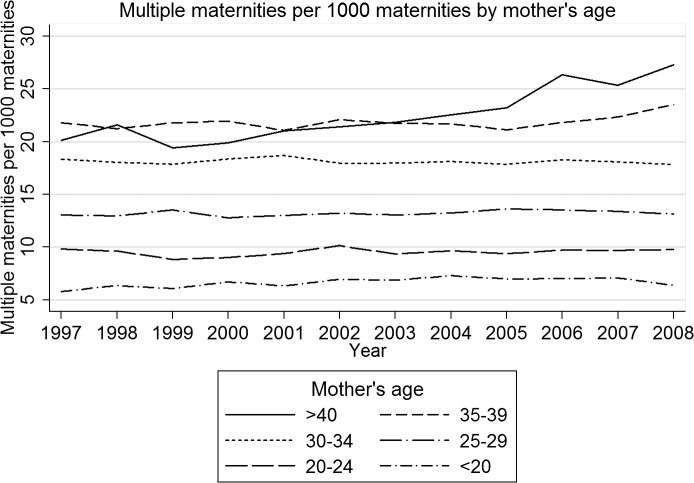
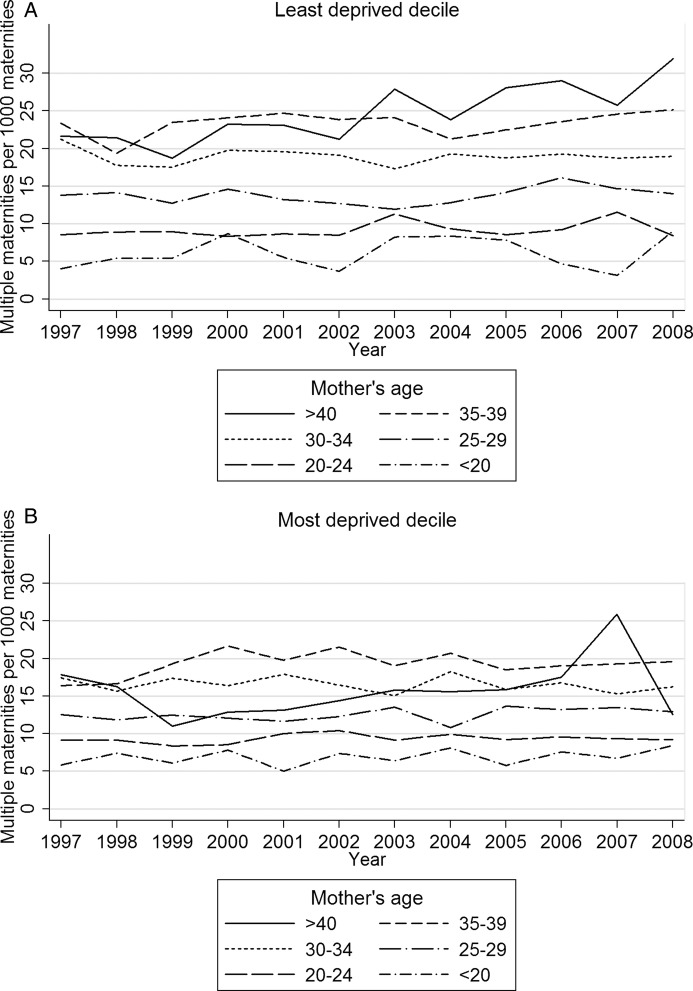
Results: The overall rate of multiple maternities increased over time (+0.64% per annum 95% CI (0.47% to 0.81%)) with an increase in twin maternities (+0.85% per annum 95% CI (0.67% to 1.0%)) but a large decrease in triplet and higher order maternities (-8.32% per annum 95% CI (-9.39% to -7.25%)). Multiple maternities were significantly lower in the most deprived areas, and this was most evident in the older age groups. Women over 40 years of age from the most deprived areas had a 34% lower rate of multiple births compared with similar aged women from the most deprived areas (rate ratio (RR) 0.66 95% CI (0.61 to 0.73)). Multiple births remain at substantially higher risk of neonatal mortality (RR 6.30 95% CI (6.07 to 6.53)). However, for stillbirths, while twins remain at higher risk, this has decreased over time (1997-2000: RR 2.89 (2.69 to 3.10); 2005-2008: RR 2.22 95% CI (2.06 to 2.40)). Socioeconomic inequalities existed in mortality for singletons and multiple births.
Conclusions: This period has seen increasing rates of twin pregnancies and decreasing rates of higher order births which have coincided with changes in recommendations regarding assisted reproductive techniques. Socioeconomic differences in multiple births may reflect differential access to these treatments. Improved monitoring of multiple pregnancies is likely to have led to the reductions in stillbirths over this time.
Keywords: Epidemiology; Neonatology; Statistics & Research Methods.
Figures
References
MeSH terms
Grants and funding
LinkOut - more resources
Full Text Sources
Other Literature Sources
