


Progress toward measles preelimination--African Region, 2011-2012
- PMID: 24699765
- PMCID: PMC5779352
Progress toward measles preelimination--African Region, 2011-2012
Abstract
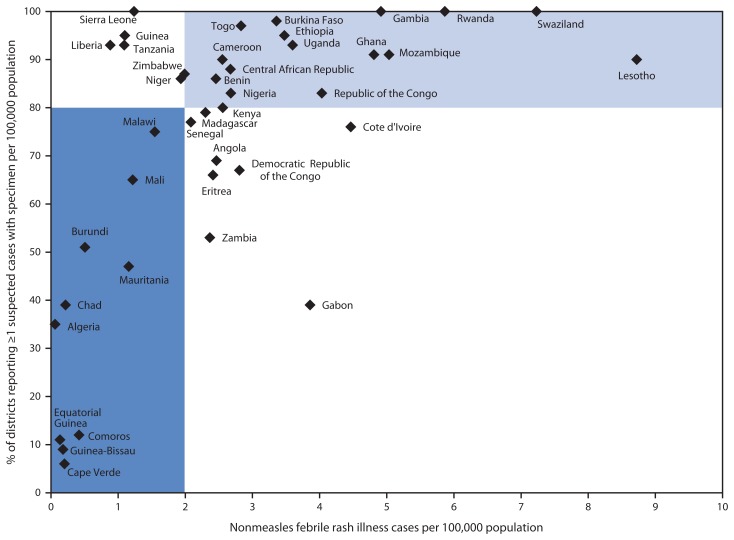
In 2008, the 46 member states of the World Health Organization (WHO) African Region (AFR) adopted a measles preelimination goal to reach by the end of 2012 with the following targets: 1) >98% reduction in estimated regional measles mortality compared with 2000, 2) annual measles incidence of fewer than five reported cases per million population nationally, 3) >90% national first dose of measles-containing vaccine (MCV1) coverage and >80% MCV1 coverage in all districts, and 4) >95% MCV coverage in all districts by supplementary immunization activities (SIAs). Surveillance performance objectives were to report two or more cases of nonmeasles febrile rash illness per 100,000 population, one or more suspected measles cases investigated with blood specimens in ≥80% of districts, and 100% completeness of surveillance reporting from all districts. This report updates previous reports and describes progress toward the measles preelimination goal during 2011-2012. In 2012, 13 (28%) member states had >90% MCV1 coverage, and three (7%) reported >90% MCV1 coverage nationally and >80% coverage in all districts. During 2011-2012, four (15%) of 27 SIAs with available information met the target of >95% coverage in all districts. In 2012, 16 of 43 (37%) member states met the incidence target of fewer than five cases per million, and 19 of 43 (44%) met both surveillance performance targets. In 2011, the WHO Regional Committee for AFR established a goal to achieve measles elimination by 2020. To achieve this goal, intensified efforts to identify and close population immunity gaps and improve surveillance quality are needed, as well as committed leadership and ownership of the measles elimination activities and mobilization of adequate resources to complement funding from global partners.
Figures
References
-
- World Health Organization. Report of the second meeting of the African regional measles technical advisory group (TAG), recommendations. Addis Ababa, Ethiopia: World Health Organization, Regional Office for Africa; 2008. Available at http://www.afro.who.int/index.php?option=com_docman&task=doc_download&gi....
-
- CDC. Progress toward measles control—African Region, 2001–2008. MMWR. 2009;58:1036–41. - PubMed
-
- Masresha BG, Fall A, Eshetu M, et al. Measles mortality reduction and pre-elimination in the African region, 2001–2009. J Infect Dis. 2011;204(Suppl 1):S198–204. - PubMed
-
- CDC. Measles outbreaks and progress toward measles preelimination—African Region, 2009–2010. MMWR. 2011;60:374–8. - PubMed
-
- World Health Organization. African regional guidelines for measles surveillance. Brazzaville, Congo: World Health Organization; 2011.
MeSH terms
Substances
Grants and funding
LinkOut - more resources
Full Text Sources
Medical
Miscellaneous
