


Hundred forty eight more days with depression: the association between marital conflict and depression-free days
- PMID: 24700495
- PMCID: PMC5772878
- DOI: 10.1002/gps.4107
Hundred forty eight more days with depression: the association between marital conflict and depression-free days
Abstract
Background: Although collaborative care programs are effective in improving late-life depression, only about half of treated patients achieve clinically meaningful improvement. Thus, we need to examine what characteristics may predict poor late-life depression course. Despite the robust evidence for the negative association between the quality of couple relationships and depression outcomes, few studies have examined these associations in the context of long-term late-life depression course.
Aim: The objective of this study is to examine the relations between the severity of couple conflict, receiving collaborative depression care program, and 24-months depression outcomes.
Methods: Study sample comprised 840 depressed older adults subsample from the improving mood, promoting access to collaborative treatment for late-life depression trial (IMPACT). Depression and couple conflict were assessed at baseline, 12-month, and 24-month follow-up. Descriptive statistics and multivariate regression analyses were performed to examine mean 24-month depression-free days (DFD) and the marginal effects of receiving IMAPCT program over usual care among participants with varying degrees of 24-month couple conflict.
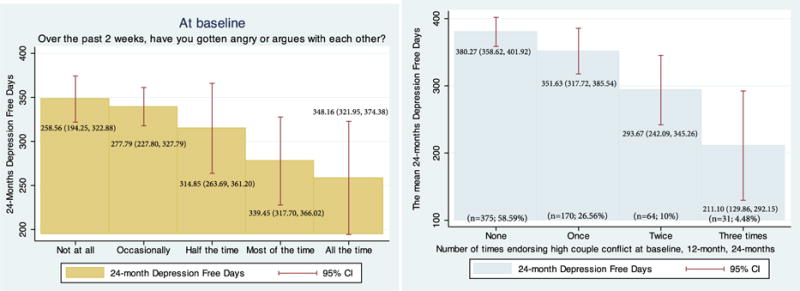
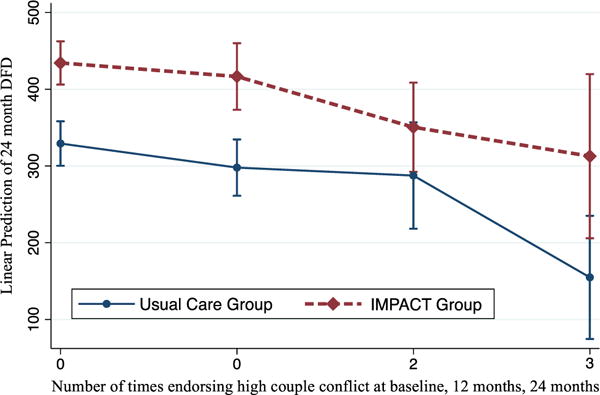
Results: Compared with those who never endorsed frequent couple conflict over the three observation points, those who did twice had 63 fewer DFD (p = 0.01), and those who did three times experienced 148 fewer DFD (p < 0.001). Although the marginal effects of receiving IMPACT program over usual care was greater in overall sample, it was not statistically significant among those who endorsed frequent conflict at two or three times.
Conclusion: Frequent couple conflict is associated with worse long-term late-life depression outcomes among the patients in primary care clinics.
Keywords: IMPACT model; late-life depression; marital conflict.
Copyright © 2014 John Wiley & Sons, Ltd.
Conflict of interest statement
None declared.
Figures
References
-
- Murray C, Lopez A. Alternative projections of mortality by cause 1990–2020: global burden of disease study. Lancet. 1997;349:1498–1504. - PubMed
-
- Unützer J, Katon W, Callahan CM, et al. Collaborative care management of late-life depression in the primary care setting. JAMA. 2002;288(22):2836–2845. - PubMed
-
- Bruce M, Ten Have T, Reynolds C, Katz I, Schulberg H. Reducing suicidal ideation and depressive symptoms in depressed older primary care patients: a randomized controlled trial. JAMA. 2004;291(9):1081–1091. - PubMed
-
- Carstensen LL, Gottman JM, Levenson RW. Emotional behavior in long-term marriage. Psychol Aging. 1995;10(1):140–149. - PubMed
-
- Yalom M, Carstensen LL. Inside the American Couple: new Thinking, New Challenges. University of California Pr; Berkeley, CA: 2002.
MeSH terms
Grants and funding
LinkOut - more resources
Full Text Sources
Other Literature Sources
