


Diffusion-weighted MRI for staging and evaluation of response in diffuse large B-cell lymphoma: a pilot study
- PMID: 24700565
- PMCID: PMC4026031
- DOI: 10.1002/nbm.3105
Diffusion-weighted MRI for staging and evaluation of response in diffuse large B-cell lymphoma: a pilot study
Abstract
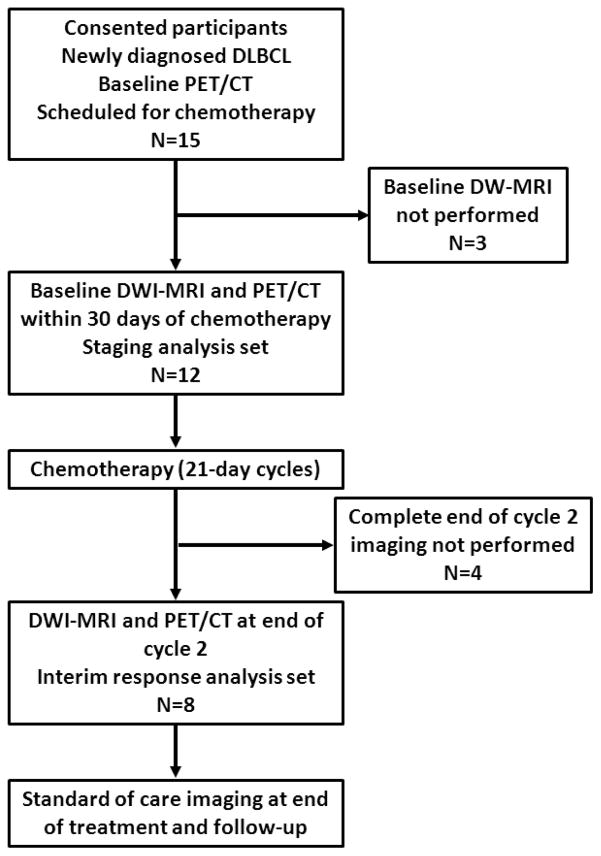
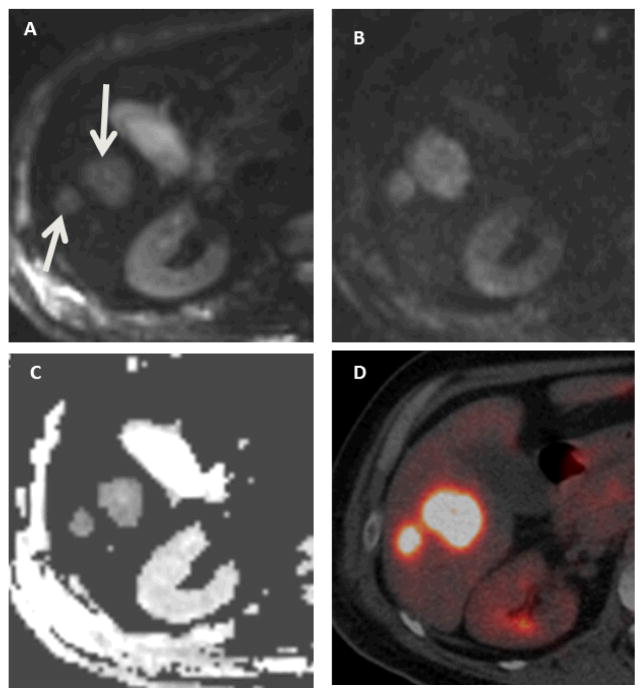
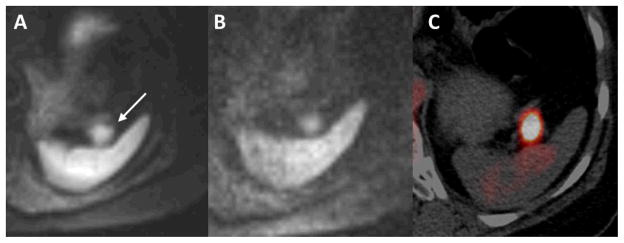
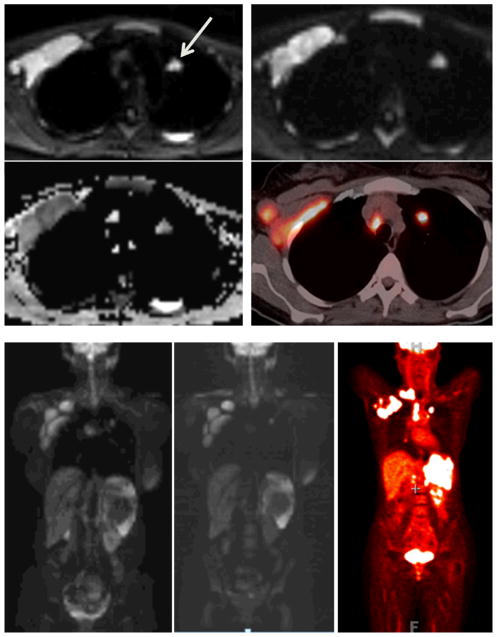
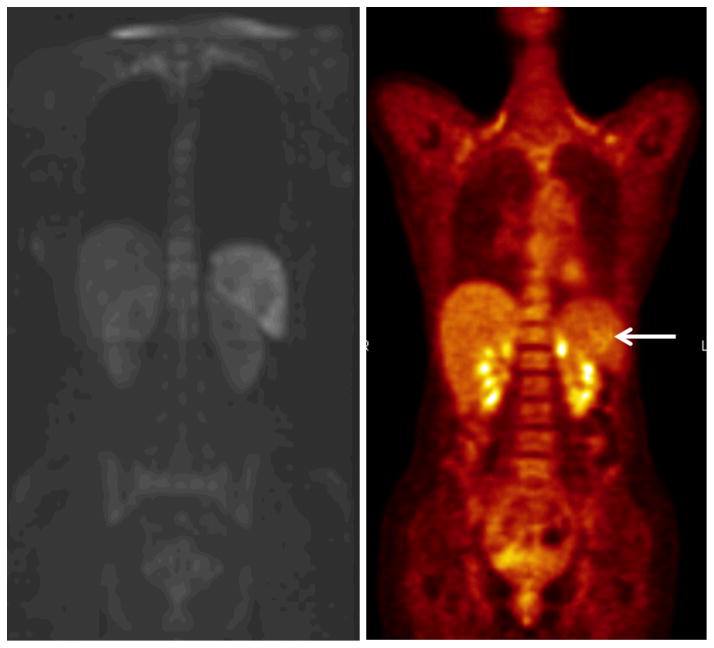
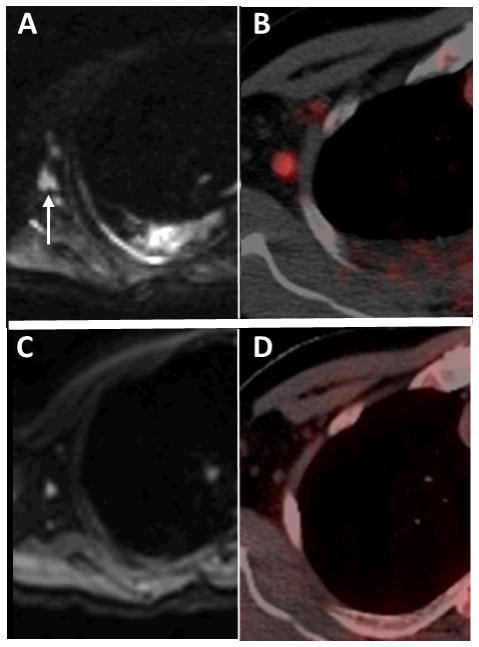
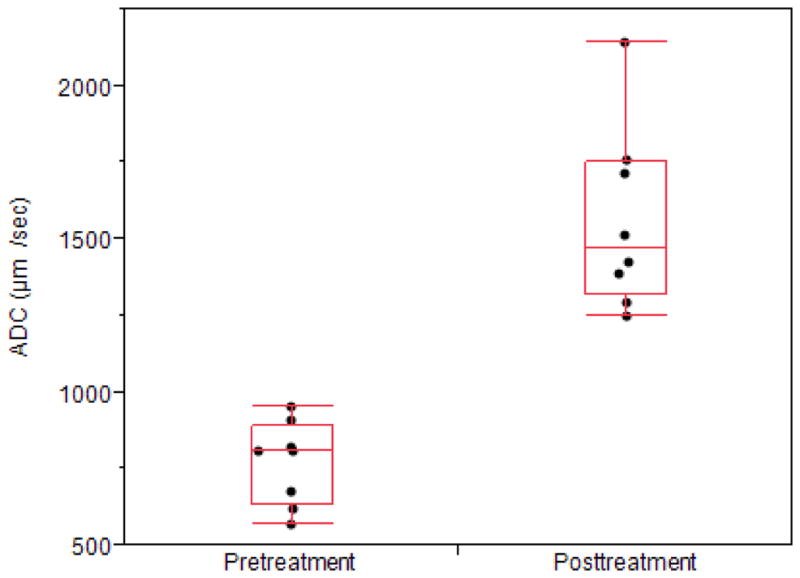
The aim of this study was to compare diffusion-weighted MRI (DW-MRI) with positron emission tomography/computed tomography (PET/CT) for the staging and evaluation of the treatment response in patients with diffuse large B-cell lymphoma (DLBCL). Institutional review board approval was obtained for this study; all subjects gave informed consent. Twelve patients were imaged before treatment and eight of these were also imaged after two cycles of chemotherapy using both DW-MRI and PET/CT. Up to six target lesions were selected at baseline for response assessment based on International Working Group criteria (nodes > 1.5 cm in diameter; extranodal lesions > 1 cm in diameter). For pretreatment staging, visual analysis of the numbers of nodal and extranodal lesions based on PET/CT was performed. For interim response assessment after cycle 2 of chemotherapy, residual tumor sites were assessed visually and the percentage changes in target lesion size, maximum standardized uptake value (SUVmax ) and apparent diffusion coefficient (ADC) from pretreatment values were calculated. In 12 patients studied pretreatment, there were 46 nodal and 16 extranodal sites of lymphomatous involvement. Agreement between DW-MRI and PET/CT for overall lesion detection was 97% (60/62 tumor sites; 44/46 nodal and 16/16 extranodal lesions) and, for Ann Arbor stage, it was 100%. In the eight patients who had interim assessment, five of their 49 tumor sites remained abnormal on visual analysis of both DW-MRI and PET/CT, and there was one false positive on DW-MRI. Of their 24 target lesions, the mean pretreatment ADC value, tumor size and SUVmax were 772 µm(2) /s, 21.3 cm(2) and 16.9 g/mL, respectively. At interim assessment of the same 24 target lesions, ADC values increased by 85%, tumor size decreased by 74% and SUVmax decreased by 83% (all p < 0.01 versus baseline). DW-MRI provides results comparable with those of PET/CT for staging and early response assessment in patients with DLBCL.
Keywords: apparent diffusion coefficient; diffuse large B-cell lymphoma; diffusion-weighted MRI; positron emission tomography/computed tomography (PET/CT); response to chemotherapy; standardized uptake value.
Copyright © 2014 John Wiley & Sons, Ltd.
Figures
References
-
- Jemal A, Siegel R, Ward E, Murray T, Xu J, Thun MJ. Cancer statistics, 2007. CA Cancer J Clin. 2007;57:43–66. - PubMed
-
- Juweid ME, Cheson BD. Role of positron emission tomography in lymphoma. J Clin Oncol. 2005;23:4577–4580. - PubMed
-
- Juweid ME, Cheson BD. Positron-emission tomography and assessment of cancer therapy. N Engl J Med. 2006;254:496–507. - PubMed
-
- Kwee TC, Kwee RM, Nievelstein RA. Imaging in staging of malignant lymphoma: a systematic review. Blood. 2008;111:504–516. - PubMed
-
- Shankar LK, Hoffman JM, Bacharach S, Graham MM, Karp J, Lammertsma A, Larson S, Mankoff DA, Siegel BA, Van den Abeele A, Yap J, Sullivan D. Consensus recommendations for the use of 18F-FDG PET as an indicator of therapeutic response in patients in National Cancer Institute trials. J Nucl Med. 2006;47:1059–1066. - PubMed
Publication types
MeSH terms
Grants and funding
LinkOut - more resources
Full Text Sources
Other Literature Sources
