. 2014 Aug;115(8):1412-9.
doi: 10.1002/jcb.24792.

Effect of age on regulation of human osteoclast differentiation

Affiliations

Effect of age on regulation of human osteoclast differentiation

Ping-Lin Chung et al. J Cell Biochem. 2014 Aug.

Abstract

Human skeletal aging is characterized as a gradual loss of bone mass due to an excess of bone resorption not balanced by new bone formation. Using human marrow cells, we tested the hypothesis that there is an age-dependent increase in osteoclastogenesis due to intrinsic changes in regulatory factors [macrophage-colony stimulating factor (M-CSF), receptor activator of NF-κB ligand (RANKL), and osteoprotegerin (OPG)] and their receptors [c-fms and RANK]. In bone marrow cells (BMCs), c-fms (r = 0.61, P = 0.006) and RANK expression (r = 0.59, P = 0.008) were increased with age (27-82 years, n = 19). In vitro generation of osteoclasts was increased with age (r = 0.89, P = 0.007). In enriched marrow stromal cells (MSCs), constitutive expression of RANKL was increased with age (r = 0.41, P = 0.049) and expression of OPG was inversely correlated with age (r = -0.43, P = 0.039). Accordingly, there was an age-related increase in RANKL/OPG (r = 0.56, P = 0.005). These data indicate an age-related increase in human osteoclastogenesis that is associated with an intrinsic increase in expression of c-fms and RANK in osteoclast progenitors, and, in the supporting MSCs, an increase in pro-osteoclastogenic RANKL expression and a decrease in anti-osteoclastogenic OPG. These findings support the hypothesis that human marrow cells and their products can contribute to skeletal aging by increasing the generation of bone-resorbing osteoclasts. These findings help to explain underlying molecular mechanisms of progressive bone loss with advancing age in humans.

Keywords: AGING; MARROW STROMAL CELL; OPG; OSTEOCLAST; RANKL.


Figures

Fig. 1
Fig. 1
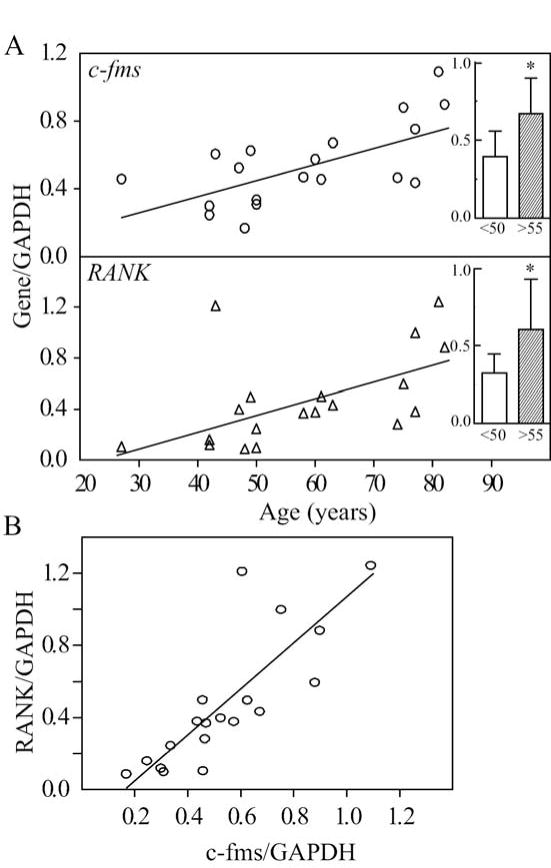
Effects of subject age on constitutive expression of c-fms and RANK in low-density mononuclear bone marrow cells (BMCs) isolated from 19 subjects (age range, 27 to 82 years). (A) There were age-dependent increases in expression of c-fms (Spearman r=0.61, p=0.006) and RANK (r=0.59, p=0.008) in BMCs. Expression of c-fms and RANK was 1.7-fold (*p=0.017) and 1.9-fold (*p=0.028) higher, respectively, in BMCs from the older subjects (inset, shaded bars, >55 years, n=10) than for the younger subjects (open bars, <50 years, n=9). (B) There was a correlation between RANK and c-fms gene expression (r=0.85, p<0.0001).
Fig. 2
Fig. 2
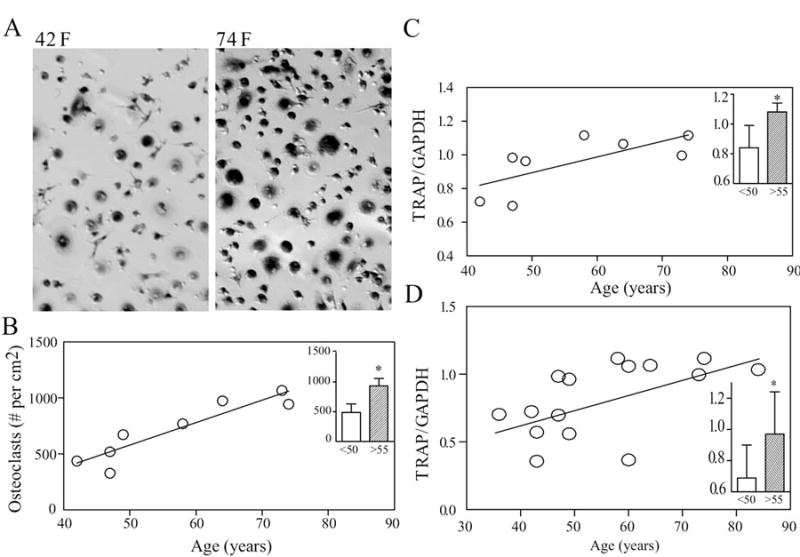
Effect of subject age on in vitro osteoclastogenesis in cultures of BMCs after 14 days. (A) Photomicrographs show TRAP-positive multinucleated cells in BMC cultures from a 74-year-old female subject (right), compared with a 42-year-old female subject (left). (B) The number of generated osteoclasts was positively correlated with age of subject (r=0.89, p=0.007, n=8). The number of osteoclasts was 1.9-fold (p=0.029) higher in BMC cultures from the older subjects (inset, shaded bar, n=4) than for the younger subjects (open bar, n=4). (C) Expression of TRAP in a series of samples was correlated with age (r=0.75, p=0.037, n=8). TRAP gene expression was 1.3-fold (p=0.029) higher in BMC cultures from the older subjects (inset, shaded bar, n=4) than for the younger subjects (open bar, n=4). (D) For a series of 15 different samples, TRAP mRNA was correlated with the age of subjects (r=0.60, p=0.019). TRAP gene expression was 1.4-fold (p=0.014) higher in older subjects (inset, shaded bar, n=8) than for the younger subjects (inset, open bar, n=7).
Fig. 3
Fig. 3
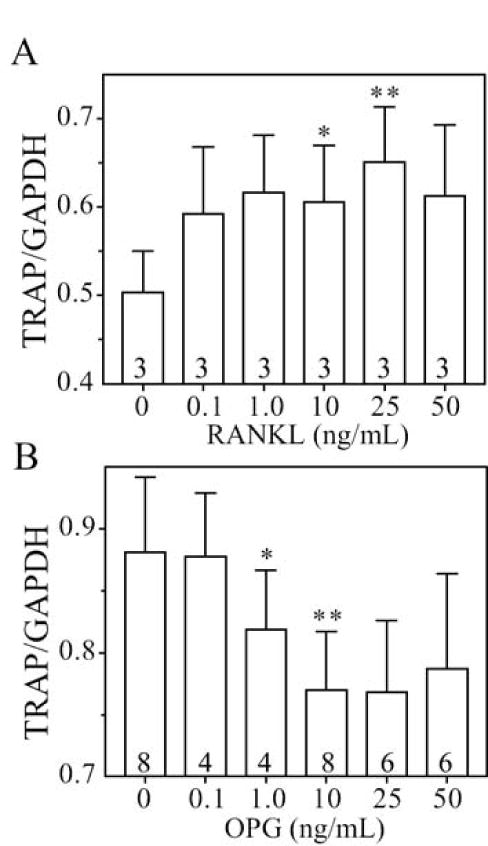
Effects of exogenous factors on osteoclast differentiation in BMC cultures from young or old subjects. (A) Recombinant human RANKL stimulated osteoclast differentiation in BMC cultures from 3 subjects younger than 50 years. Bars represent the mean values ± S.D. *p=0.044; **p=0.041 (B) Recombinant human OPG inhibited osteoclast differentiation in BMC cultures from 4 to 8 subjects older than 55 years. Bars represent the mean values of 4-8 specimens. *p=0.035; **p=0.004
Fig. 4
Fig. 4
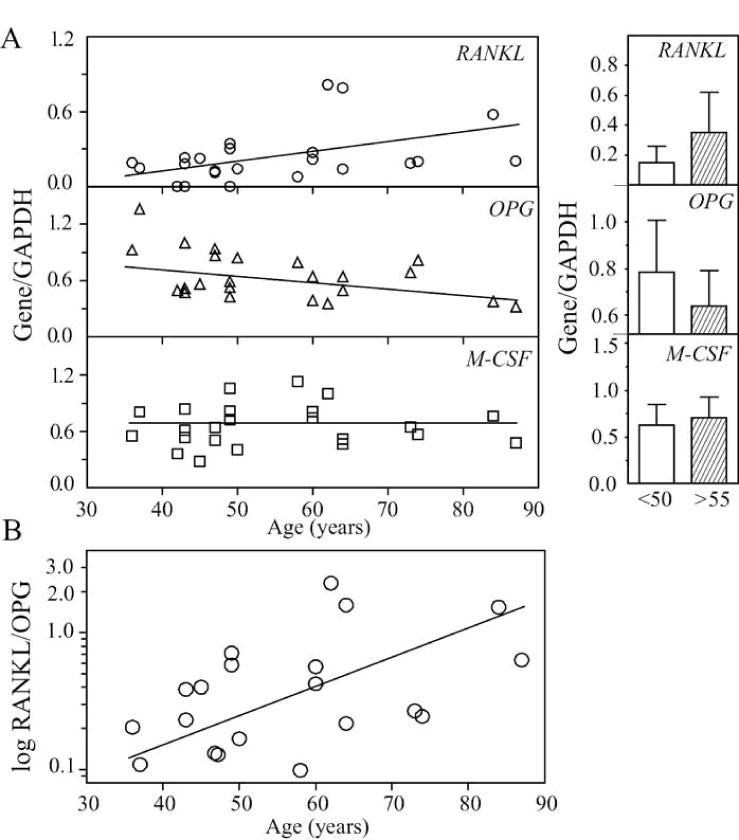
Effects of subject age on constitutive expression of osteoclast differentiation factors in hMSCs. (A) With the age of subjects (n=23), there was a positive correlation for RANKL expression (r=0.41, p=0.049) and an inverse correlation for OPG (r=-0.43, p=0.039). There was a trend of 2.3-fold (p=0.072) higher expression of RANKL in hMSCs from the older subjects (shaded bar, n=10) than for the younger subjects (open bar, n=13) and a trend of 1.4-fold (p=0.088) higher expression of OPG in hMSCs from the younger subjects (open bar, n=13) than that for the older subjects (shaded bar, n=10). M-CSF expression did not appear to vary with age. (B) The ratio of RANKL/OPG was significantly correlated with the age of subject (r=0.56, p=0.005).

References

    1. Abdallah BM, Stilgren LS, Nissen N, Kassem M, Jørgensen HR, Abrahamsen B. Increased RANKL/OPG mRNA ratio in iliac bone biopsies from women with hip fractures. Calcif Tissue Int. 2005;76:90–97. - PubMed
    1. Almeida M, Han L, Martin-Millan M, Plotkin LI, Stewart SA, Roberson PK, Kousteni S, O'Brien CA, Bellido T, Parfitt AM, Weinstein RS, Jilka RL, Manolagas SC. Skeletal involution by age-associated oxidative stress and its acceleration by loss of sex steroids. J Biol Chem. 2007;282:27285–97. - PMC - PubMed
    1. Arai F, Miyamoto T, Ohneda O, Inada T, Sudo T, Brasel K, Miyata T, Anderson DM, Suda T. Commitment and differentiation of osteoclast precursor cells by the sequential expression of c-Fms and receptor activator of nuclear factor kappaB (RANK) receptors. J Exp Med. 1999;190:1741–1754. - PMC - PubMed
    1. Atkins GJ, Haynes DR, Graves SE, Evdokiou A, Hay S, Bouralexis S, Findlay DM. Expression of osteoclast differentiation signals by stromal elements of giant cell tumors. J Bone Miner Res. 2000;15:640–649. - PubMed
    1. Bellantuono I, Aldahmash A, Kassem M. Aging of marrow stromal (skeletal) stem cells and their contribution to age-related bone loss. Biochim Biophys Acta. 2009;1792:364–370. - PubMed

Publication types

MeSH terms

Substances