


Relative contribution of haptic technology to assessment and training in implantology
- PMID: 24701577
- PMCID: PMC3950590
- DOI: 10.1155/2014/413951
Relative contribution of haptic technology to assessment and training in implantology
Abstract
Background: The teaching of implant surgery, as in other medical disciplines, is currently undergoing a particular evolution.
Aim of the study: To assess the usefulness of haptic device, a simulator for learning and training to accomplish basic acts in implant surgery.
Materials and methods: A total of 60 people including 40 third-year dental students without knowledge in implantology (divided into 2 groups: 20 beginners and 20 experiencing a simulator training course) and 20 experienced practitioners (experience in implantology >15 implants) participated in this study. A basic exercise drill was proposed to the three groups to assess their gestural abilities.
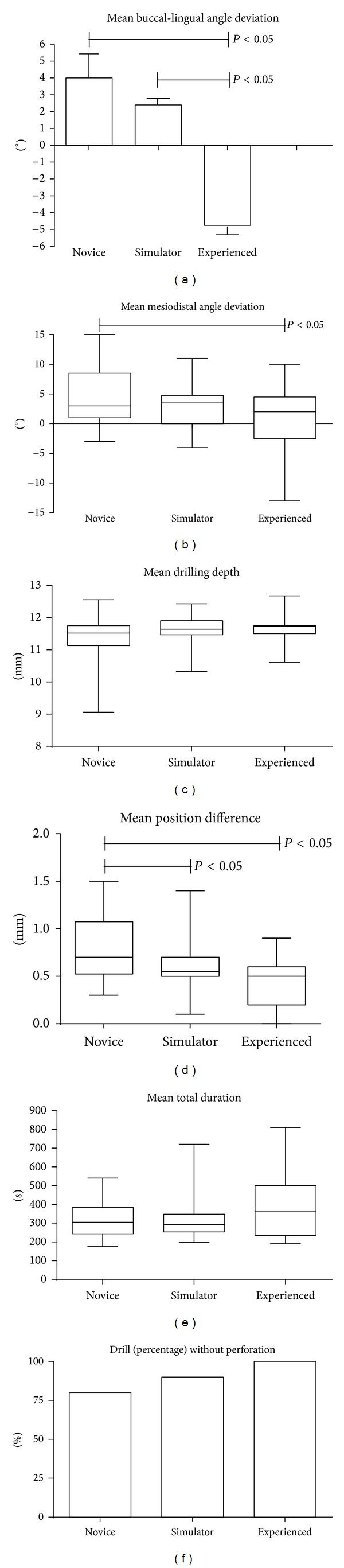
Results: The results of the group training with the simulator tended to be significantly close to those of the experienced operators.
Conclusion: Haptic simulator brings a real benefit in training for implant surgery. Long-term benefit and more complex exercises should be evaluated.
Figures
References
-
- Gallagher AG, Lederman AB, McGlade K, Satava RM, Smith CD. Discriminative validity of the minimally-invasive surgical trainer in virtual reality (MIST-VR) using criteria levels based on expert performance. Surgical Endoscopy. 2004;18(4):660–665. - PubMed
-
- Gallagher AG, Richie K, McClure N, McGuigan J. Objective psychomotor skills assessment of experienced, junior, and novice laparoscopists with virtual reality. World Journal of Surgery. 2001;25(11):1478–1483. - PubMed
-
- Gallagher K, Stephenson J, Brown RW, Holmes C, Ballester P. Exploiting 3D spatial sampling in inverse modeling of thermochronological data. Reviews in Mineralogy and Geochemistry. 2005;58(1):375–387.
-
- Okuda Y, Bryson EO, DeMaria S, Jr., et al. The utility of simulation in medical education: what is the evidence? Mount Sinai Journal of Medicine. 2009;76(4):330–343. - PubMed
Publication types
MeSH terms
LinkOut - more resources
Full Text Sources
Other Literature Sources
Research Materials
