


Radiofrequency ablation of T1 lung carcinoma: comparison of outcomes for first primary, metachronous, and synchronous lung tumors
- PMID: 24703321
- PMCID: PMC9382850
- DOI: 10.1016/j.jvir.2014.02.021
Radiofrequency ablation of T1 lung carcinoma: comparison of outcomes for first primary, metachronous, and synchronous lung tumors
Abstract
Purpose: To report and compare outcomes after radiofrequency ablation for treatment-naïve first primary, metachronous, and synchronous T1 lung tumors.
Materials and methods: This institutional review board-approved retrospective study reviewed 29 patients (12 men and 17 women; median age, 73 y; age range, 55-86 y) with treatment-naïve T1 lung tumors treated with radiofrequency ablation. Tumors in the 29 patients included 21 T1a and 8 T1b first primary (n = 11), metachronous (n = 14), or synchronous (n = 4) tumors (adenocarcinoma, n = 25; squamous cell carcinoma, n = 3; unspecified, n = 1). Median tumor diameter was 14 mm (range, 10-26 mm). Surveillance computed tomography or positron emission tomography-computed tomography was performed over a median period of 28 months (range, 12-83 mo). Technical success and effectiveness rates and overall and progression-free 1-year, 3-year, and 5-year survivals were calculated according to stage, first primary, metachronous, and synchronous tumor status.
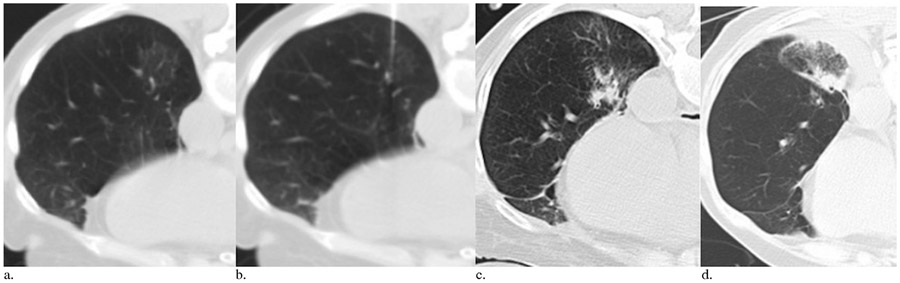
Results: Technical success and effectiveness was 97%. Local control occurred in 17 of 21 T1a tumors (81%) and 5 of 8 T1b tumors (62.5%). The local progression rate of first primary tumors (5 of 11; 45%) was higher than that of metachronous (2 of 14; 14%; P = .07) and synchronous (0 of 4; P = .01) tumors. Estimated 1-year, 3-year, and 5-year local tumor progression-free survival was 79%, 75%, and 75%. Estimated 1-year, 3-year, and 5-year overall survival was 100%, 60%, and 14%. Survival outcomes were similar for patients with first primary, metachronous, or synchronous tumors.
Conclusions: Radiofrequency ablation results in good local control and progression-free survival in patients with treatment-naïve T1 lung tumors, including patients with metachronous and synchronous tumors.
Copyright © 2014 SIR. Published by Elsevier Inc. All rights reserved.
Conflict of interest statement
None of the authors have identified a conflict of interest.
Figures


References
-
- Donington J, Ferguson M, Mazzone P, et al. Thoracic Oncology Network of American College of Chest Physicians; Workforce on Evidence-Based Surgery of Society of Thoracic Surgeons. American College of Chest Physicians and Society of Thoracic Surgeons consensus statement for evaluation and management for high-risk patients with stage I non-small cell lung cancer. Chest 2012; 142:1620–1635. - PubMed
-
- Keenan RJ, Landreneau RJ, Maley RH Jr, et al. Segmental resection spares pulmonary function in patients with stage I lung cancer. Ann Thorac Surg 2004; 78:228–233. - PubMed
-
- Howlader N, Noone AM, Krapcho M, et al. (eds). SEER Cancer Statistics Review, 1975-2010. National Cancer Institute. Available at: http://seer.cancer.gov/csr/1975_2010/. Based on November 2012 SEER data sub-mission, posted to the SEER web site April 2013.
-
- Detterbeck FC, Lewis SZ, Diekemper R, Addrizzo-Harris D, Alberts WM. Executive Summary: Diagnosis and management of lung cancer, 3rd edition: American College of Chest Physicians evidence-based clinical practice guidelines. Chest 2013; 143:7S–37S. - PubMed
-
- Johnson BE, Cortazar P, Chute JP. Second lung cancers in patients successfully treated for lung cancer. Semin Oncol 1997; 24:492–499. - PubMed
Publication types
MeSH terms
Grants and funding
LinkOut - more resources
Full Text Sources
Other Literature Sources
Medical
