Review
. 2014 Apr;25(100):111-7.
doi: 10.1016/j.sbi.2013.11.001. Epub 2014 Apr 1.

Building a secreting nanomachine: a structural overview of the T3SS

Affiliations
Review

Building a secreting nanomachine: a structural overview of the T3SS

Patrizia Abrusci et al. Curr Opin Struct Biol. 2014 Apr.

Abstract

To fulfill complex biological tasks, such as locomotion and protein translocation, bacteria assemble macromolecular nanomachines. One such nanodevice, the type III secretion system (T3SS), has evolved to provide a means of transporting proteins from the bacterial cytoplasm across the periplasmic and extracellular spaces. T3SS can be broadly classified into two highly homologous families: the flagellar T3SS which drive cell motility, and the non-flagellar T3SS (NF-T3SS) that inject effector proteins into eukaryotic host cells, a trait frequently associated with virulence. Although the structures and symmetries of ancillary components of the T3SS have diversified to match requirements of different species adapted to different niches, recent genetic, molecular and structural studies demonstrate that these systems are built by arranging homologous modular protein assemblies.


Figures

None
Graphical abstract
Figure 1
Figure 1
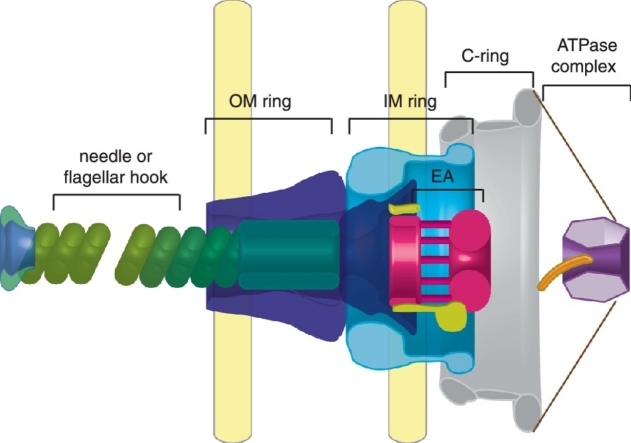
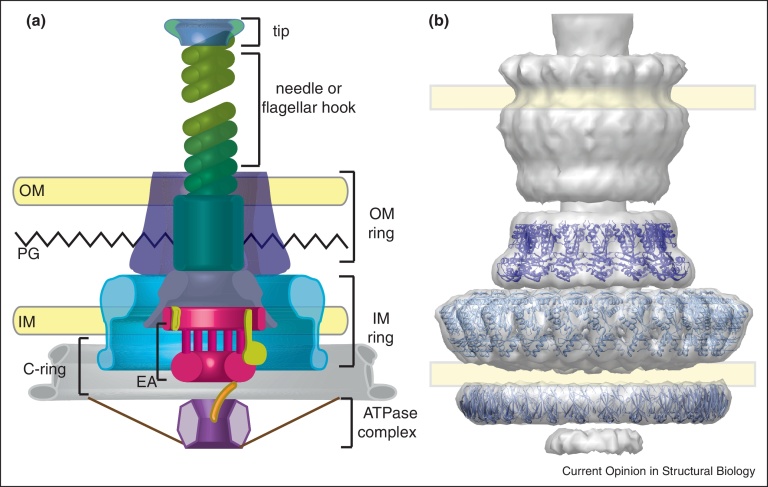
General architecture of the T3SS. (a) The cartoon schematizes the major subassemblies of the T3SS, showing their relative localization with respect to the outer membrane (OM), the peptidoglycan layer (PG) and the inner membrane (IM). (b) Surface view of the T3SS (C3) from Salmonella typhimurium (EMDB-1875; [22••]) with fitted atomic models [31] of SctC (PDB-3j1v), SctD-N (PDB-3j1w), SctD-C (PDB-3j1x).
Figure 2
Figure 2
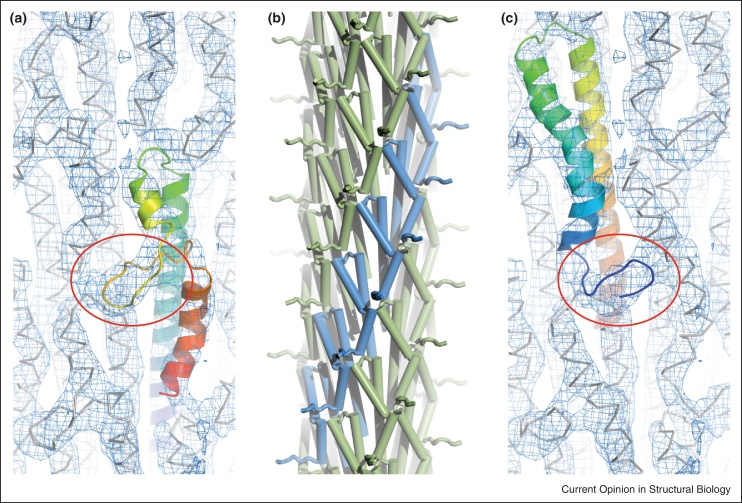
Alternate models for the helical needle assembly. (a) The high resolution EM map (EMDB-5352) and C-terminal out subunit fitting for the Shigella flexneri needle (PDB-3j0r; [15]). (b) A cartoon representation of the Salmonella enterica needle with N-terminal out subunit built using Rosetta by Loquet et al. (PDB-2lpz; [16••]). (c) Trivial remodeling of the flexible N-terminus of the Loquet et al. [16••] subunit position demonstrates a good fit of this independently derived needle model to the Fuji et al. EM map. The circled density in (a) and (c) highlights the alternate interpretations of this region by either an unwound piece of the C-terminal helix [15] or the flexible N-terminus (this work).
Figure 3
Figure 3
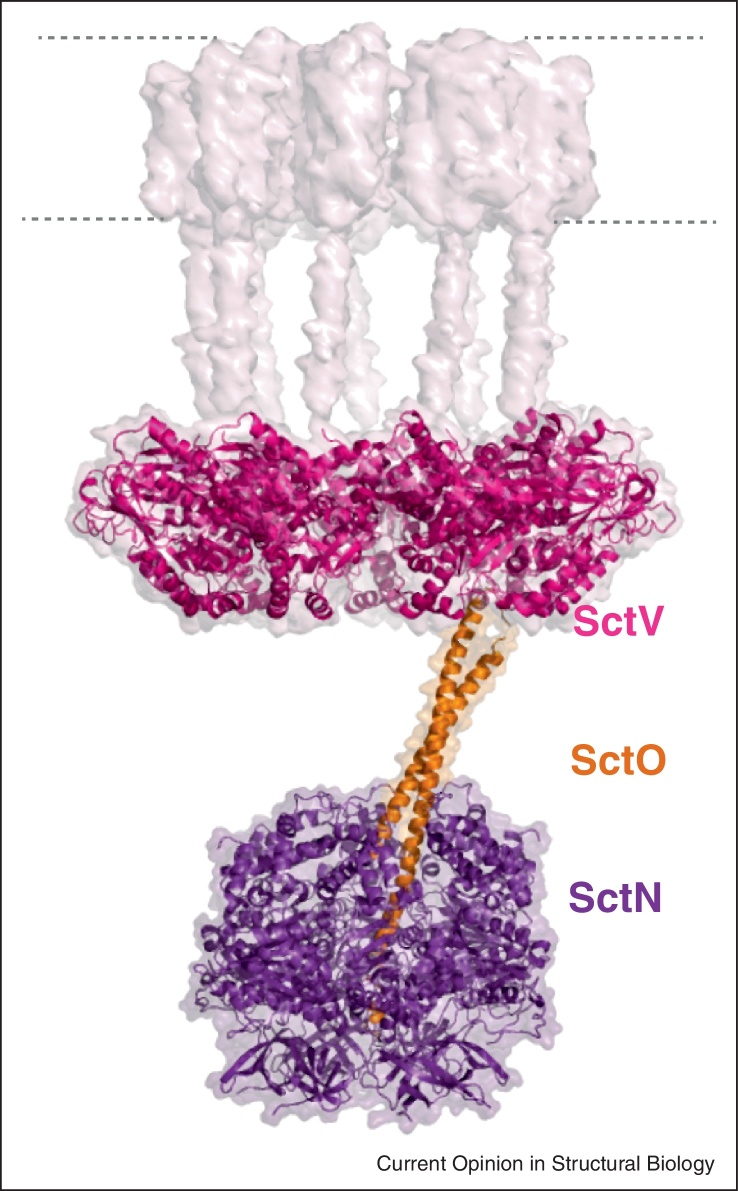
Geometry of the export machinery. The export machinery as built by Abrusci et al. [23••]. The SctV nonameric cage is represented as surface in light pink with fitted atomic model of the Shigella flexneri SctV-C (PDB-4a5p), in magenta. ATPase and its stalk are modeled using the atomic model form the Escherichia coli SctN (PDB-2obm) and the flagellar homologue of SctO form Salmonella typhimurium (PDB-3ajw) and colored in purple and orange, respectively.

References

    1. Abby S.S., Rocha E.P. The non-flagellar type III secretion system evolved from the bacterial flagellum and diversified into host-cell adapted systems. PLoS Genet. 2012;8:e1002983. - PMC - PubMed
    1. Buttner D. Protein export according to schedule: architecture, assembly, and regulation of type III secretion systems from plant- and animal-pathogenic bacteria. Microbiol Mol Biol Rev. 2012;76:262–310. - PMC - PubMed
    1. Erhardt M., Namba K., Hughes K.T. Bacterial nanomachines: the flagellum and type III injectisome. Cold Spring Harb Perspect Biol. 2010;2:a000299. - PMC - PubMed
    1. Hueck C.J. Type III protein secretion systems in bacterial pathogens of animals and plants. Microbiol Mol Biol Rev. 1998;62:379–433. - PMC - PubMed
    1. Blocker A.J., Deane J.E., Veenendaal A.K., Roversi P., Hodgkinson J.L., Johnson S., Lea S.M. What's the point of the type III secretion system needle? Proc Natl Acad Sci U S A. 2008;105:6507–6513. - PMC - PubMed

Publication types

MeSH terms

Substances

LinkOut - more resources