. 2012 Jul 23;3(3):444-60.
doi: 10.3390/genes3030444.

Microsatellites with macro-influence in ewing sarcoma

Affiliations

Microsatellites with macro-influence in ewing sarcoma

Michael J Monument et al. Genes (Basel). .

Abstract

Numerous molecular abnormalities contribute to the genetic derangements involved in tumorigenesis. Chromosomal translocations are a frequent source of these derangements, producing unique fusion proteins with novel oncogenic properties. EWS/ETS fusions in Ewing sarcoma are a prime example of this, resulting in potent chimeric oncoproteins with novel biological properties and a unique transcriptional signature essential for oncogenesis. Recent evidence demonstrates that EWS/FLI, the most common EWS/ETS fusion in Ewing sarcoma, upregulates gene expression using a GGAA microsatellite response element dispersed throughout the human genome. These GGAA microsatellites function as enhancer elements, are sites of epigenetic regulation and are necessary for EWS/FLI DNA binding and upregulation of principal oncogenic targets. An increasing number of GGAA motifs appear to substantially enhance EWS/FLI-mediated gene expression, which has compelling biological implications as these GGAA microsatellites are highly polymorphic within and between ethnically distinct populations. Historically regarded as junk DNA, this emerging evidence clearly demonstrates that microsatellite DNA plays an instrumental role in EWS/FLI-mediated transcriptional regulation and oncogenesis in Ewing sarcoma. This unprecedented role of GGAA microsatellite DNA in Ewing sarcoma provides a unique opportunity to expand our mechanistic understanding of how EWS/ETS fusions influence cancer susceptibility, prognosis and transcriptional regulation.


Figures
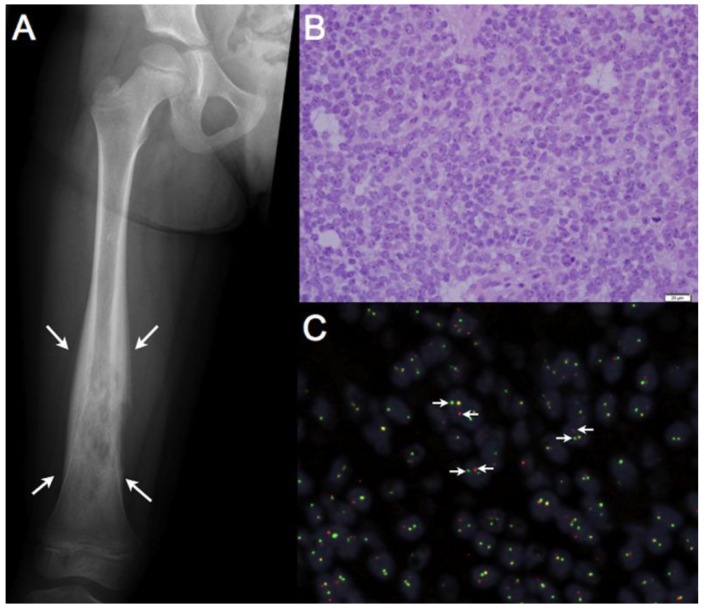
Figure 1
Figure 1
Ewing sarcoma is an aggressive bone associated malignancy characterized by chromosomal translocations. (a) Classic radiographic appearance of Ewing sarcoma: an expansile, destructive lesion (outlined by white arrows) of the femoral diaphysis (shaft) in a skeletally immature patient. Ewing sarcomas can also present as an isolated soft tissue mass, although this is less common; (b) 400× magnification of a Hematoxylin and Eosin (H & E) stained section from a Ewing sarcoma tumor. Microscopically, these tumors are characterized by sheets of small round cells with a high nuclear-to cytoplasmic ratio; (c) Break-apart Fluorescence in situ Hybridization (FISH) showing EWSR1 rearrangements in 84% of tumors cells, confirming the diagnosis of Ewing sarcoma. Dual, non-overlapping, 5’-EWSR1 probes (red) and 3’-EWSR1 probes (green) detect the presence of a chromosomal rearrangement; when the red and green probes are split into two distinct signals (white arrows) a chromosomal rearrangement is identified, whereas an orange signal indicates an intact EWSR1 locus.
Figure 2
Figure 2
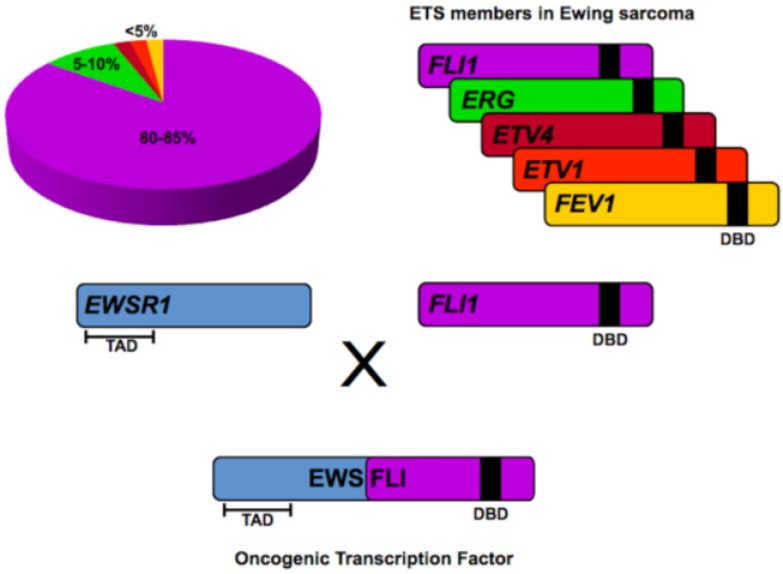
EWS/ETS fusions in Ewing sarcoma. EWS/FLI fusions comprise 80–85% of all translocations in Ewing sarcoma. Translocations involving other ETS family members such as ERG, ETV4, ETV1 and FEV1 are less common. In all instances, the transcriptional activating domain (TAD) in the N-terminus of EWS is fused to the C-terminal DNA binding domain (DBD) of the ETS family member. The resultant chimeric fusion protein functions as a potent oncogenic transcription factor responsible for tumorigenesis in Ewing sarcoma.
Figure 3
Figure 3
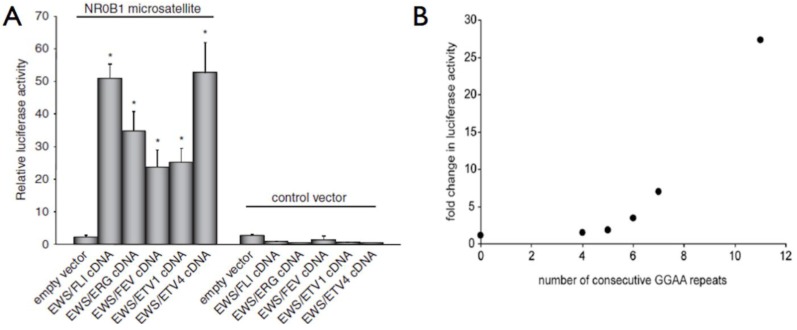
EWS/ETS fusion proteins bind DNA and regulate gene expression via a GGAA microsatellite response element. (a) In luciferase reporter constructs, all five EWS/ETS fusions can activate gene expression via the 102 bp NR0B1 microsatellite; (b) Using similar reporter constructs, an increasing number of GGAA motifs, beyond a threshold of four, results in increased gene expression. Panel A reproduced with permission from Gangwal et al., Genes Cancer. 2010 February 1; 1(2):177–187 [30].
Figure 4
Figure 4
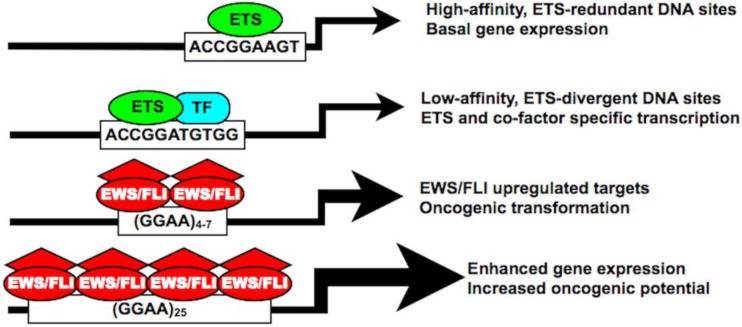
The EWS/FLI chimera possesses unique DNA binding affinities and biological properties distinct from native ETS family members. Both high- and low-affinity ETS DNA binding sites are characterized by a core ACCGGAA/T consensus sequence facilitating both ETS-redundant and ETS-divergent transcriptional regulation. In Ewing sarcoma, EWS/FLI also binds the traditional ETS-consensus sequence, but shows increased preferencefor a GGAA-containing microsatellite. In certain upregulated targets, this GGAA microsatellite response element is required for DNA binding and gene activation, which proportionately increases with an increasing number of GGAA motifs. “TF” = transcription factor.

References

    1. Helman L.J., Meltzer P. Mechanisms of sarcoma development. Nat. Rev. Cancer. 2003;3:685–694. doi: 10.1038/nrc1168. - DOI - PubMed
    1. Martens J.H., Stunnenberg H.G. The molecular signature of oncofusion proteins in acute myeloid leukemia. FEBS Lett. 2010;584:2662–2669. - PubMed
    1. Maheshwari A.V., Cheng E.Y. Ewing sarcoma family of tumors. J. Am. Acad. Orthop. Surg. 2010;18:94–107. - PubMed
    1. Balamuth N.J., Womer R.B. Ewing’s sarcoma. Lancet Oncol. 2010;11:184–192. doi: 10.1016/S1470-2045(09)70286-4. - DOI - PubMed
    1. Grier H.E., Krailo M.D., Tarbell N.J., Link M.P., Fryer C.J., Pritchard D.J., Gebhardt M.C., Dickman P.S., Perlman E.J., Meyers P.A., et al. Addition of ifosfamide and etoposide to standard chemotherapy for ewing’s sarcoma and primitive neuroectodermal tumor of bone. N. Engl. J. Med. 2003;348:694–701. - PubMed