


Reproducibility of creatine kinase reaction kinetics in human heart: a (31) P time-dependent saturation transfer spectroscopy study
- PMID: 24706347
- PMCID: PMC4106821
- DOI: 10.1002/nbm.3103
Reproducibility of creatine kinase reaction kinetics in human heart: a (31) P time-dependent saturation transfer spectroscopy study
Abstract
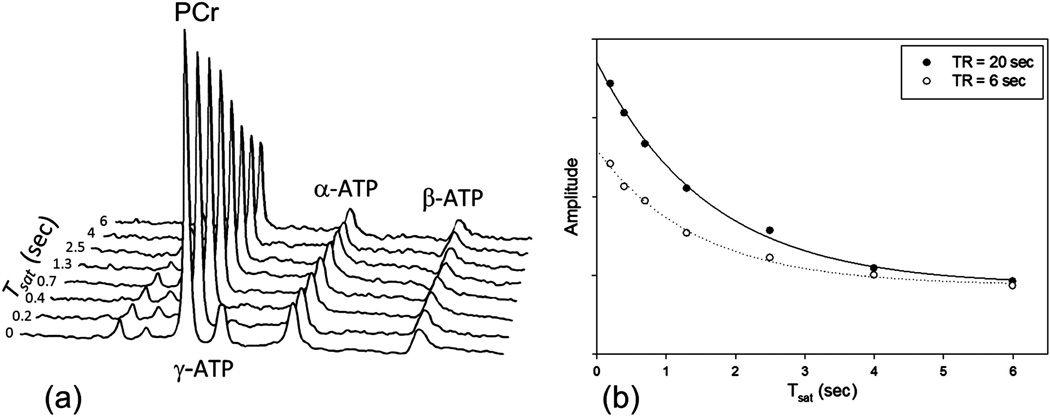
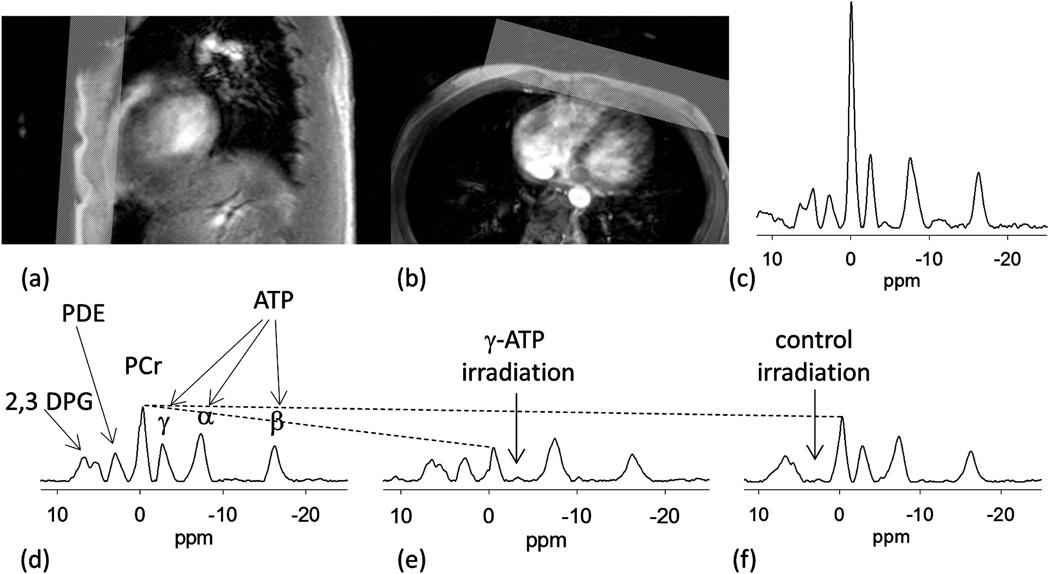
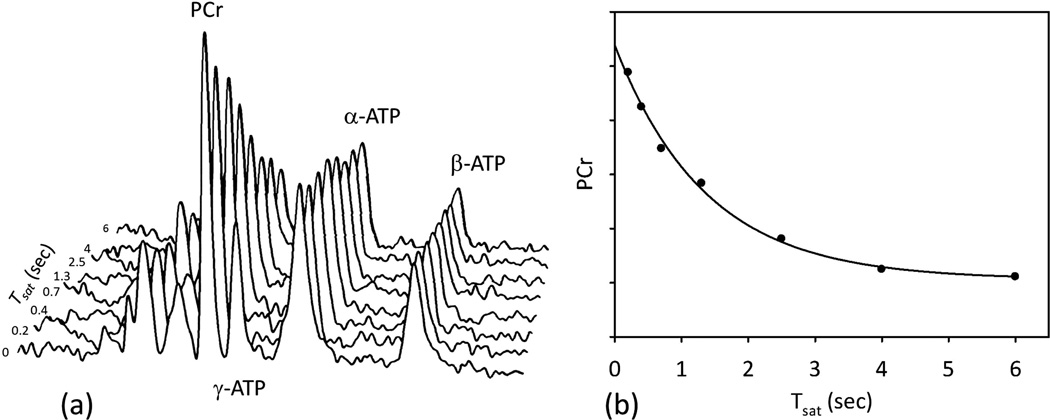
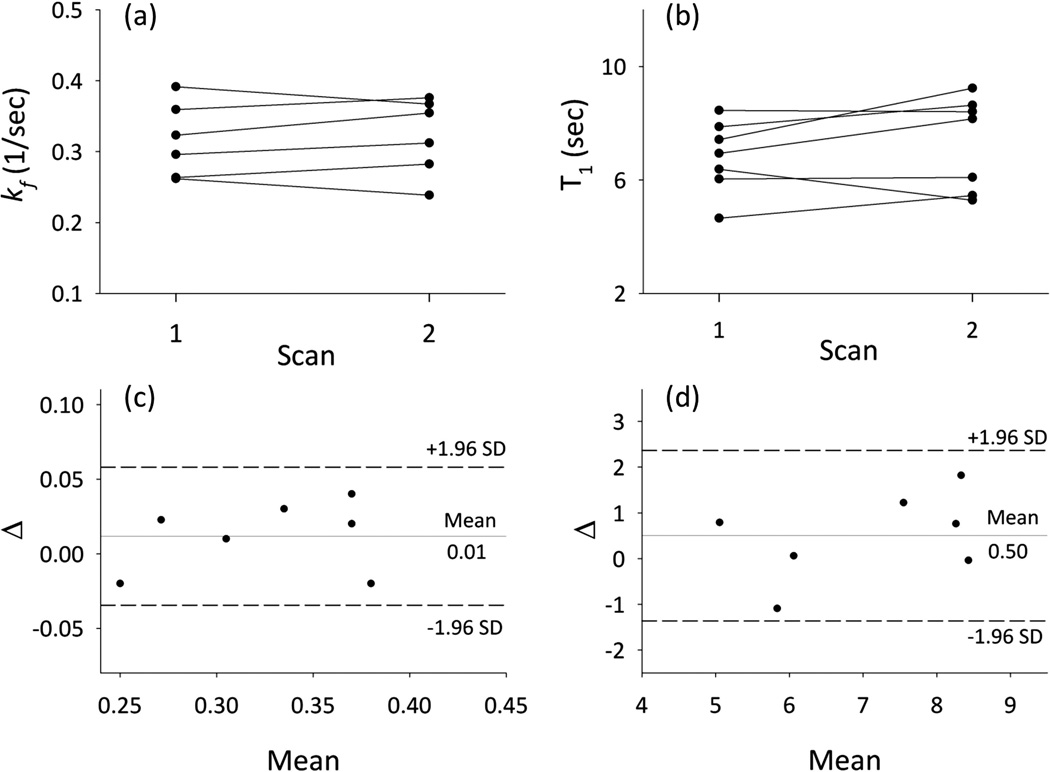
Creatine kinase (CK) is essential for the buffering and rapid regeneration of adenosine triphosphate (ATP) in heart tissue. Herein, we demonstrate a (31) P MRS protocol to quantify CK reaction kinetics in human myocardium at 3 T. Furthermore, we sought to quantify the test-retest reliability of the measured metabolic parameters. The method localizes the (31) P signal from the heart using modified one-dimensional image-selected in vivo spectroscopy (ISIS), and a time-dependent saturation transfer (TDST) approach was used to measure CK reaction parameters. Fifteen healthy volunteers (22 measurements in total) were tested. The CK reaction rate constant (kf ) was 0.32 ± 0.05 s(-1) and the coefficient of variation (CV) was 15.62%. The intrinsic T1 for phosphocreatine (PCr) was 7.36 ± 1.79 s with CV = 24.32%. These values are consistent with those reported previously. The PCr/ATP ratio was equal to 1.94 ± 0.15 with CV = 7.73%, which is within the range of healthy subjects. The reproducibility of the technique was tested in seven subjects and inferred parameters, such as kf and T1 , exhibited good reliability [intraclass correlation coefficient (ICC) of 0.90 and 0.79 for kf and T1 , respectively). The reproducibility data provided in this study will enable the calculation of the power and sample sizes required for clinical and research studies. The technique will allow for the examination of cardiac energy metabolism in clinical and research studies, providing insight into the relationship between energy deficit and functional deficiency in the heart.
Keywords: 31P MRS; adenosine triphosphate (ATP); creatine kinase; heart; image-selected in vivo spectroscopy (ISIS); reproducibility; saturation transfer; time-dependent saturation transfer (TDST).
Copyright © 2014 John Wiley & Sons, Ltd.
Figures
References
-
- Lipskaya TY. Mitochondrial creatine kinase: properties and function. Biochemistry (Mosc) 2001;66(10):1098–1111. - PubMed
-
- Nascimben L, Ingwall JS, Pauletto P, Friedrich J, Gwathmey JK, Saks V, Pessina AC, Allen PD. Creatine kinase system in failing and nonfailing human myocardium. Circulation. 1996;94(8):1894–1901. - PubMed
-
- De Sousa E, Veksler V, Minajeva A, Kaasik A, Mateo P, Mayoux E, Hoerter J, Bigard X, Serrurier B, Ventura-Clapier R. Subcellular creatine kinase alterations. Implications in heart failure. Circ Res. 1999;85(1):68–76. - PubMed
-
- Nascimben L, Friedrich J, Liao R, Pauletto P, Pessina AC, Ingwall JS. Enalapril treatment increases cardiac performance and energy reserve via the creatine kinase reaction in myocardium of Syrian myopathic hamsters with advanced heart failure. Circulation. 1995;91(6):1824–1833. - PubMed
-
- Tian R, Nascimben L, Kaddurah-Daouk R, Ingwall JS. Depletion of energy reserve via the creatine kinase reaction during the evolution of heart failure in cardiomyopathic hamsters. Journal of molecular and cellular cardiology. 1996;28(4):755–765. - PubMed
Publication types
MeSH terms
Substances
Grants and funding
LinkOut - more resources
Full Text Sources
Other Literature Sources
Research Materials
