. 2014 Apr 15;111(15):5640-5.
doi: 10.1073/pnas.1400247111. Epub 2014 Mar 31.

Bypass of the pre-60S ribosomal quality control as a pathway to oncogenesis

Affiliations

Bypass of the pre-60S ribosomal quality control as a pathway to oncogenesis

Sergey O Sulima et al. Proc Natl Acad Sci U S A. .

Abstract

Ribosomopathies are a class of diseases caused by mutations that affect the biosynthesis and/or functionality of the ribosome. Although they initially present as hypoproliferative disorders, such as anemia, patients have elevated risk of hyperproliferative disease (cancer) by midlife. Here, this paradox is explored using the rpL10-R98S (uL16-R98S) mutant yeast model of the most commonly identified ribosomal mutation in acute lymphoblastic T-cell leukemia. This mutation causes a late-stage 60S subunit maturation failure that targets mutant ribosomes for degradation. The resulting deficit in ribosomes causes the hypoproliferative phenotype. This 60S subunit shortage, in turn, exerts pressure on cells to select for suppressors of the ribosome biogenesis defect, allowing them to reestablish normal levels of ribosome production and cell proliferation. However, suppression at this step releases structurally and functionally defective ribosomes into the translationally active pool, and the translational fidelity defects of these mutants culminate in destabilization of selected mRNAs and shortened telomeres. We suggest that in exchange for resolving their short-term ribosome deficits through compensatory trans-acting suppressors, cells are penalized in the long term by changes in gene expression that ultimately undermine cellular homeostasis.

Keywords: L10/uL16; frameshifting.


Conflict of interest statement

The authors declare no conflict of interest.

Figures
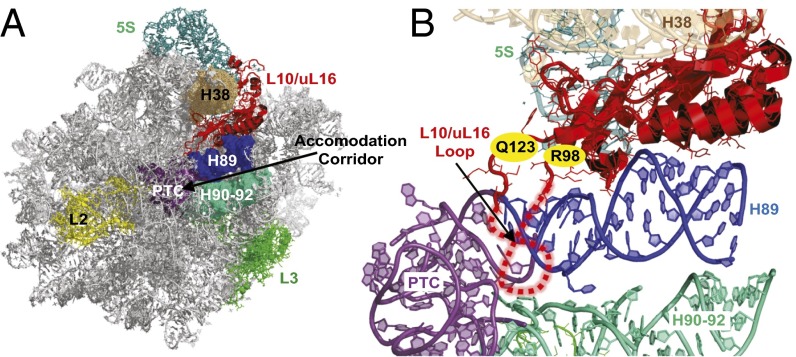
Fig. 1.
Fig. 1.
Localization of rpL10 and the loop in the LSU. (A) rpL10/uL16 in the context of the crown view of the LSU. (B) Close-up view of rpL10/uL16 and the local environment. The flexible loop structure is indicated by dashed red lines, and the positions of R98 and Q123 are indicated. rpL10/uL16 is situated between helices 38 and 89, and it is located in close proximity to several functional centers of the LSU, including the peptidyltransferase center (PTC), aa-tRNA accommodation corridor, and elongation factor binding site. Images were generated using PyMOL.
Fig. 2.
Fig. 2.
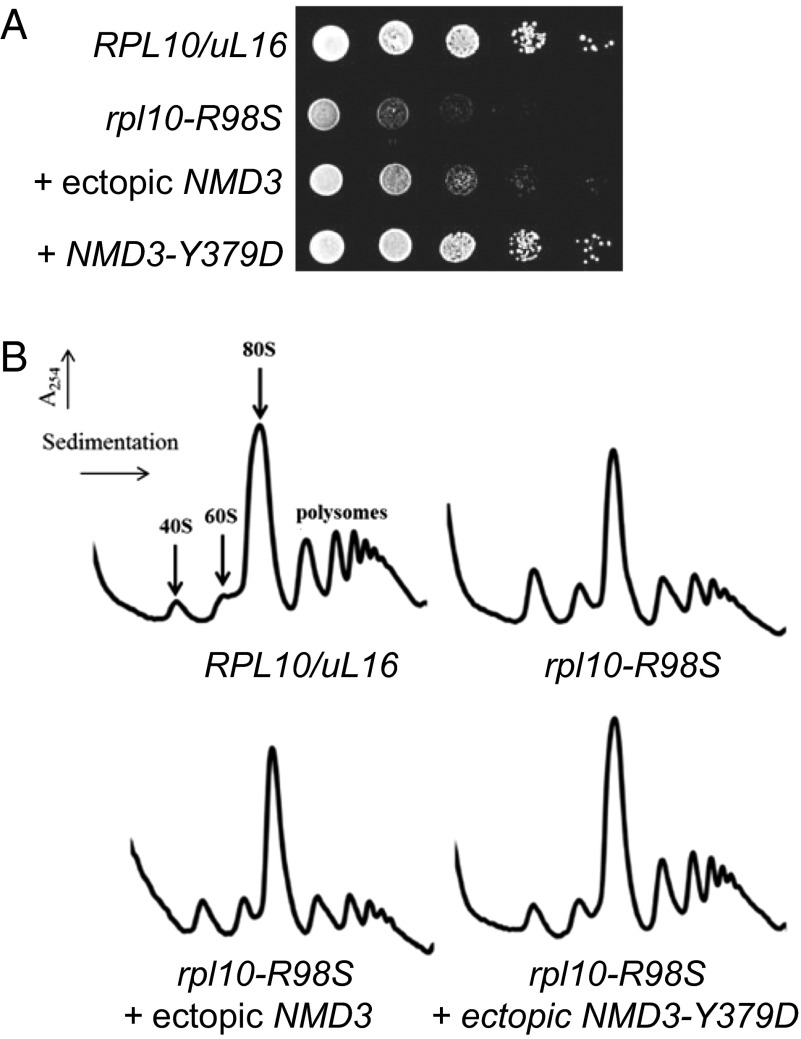
(A) Overexpression of NMD3 or coexpression of NMD3-Y379D suppresses the rpl10-R98S growth defect. A 10-fold dilution spot assay of isogenic strains demonstrates that the rpl10-R98S growth defect is suppressed by ectopic expression of NMD3 and by the NMD3-Y379D mutation. (B) Overexpression of NMD3 or coexpression of NMD3-Y379D suppresses the rpl10-R98S biogenesis defect. Sucrose density gradient analysis. Indicated strains were grown in glucose to repress genomic RPL10/uL16 for 6 h before cells were harvested. Extracts were prepared, and nine A260 units were sedimented through 7–47% sucrose gradients.
Fig. 3.
Fig. 3.
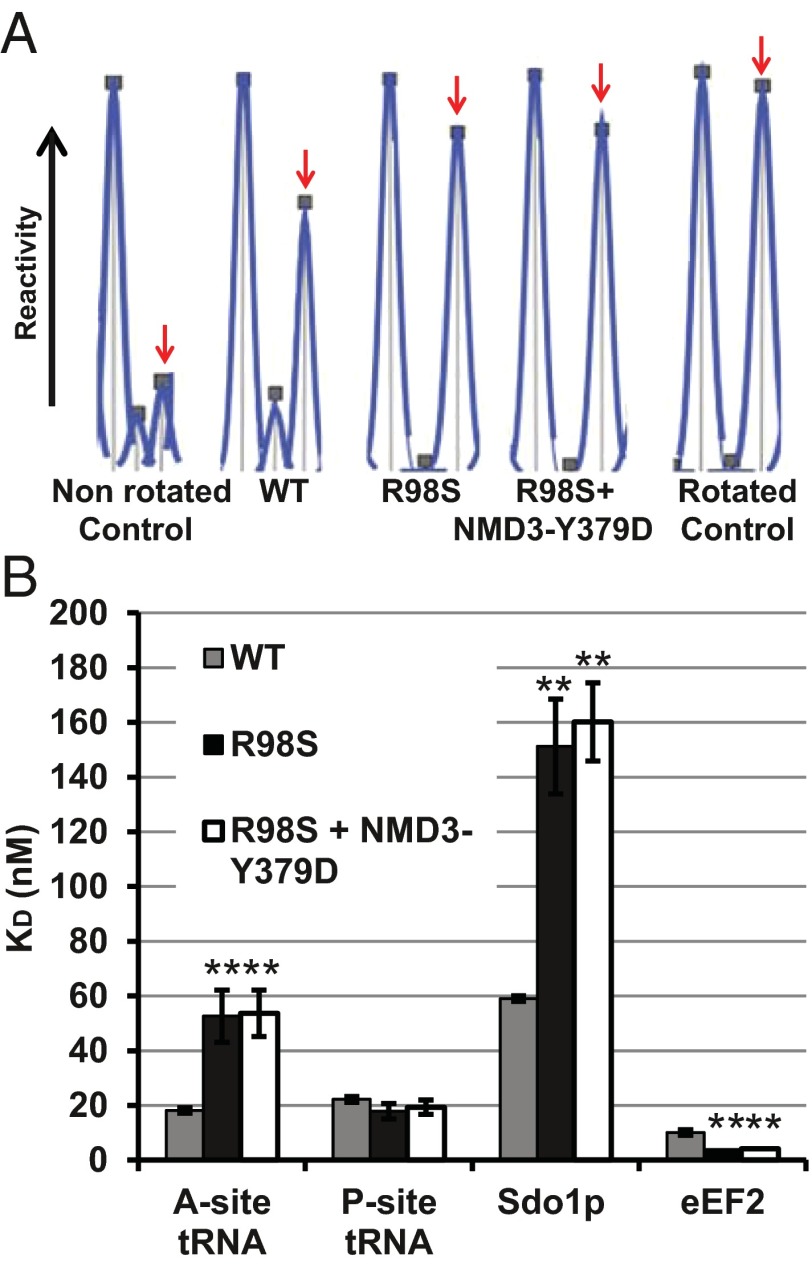
(A) Coexpression of NMD3-Y379D does not suppress the rpl10-R98S rotational defect. Reactivity peaks obtained by hSHAPE after probing of the landmark base A2207 (arrows) at the LSU side of the B7a intersubunit bridge with 1M7. The control ribosomes were assembled as previously reported (13, 54). The nonrotated control is empty WT ribosomes containing Ac-aa-tRNA in the P-site. The rotated control is empty WT ribosomes containing deacylated tRNAPhe + eEF2-5'-guanyl-imidodiphosphate (GDPNP). (B) Coexpression of NMD3-Y379D does not suppress the rpl10-R98S biochemical defects. Steady-state binding of indicated ligands to ribosomes isolated from cells expressing WT, rpl10-R98S, and rpl10-R98S + NMD3-Y379D. Dissociation constants were obtained from binding assays of elongation ternary complex to the A-site and Ac-aa-tRNA to the P-site as monitored by filter binding. Sdo1p binding was monitored by measuring levels of [32P]-labeled Sdo1 associated with ribosomes, and eEF2 binding was monitored by the extent of [14C]-ADP ribosylation of unbound protein. Bars indicate SEM (n = 4). *P < 0.05; **P < 0.01.
Fig. 4.
Fig. 4.
Coexpression of NMD3-Y379D does not suppress the rpl10-R98S telomere maintenance defects. (A) The −1 PRF directed by sequences in the following yeast genes: EST1 (signal beginning at nucleotide 1,272), EST2 (signal beginning at nucleotide 1,251), STN1 (signal beginning at nucleotide 1,203), and CDC13 (signal beginning at nucleotide 1,272). (B) Expression of endogenous EST1, EST2, STN1, and CDC13 mRNAs was monitored by quantitative RT-PCR. Bars indicate SEM (n = 4). (C) Coexpression of NMD3-Y379D does not suppress the rpl10-R98S telomere length defects. The abundance of telomere repeat sequences was quantified by PCR, with the single-copy reference gene SGS1 as the loading control. Bars indicate SEM (n = 9). *P < 0.05; **P < 0.01.
Fig. 5.
Fig. 5.
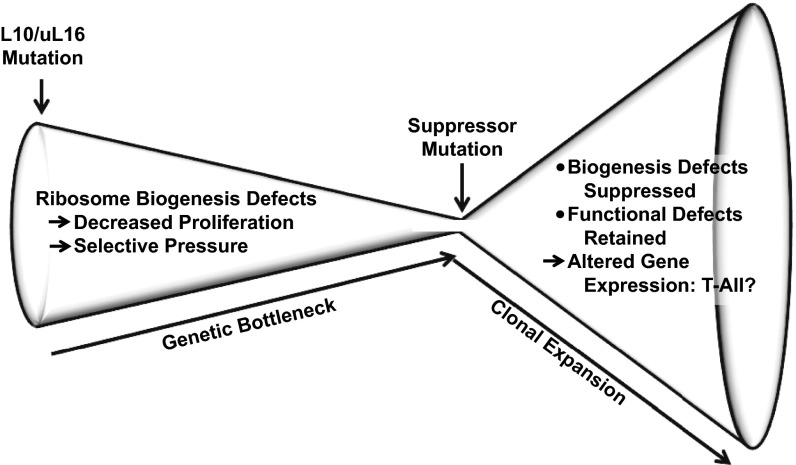
Model of T-ALL progression. A mutation in RPL10/uL16 results in the inability of the pre-60S subunits to pass the quality control checkpoint, leading to decreased ribosome assembly and proliferation. A ribosome biogenesis suppressor can arise due to selective pressure allowing the bypass the quality test drive, thereby boosting production of defective ribosomes. Continued defective translation ultimately leads to an altered gene expression profile and the onset of T-ALL.

References

    1. Narla A, Ebert BL. Ribosomopathies: Human disorders of ribosome dysfunction. Blood. 2010;115(16):3196–3205. - PMC - PubMed
    1. Chirnomas SD, Kupfer GM. The inherited bone marrow failure syndromes. Pediatr Clin North Am. 2013;60(6):1291–1310. - PMC - PubMed
    1. Vlachos A, Rosenberg PS, Atsidaftos E, Alter BP, Lipton JM. Incidence of neoplasia in Diamond Blackfan anemia: A report from the Diamond Blackfan Anemia Registry. Blood. 2012;119(16):3815–3819. - PMC - PubMed
    1. Alter BP, et al. Malignancies and survival patterns in the National Cancer Institute inherited bone marrow failure syndromes cohort study. Br J Haematol. 2010;150(2):179–188. - PMC - PubMed
    1. Post SM, Quintás-Cardama A. Closing in on the pathogenesis of the 5q- syndrome. Expert Rev Anticancer Ther. 2010;10(5):655–658. - PubMed

Publication types

MeSH terms

Substances