


Whole-exome sequencing reveals LRP5 mutations and canonical Wnt signaling associated with hepatic cystogenesis
- PMID: 24706814
- PMCID: PMC3986119
- DOI: 10.1073/pnas.1309438111
Whole-exome sequencing reveals LRP5 mutations and canonical Wnt signaling associated with hepatic cystogenesis
Abstract
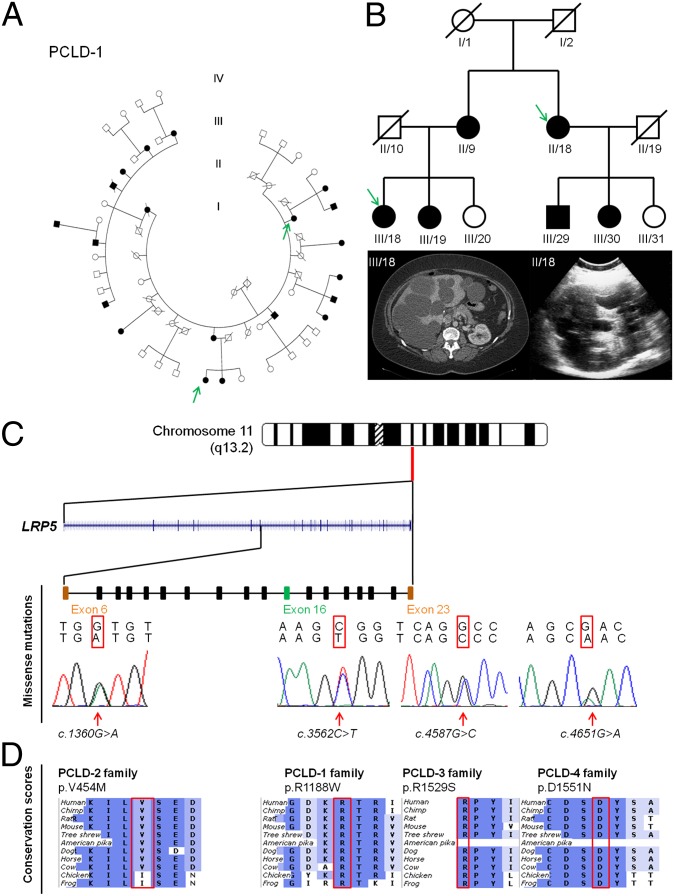
Polycystic livers are seen in the rare inherited disorder isolated polycystic liver disease (PCLD) and are recognized as the most common extrarenal manifestation in autosomal dominant polycystic kidney disease. Hepatic cystogenesis is characterized by progressive proliferation of cholangiocytes, ultimately causing hepatomegaly. Genetically, polycystic liver disease is a heterogeneous disorder with incomplete penetrance and caused by mutations in PRKCSH, SEC63, PKD1, or PKD2. Genome-wide SNP typing and Sanger sequencing revealed no pathogenic variants in hitherto genes in an extended PCLD family. We performed whole-exome sequencing of DNA samples from two members. A heterozygous variant c.3562C > T located at a highly conserved amino acid position (p.R1188W) in the low density lipoprotein receptor-related protein 5 (LRP5) gene segregated with the disease (logarithm of odds score, 4.62) but was not observed in more than 1,000 unaffected individuals. Screening of LRP5 in a PCLD cohort identified three additional mutations in three unrelated families with polycystic livers (p.V454M, p.R1529S, and p.D1551N), again all undetected in controls. All variants were predicted to be damaging with profound structural effects on LRP5 protein domains. Liver cyst tissue and normal hepatic tissue samples from patients and controls showed abundant LRP5 expression by immunohistochemistry. Functional activity analyses indicated that mutant LRP5 led to reduced wingless signal activation. In conclusion, we demonstrate that germ-line LRP5 missense mutations are associated with hepatic cystogenesis. The findings presented in this study link the pathophysiology of PCLD to deregulation of the canonical wingless signaling pathway.
Keywords: gene identification; β-catenin pathway.
Conflict of interest statement
The authors declare no conflict of interest.
Figures

References
-
- Bae KT, et al. Consortium for Radiologic Imaging Studies of Polycystic Kidney Disease (CRISP) Magnetic resonance imaging evaluation of hepatic cysts in early autosomal-dominant polycystic kidney disease: The Consortium for Radiologic Imaging Studies of Polycystic Kidney Disease cohort. Clin J Am Soc Nephrol. 2006;1(1):64–69. - PubMed
-
- Ravine D, et al. Evaluation of ultrasonographic diagnostic criteria for autosomal dominant polycystic kidney disease 1. Lancet. 1994;343(8901):824–827. - PubMed
Publication types
MeSH terms
Substances
Supplementary concepts
LinkOut - more resources
Full Text Sources
Other Literature Sources
Medical
Molecular Biology Databases
Miscellaneous
