


Physical activity when young provides lifelong benefits to cortical bone size and strength in men
- PMID: 24706816
- PMCID: PMC3986122
- DOI: 10.1073/pnas.1321605111
Physical activity when young provides lifelong benefits to cortical bone size and strength in men
Abstract
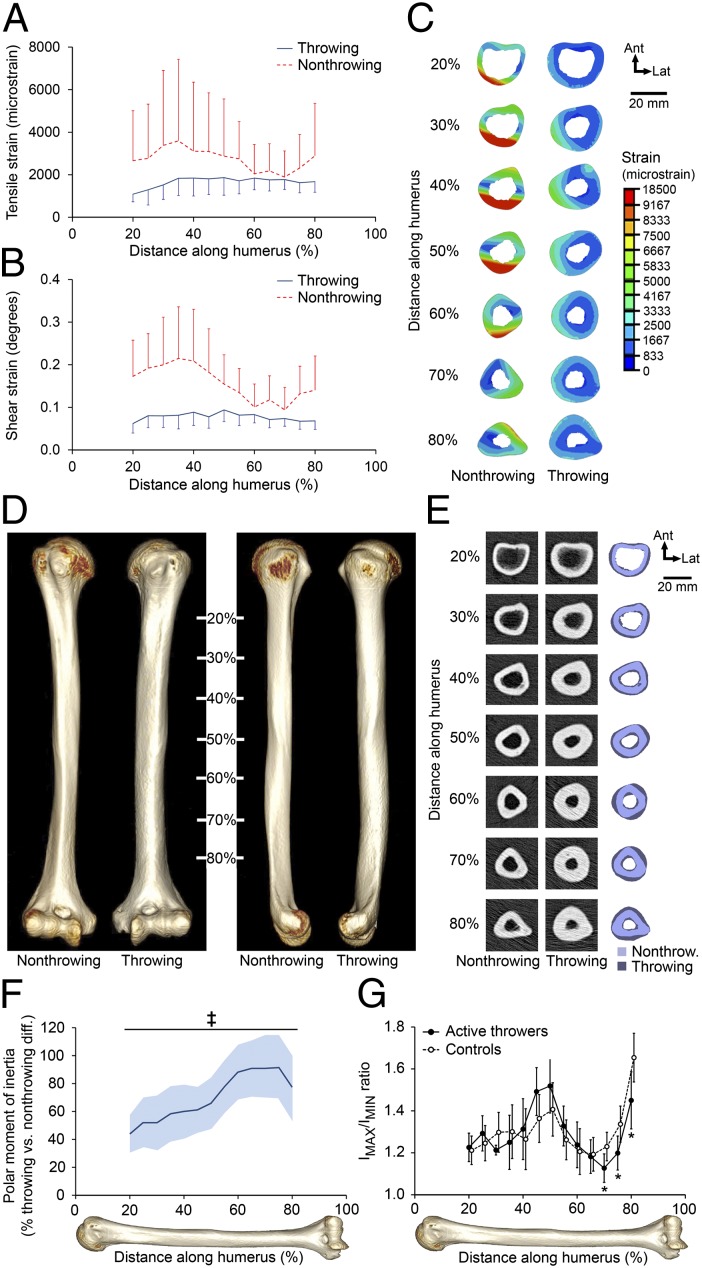
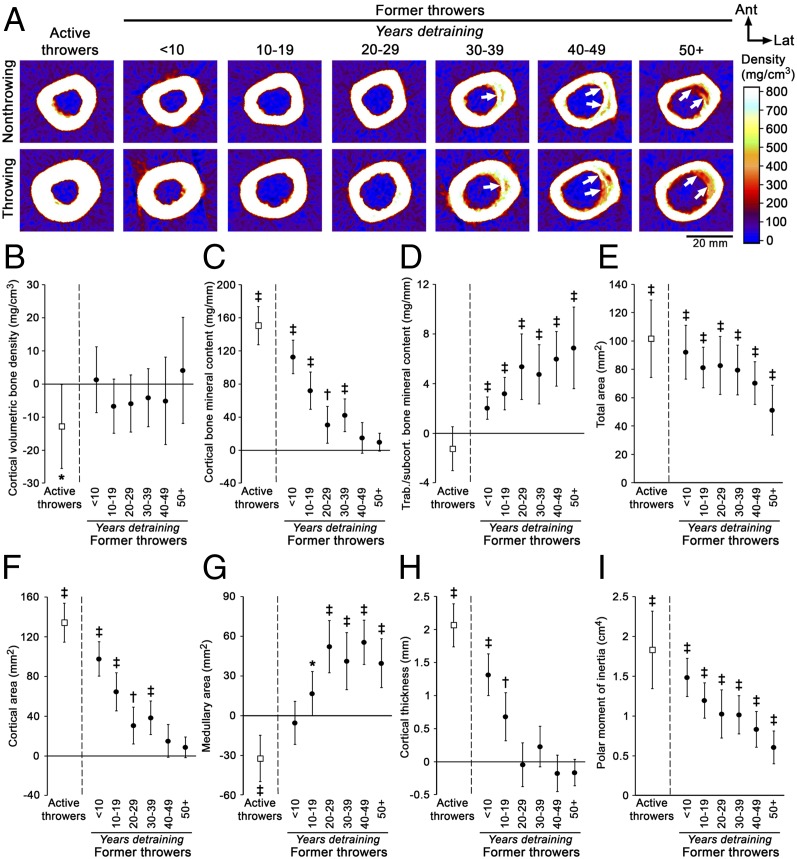
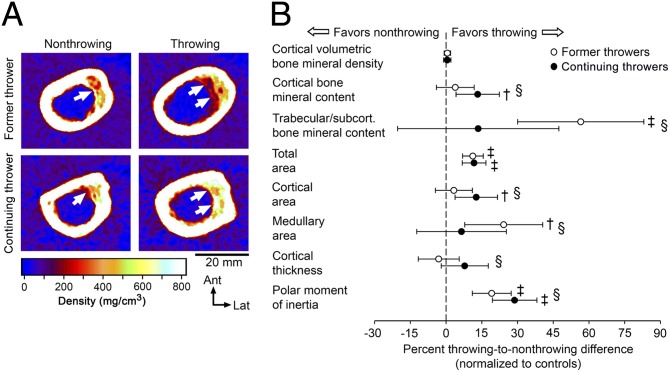
The skeleton shows greatest plasticity to physical activity-related mechanical loads during youth but is more at risk for failure during aging. Do the skeletal benefits of physical activity during youth persist with aging? To address this question, we used a uniquely controlled cross-sectional study design in which we compared the throwing-to-nonthrowing arm differences in humeral diaphysis bone properties in professional baseball players at different stages of their careers (n = 103) with dominant-to-nondominant arm differences in controls (n = 94). Throwing-related physical activity introduced extreme loading to the humeral diaphysis and nearly doubled its strength. Once throwing activities ceased, the cortical bone mass, area, and thickness benefits of physical activity during youth were gradually lost because of greater medullary expansion and cortical trabecularization. However, half of the bone size (total cross-sectional area) and one-third of the bone strength (polar moment of inertia) benefits of throwing-related physical activity during youth were maintained lifelong. In players who continued throwing during aging, some cortical bone mass and more strength benefits of the physical activity during youth were maintained as a result of less medullary expansion and cortical trabecularization. These data indicate that the old adage of "use it or lose it" is not entirely applicable to the skeleton and that physical activity during youth should be encouraged for lifelong bone health, with the focus being optimization of bone size and strength rather than the current paradigm of increasing mass. The data also indicate that physical activity should be encouraged during aging to reduce skeletal structural decay.
Keywords: exercise; intracortical remodeling; osteoporosis; peak bone mass.
Conflict of interest statement
The authors declare no conflict of interest.
Figures
References
-
- Kannus P, et al. Effect of starting age of physical activity on bone mass in the dominant arm of tennis and squash players. Ann Intern Med. 1995;123(1):27–31. - PubMed
-
- Rizzoli R, Bianchi ML, Garabédian M, McKay HA, Moreno LA. Maximizing bone mineral mass gain during growth for the prevention of fractures in the adolescents and the elderly. Bone. 2010;46(2):294–305. - PubMed
-
- Erlandson MC, et al. Higher premenarcheal bone mass in elite gymnasts is maintained into young adulthood after long-term retirement from sport: A 14-year follow-up. J Bone Miner Res. 2012;27(1):104–110. - PubMed
-
- Kontulainen S, et al. Good maintenance of exercise-induced bone gain with decreased training of female tennis and squash players: A prospective 5-year follow-up study of young and old starters and controls. J Bone Miner Res. 2001;16(2):195–201. - PubMed
Publication types
MeSH terms
Grants and funding
LinkOut - more resources
Full Text Sources
Other Literature Sources
Medical
