


Biomechanics of milk extraction during breast-feeding
- PMID: 24706845
- PMCID: PMC3986202
- DOI: 10.1073/pnas.1319798111
Biomechanics of milk extraction during breast-feeding
Abstract
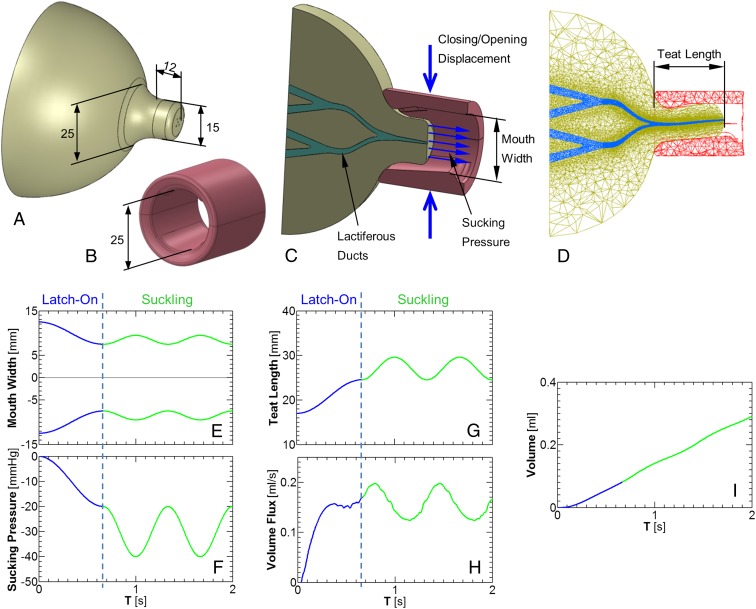
How do infants extract milk during breast-feeding? We have resolved a century-long scientific controversy, whether it is sucking of the milk by subatmospheric pressure or mouthing of the nipple-areola complex to induce a peristaltic-like extraction mechanism. Breast-feeding is a dynamic process, which requires coupling between periodic motions of the infant's jaws, undulation of the tongue, and the breast milk ejection reflex. The physical mechanisms executed by the infant have been intriguing topics. We used an objective and dynamic analysis of ultrasound (US) movie clips acquired during breast-feeding to explore the tongue dynamic characteristics. Then, we developed a new 3D biophysical model of the breast and lactiferous tubes that enables the mimicking of dynamic characteristics observed in US imaging during breast-feeding, and thereby, exploration of the biomechanical aspects of breast-feeding. We have shown, for the first time to our knowledge, that latch-on to draw the nipple-areola complex into the infant mouth, as well as milk extraction during breast-feeding, require development of time-varying subatmospheric pressures within the infant's oral cavity. Analysis of the US movies clearly demonstrated that tongue motility during breast-feeding was fairly periodic. The anterior tongue, which is wedged between the nipple-areola complex and the lower lips, moves as a rigid body with the cycling motion of the mandible, while the posterior section of the tongue undulates in a pattern similar to a propagating peristaltic wave, which is essential for swallowing.
Keywords: computational model; fluid-structure interaction; submental ultrasound; sucking pressure.
Conflict of interest statement
The authors declare no conflict of interest.
Figures


References
-
- Palmer B. The influence of breastfeeding on the development of the oral cavity: A commentary. J Hum Lact. 1998;14(2):93–98. - PubMed
-
- Goldfield EC, Richardson MJ, Lee KG, Margetts S. Coordination of sucking, swallowing, and breathing and oxygen saturation during early infant breast-feeding and bottle-feeding. Pediatr Res. 2006;60(4):450–455. - PubMed
-
- Woolridge MW. The ‘anatomy’ of infant sucking. Midwifery. 1986;2(4):164–171. - PubMed
-
- Neville MC. Anatomy and physiology of lactation. Pediatr Clin North Am. 2001;48(1):13–34. - PubMed
-
- Wagner CL. 2009. Counseling the Breastfeeding Mother. eMedicine. Available at http://emedicine.medscape.com/article/979458-overview. Accessed March 9, 2014.
MeSH terms
LinkOut - more resources
Full Text Sources
Other Literature Sources
Medical
Molecular Biology Databases
