. 2014 Jun;349(3):480-6.
doi: 10.1124/jpet.114.213520. Epub 2014 Apr 4.

Targeting the myofibroblast genetic switch: inhibitors of myocardin-related transcription factor/serum response factor-regulated gene transcription prevent fibrosis in a murine model of skin injury

Affiliations

Targeting the myofibroblast genetic switch: inhibitors of myocardin-related transcription factor/serum response factor-regulated gene transcription prevent fibrosis in a murine model of skin injury

Andrew J Haak et al. J Pharmacol Exp Ther. 2014 Jun.

Abstract

Systemic sclerosis (SSc), or scleroderma, similar to many fibrotic disorders, lacks effective therapies. Current trials focus on anti-inflammatory drugs or targeted approaches aimed at one of the many receptor mechanisms initiating fibrosis. In light of evidence that a myocardin-related transcription factor (MRTF)-and serum response factor (SRF)-regulated gene transcriptional program induced by Rho GTPases is essential for myofibroblast activation, we explored the hypothesis that inhibitors of this pathway may represent novel antifibrotics. MRTF/SRF-regulated genes show spontaneously increased expression in primary dermal fibroblasts from patients with diffuse cutaneous SSc. A novel small-molecule inhibitor of MRTF/SRF-regulated transcription (CCG-203971) inhibits expression of connective tissue growth factor (CTGF), α-smooth muscle actin (α-SMA), and collagen 1 (COL1A2) in both SSc fibroblasts and in lysophosphatidic acid (LPA)-and transforming growth factor β (TGFβ)-stimulated fibroblasts. In vivo treatment with CCG-203971 also prevented bleomycin-induced skin thickening and collagen deposition. Thus, targeting the MRTF/SRF gene transcription pathway could provide an efficacious new approach to therapy for SSc and other fibrotic disorders.


Figures
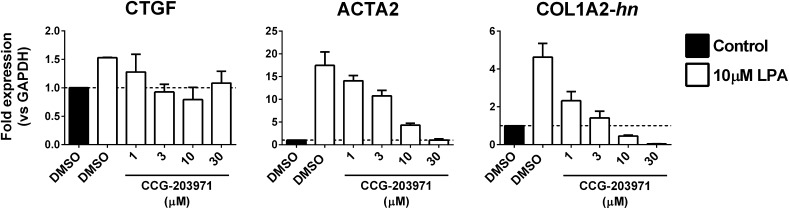
Fig. 1.
Fig. 1.
LPA activates fibrotic gene expression in 3T3 fibroblasts in a Rho/MRTF-dependent manner. NIH-3T3 cells were treated with the indicated concentration of CCG-203971 or DMSO for 23 hours. One hour prior to RNA isolation, cells were stimulated with 10 μM LPA. Expression of MRTF target genes CTGF, ACTA2, and COL1A2 was assessed by qPCR. For COL1A2, primers were designed to amplify newly synthesized heterogeneous nuclear RNA (hnRNA). Expression levels were quantified relative to GAPDH. Data are mean ± S.D. of two independent experiments.
Fig. 2.
Fig. 2.
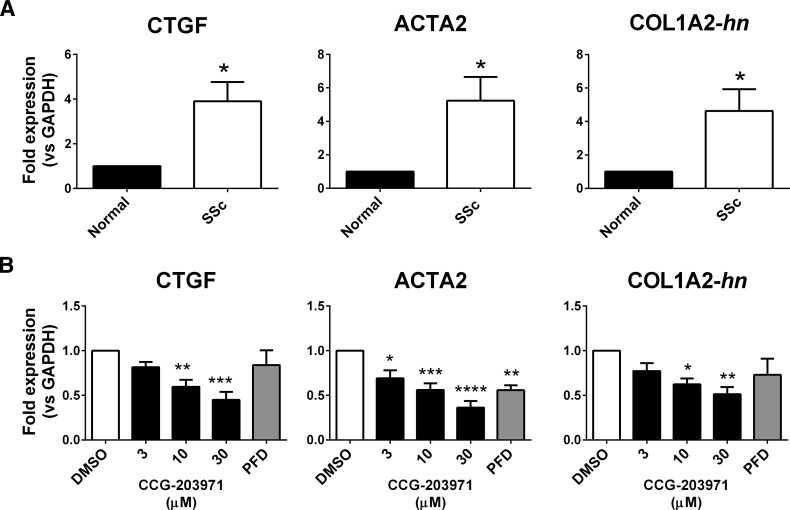
SSc-patient dermal fibroblasts show increased expression of fibrosis markers/MRTF target genes, which are inhibited by CCG-203971. (A) mRNA expression for fibrotic markers connective tissue growth factor (CTGF), alpha smooth muscle actin (ACTA2), and collagen (COL1A2) were quantified by qPCR. Primary human dermal fibroblasts isolated from normal donors or patients with SSc were grown in culture for no more than five passages prior to mRNA isolation. Data are mean ± S.E.M. of samples from three individuals. (B) CCG-203971 treatment reduces expression of CTGF, ACTA2, and COL1A2. Prior to mRNA isolation, SSc dermal fibroblasts were treated for 24 hours in the presence of the indicated concentration (μM) of CCG-203971 or 300 μM PFD. Data are mean ± S.E.M. of samples from at least four individuals. (*P < 0.05, **P < 0.01, ***P < 0.001, ****P < 0.0001 versus DMSO control.)
Fig. 3.
Fig. 3.
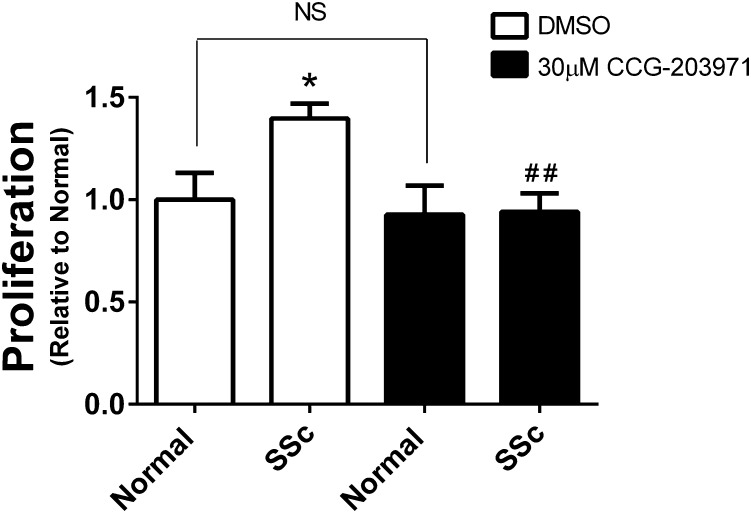
Scleroderma dermal fibroblasts proliferate faster than normal cells, and this is inhibited by CCG-203971. Cells were plated onto 96-well plates and allowed to grow for 3 days in the presence of 30 μM CCG-203971 or DMSO vehicle. Viable cell density was assessed through enzymatic reduction of the water-soluble tetrazolium dye WST-1. Data are mean ± S.E.M. of samples from three individuals. (*P < 0.05 versus DMSO-treated Normal, ##P < 0.01 versus DMSO-treated SSc.)
Fig. 4.
Fig. 4.
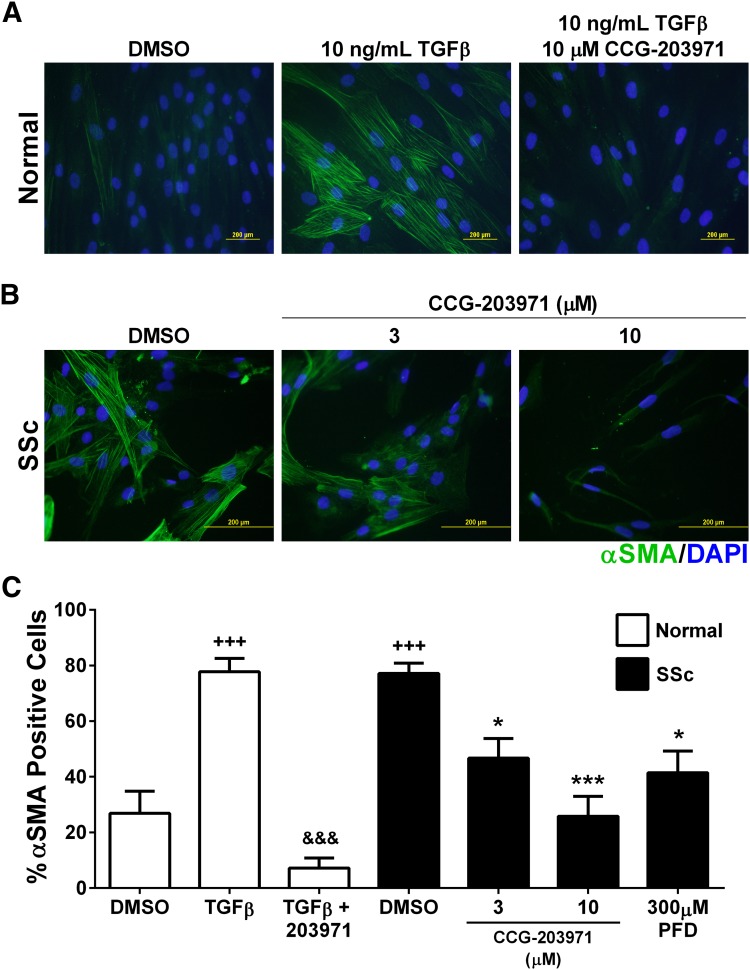
CCG-203971 modulates myofibroblast transition of dermal fibroblasts. (A) Primary human dermal fibroblasts from normal donors were plated onto cover slips and treated with or without 10 ng/ml TGFβ for 3 days to induce a myofibroblast transition; during stimulation cells were also treated with 10 μM CCG-203971 or DMSO. Cells were then fixed, and α-SMA was visualized using immunocytochemistry along with nuclear DAPI staining. Shown are two representative individual samples. (B) Human dermal fibroblasts from patients with diffuse SSc were plated onto coverslips and treated with the indicated concentration of CCG-203971. Cells were then fixed and visualized using immunocytochemistry along with nuclear DAPI staining. Shown are two representative individual samples. (C) The fraction of cells positive for α-SMA was scored by an observer blinded to the sample identification. Data are mean ± S.E.M. of samples from at least four individuals. (*P < 0.05, ***P < 0.001 versus DMSO Scleroderma, +++P < 0.001 versus Normal DMSO, &&&P < 0.001 versus Normal TGFβ.)
Fig. 5.
Fig. 5.
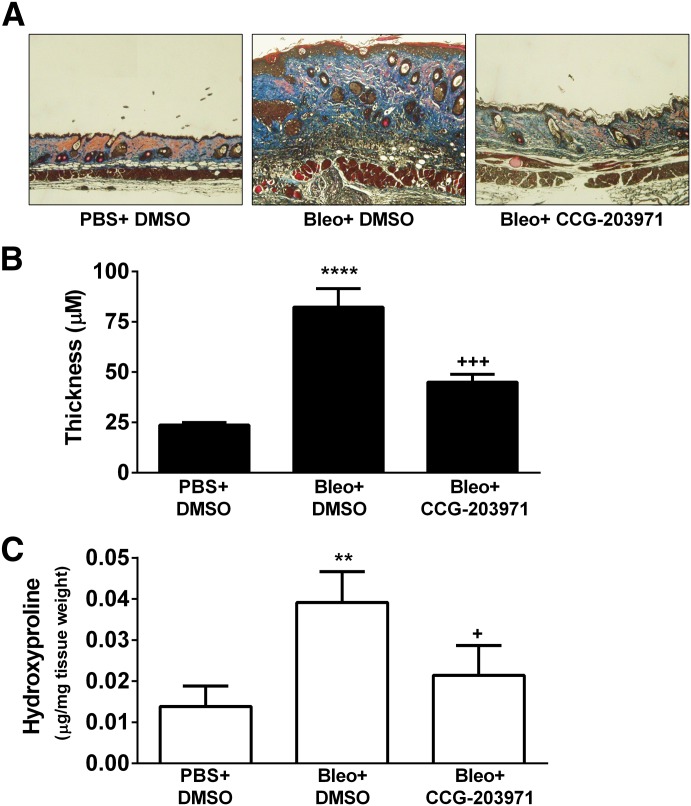
CCG-203971 prevents bleomycin-induced fibrosis in vivo. Bleomycin (0.1 mg) or vehicle (PBS) was injected intradermally in three groups of seven C57BL/6J mice for 2 weeks. Mice were also treated with twice daily injections of either CCG-203971 (100 mg/kg i.p.) or vehicle control (50 μl i.p. of DMSO). At the end of the treatment period, skin samples were collected and either stained with Masson’s trichrome (A and B) or analyzed for hydroxyl-proline content (C), as described in Materials and Methods. Differences in skin thickness (triplicate measures from each mouse) and hydroxyproline content were assessed by one-way analysis of variance with the Bonferroni post-test to correct for multiple comparisons. (**P < 0.01, ****P < 0.0001, Bleo versus PBS control; +P < 0.05, +++P < 0.001, Bleo and CCG-203971 versus Bleo and DMSO.)
Fig. 6.
Fig. 6.
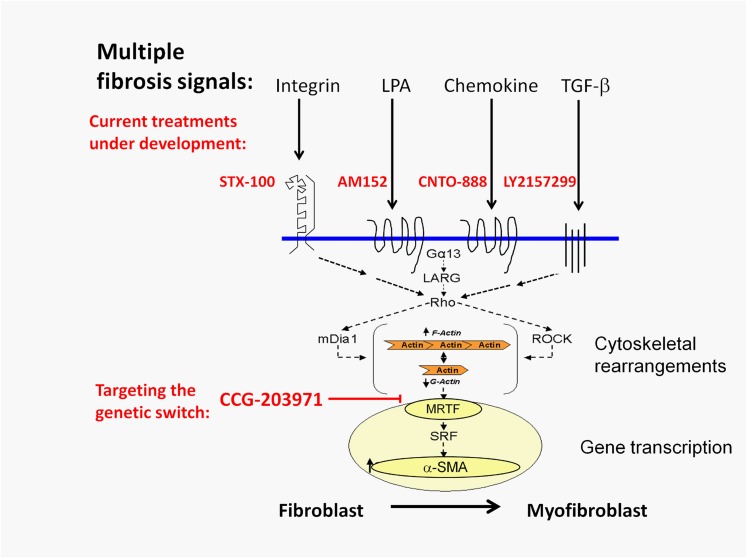
Schematic model of multiple profibrotic stimuli that all use the MRTF/SRF-regulated gene transcription mechanism. Several mechanisms being targeted in fibrosis in SSc and other primary fibrotic diseases are illustrated. All appear to activate Rho GTPase and the downstream MRTF/SRF gene transcription mechanism. By blocking MRTF nuclear localization, our compound CCG-203971 may prove more effective than disrupting each individual profibrotic input.

Comment in

References

    1. Akhmetshina A, Dees C, Pileckyte M, Szucs G, Spriewald BM, Zwerina J, Distler O, Schett G, Distler JH. (2008) Rho-associated kinases are crucial for myofibroblast differentiation and production of extracellular matrix in scleroderma fibroblasts. Arthritis Rheum 58:2553–2564 - PubMed
    1. Badri L, Lama VN. (2012) Lysophosphatidic acid induces migration of human lung-resident mesenchymal stem cells through the β-catenin pathway. Stem Cells 30:2010–2019 - PMC - PubMed
    1. Bell JL, Haak AJ, Wade SM, Kirchhoff PD, Neubig RR, Larsen SD. (2013) Optimization of novel nipecotic bis(amide) inhibitors of the Rho/MKL1/SRF transcriptional pathway as potential anti-metastasis agents. Bioorg Med Chem Lett 23:3826–3832 - PMC - PubMed
    1. Beyer C, Schett G, Distler O, Distler JH. (2010) Animal models of systemic sclerosis: prospects and limitations. Arthritis Rheum 62:2831–2844 - PubMed
    1. Beyer C, Distler O, Distler JH. (2012) Innovative antifibrotic therapies in systemic sclerosis. Curr Opin Rheumatol 24:274–280 - PubMed

Publication types

MeSH terms