Race/ethnicity and measurement equivalence of the Everyday Discrimination Scale
- PMID: 24708076
- PMCID: PMC4152383
- DOI: 10.1037/a0036431
Race/ethnicity and measurement equivalence of the Everyday Discrimination Scale
Abstract
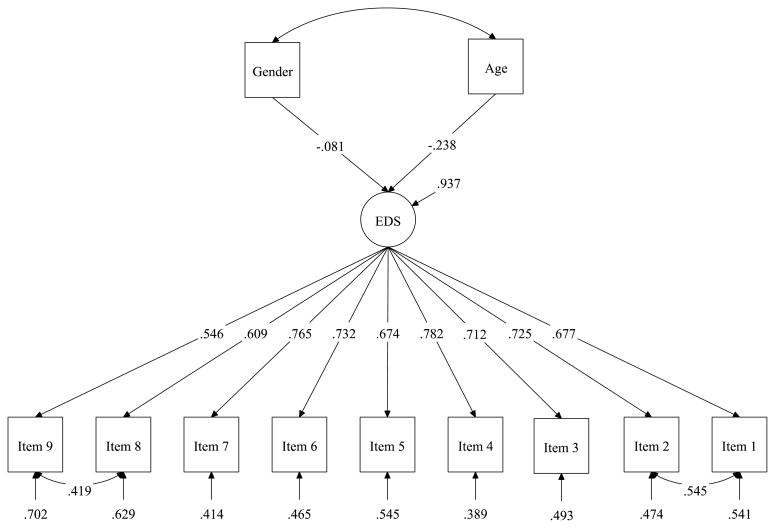
The present study examines the effect of race/ethnicity on measurement equivalence of the Everyday Discrimination Scale (EDS; Williams, Yu, Jackson, & Anderson, 1997). Drawn from the Collaborative Psychiatric Epidemiology Surveys (CPES; Alegría, Jackson, Kessler, & Takeuchi, 2008), adults aged 18 and older from four racial/ethnic groups were selected for analyses: 884 non-Hispanic Whites, 4,950 Blacks, 2,733 Hispanics/Latinos, and 2,089 Asians. Multiple-group confirmatory factor analyses were conducted. After adjusting for age and gender, the underlying construct of the EDS was invariant across four racial/ethnic groups, with Item 7 ("People act as if they're better than you are") associated with lower intercepts for the Hispanic/Latino and Asian groups relative to the non-Hispanic White and Black groups. In terms of latent factor differences, Blacks tended to score higher on the latent construct compared to other racial/ethnic groups, whereas Asians tended to score lower on the latent construct compared to Whites and Hispanics/Latinos. Findings suggest that although the EDS in general assesses the underlying construct of perceived discrimination equivalently across diverse racial/ethnic groups, caution is needed when Item 7 is used among Hispanics/Latinos or Asians. Implications are discussed in cultural and methodological contexts.
PsycINFO Database Record (c) 2014 APA, all rights reserved.
Figures
References
-
- Barnes LL, De Leon CFM, Wilson RS, Bienias JL, Bennett DA, Evans DA. Racial differences in perceived discrimination in a community population of older Blacks and Whites. Journal of Aging and Health. 2004;16(3):315–337. - PubMed
-
- Blazer DG, Landerman LR, Hays JC, Simonsick EM, Saunders WB. Symptoms of depression among community-dwelling elderly African-American and White older adults. Psychological Medicine. 1998;28:1311–1320. - PubMed
-
- Byrne B. Structural Equation Modeling with Mplus. New York: Routledge; 2011.
-
- Bryne BM, Shavelson RJ, Muthen B. Testing for the equivalence of factor covariance and mean structures: The issue of partial measurement invariance. Psychological Bulletin. 1989;105:456–466.
Publication types
MeSH terms
Grants and funding
LinkOut - more resources
Full Text Sources
Other Literature Sources