


Review
doi: 10.1038/nrg3707.
Epub 2014 Apr 8.
Comparative primate genomics: emerging patterns of genome content and dynamics
Affiliations
- PMID: 24709753
- PMCID: PMC4113315
- DOI: 10.1038/nrg3707
Item in Clipboard
Review
Comparative primate genomics: emerging patterns of genome content and dynamics
Nat Rev Genet.
2014 May.
Abstract
Advances in genome sequencing technologies have created new opportunities for comparative primate genomics. Genome assemblies have been published for various primate species, and analyses of several others are underway. Whole-genome assemblies for the great apes provide remarkable new information about the evolutionary origins of the human genome and the processes involved. Genomic data for macaques and other non-human primates offer valuable insights into genetic similarities and differences among species that are used as models for disease-related research. This Review summarizes current knowledge regarding primate genome content and dynamics, and proposes a series of goals for the near future.
Figures
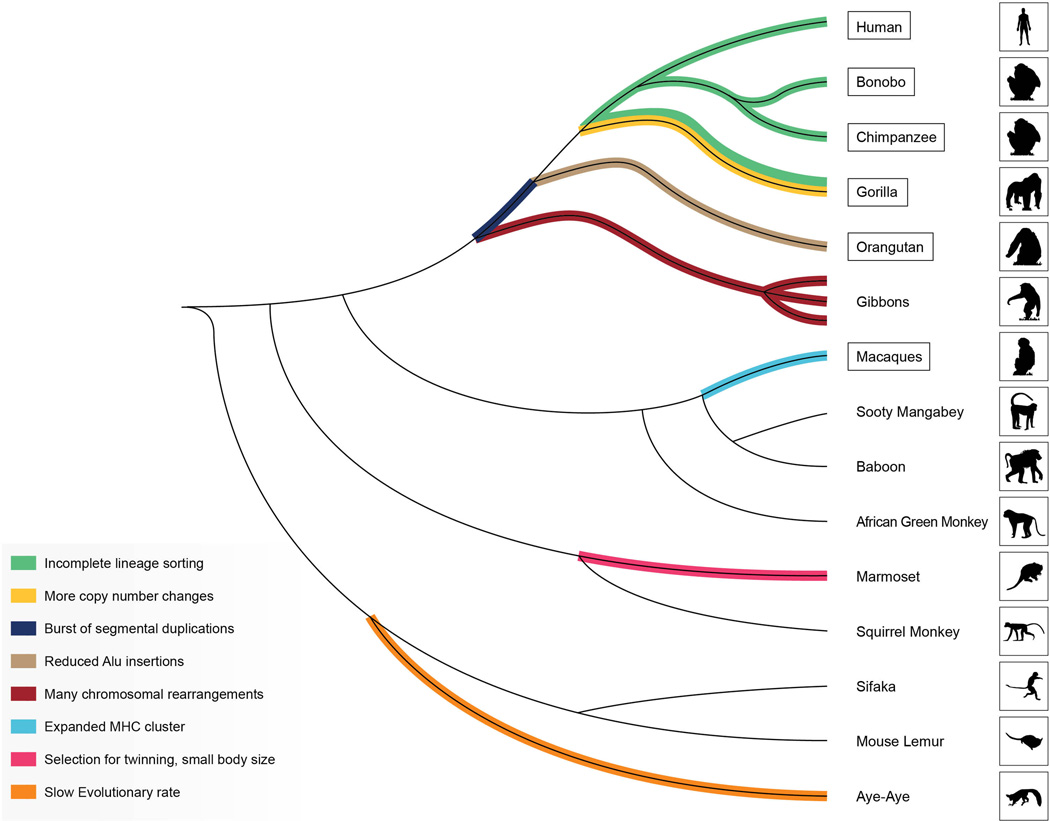
This diagram presents the evolutionary relationships among species for which genome sequences are published, available or in progress. The genomes for species enclosed in boxes are already published. Among the macaques, the rhesus and cynomolgus macaque genomes are published, , but sequencing of other macaque genomes is underway. Selected lineages are highlighted to indicate specific genomic features of interest, or unexpected genomic traits, such as reduced rate of Alu insertion in the orangutan genome or the lower evolutionary rate in the aye-aye.
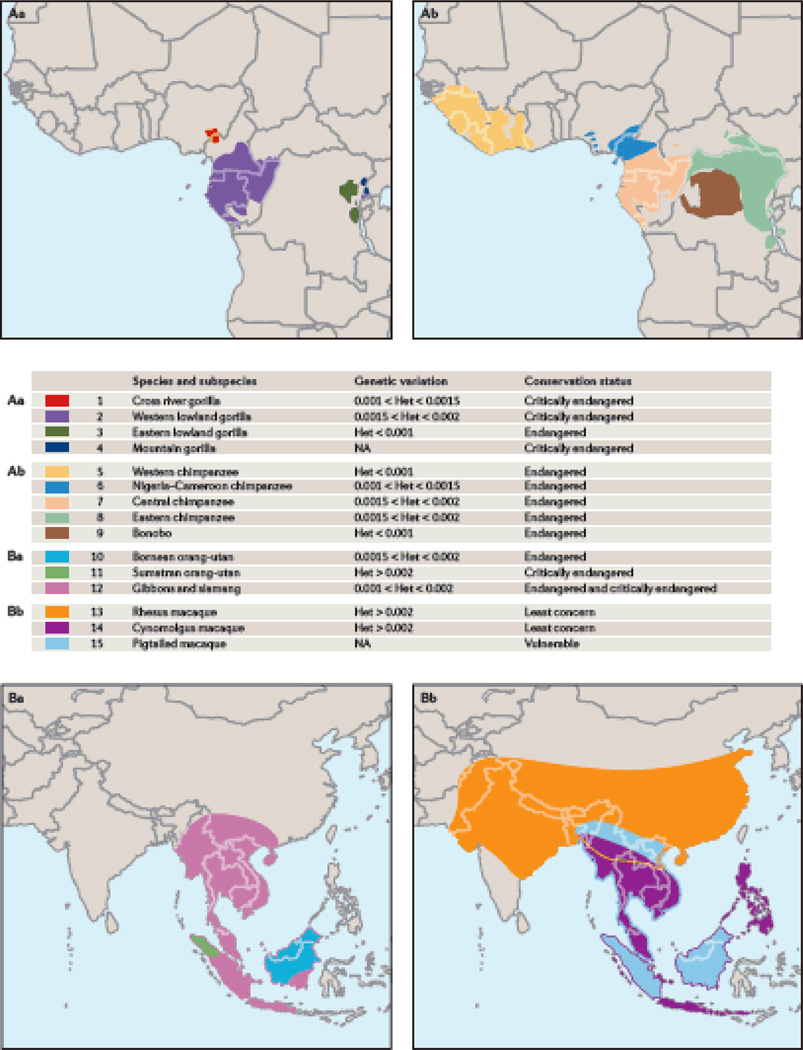
Despite having modest or small current population sizes, and in most cases being either endangered or critically endangered (www.iucnredlist.org ), most nonhuman primate species investigated to date have substantial levels of within-species genetic variability. Panel A: The approximate geographic distributions of African ape species, although actual distributions are generally discontinuous isolated populations within these areas. Hatching indicates the level of genetic variation estimated through the Great Ape Genome Project. The IUCN conservation status is indicated by legend font. Panel B: Approximate geographic distributions for gibbons, orangutans and selected macaque species. As for the African species, conservation status is indicated by the legend font and the estimated level of genetic variation is shown by hatching. Information on genetic variation from references #33, 34 and 66.
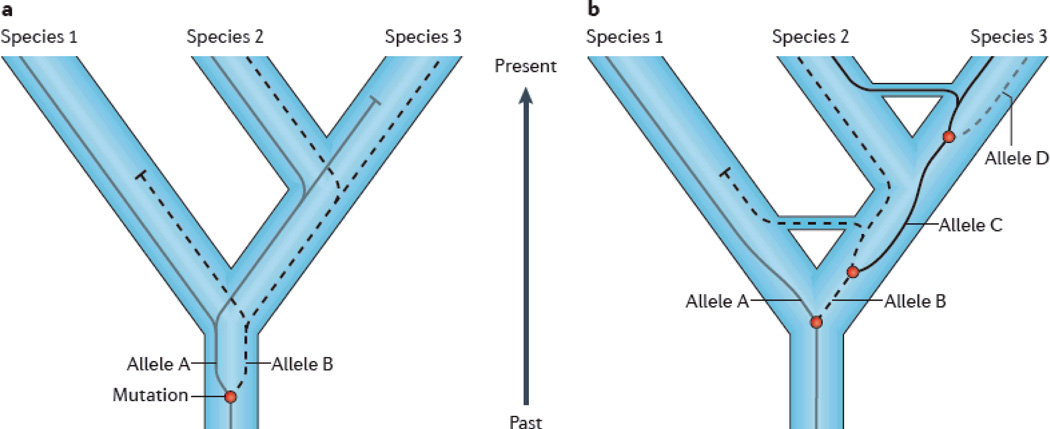
Incomplete lineage sorting can produce discrepancy between the phylogenetic tree for a specific gene or genomic segment and the overall species-level phylogenetic tree. If an ancestral species is polymorphic, segregating alleles A and B, and divides into two descendent lineages, both alleles can be retained in both daughter lineages. If one of those lineages then divides again relatively soon, all three species lineages may carry both alleles. Over time, each lineage will lose one or the other allele due to drift or selection. In this case, assume that Species 1 retains allele A and Species 3 retains B. Species 2 will, for this genomic segment, appear more closely related to either Species 1 or Species 3 depending on whether it retains allele A or B. Retention of allele B would mean this genomic segment matches the overall species-level phylogenetic tree, but retention of allele A would lead to discrepancy. Analysis of whole genome sequences for human, chimpanzee and gorilla indicate that “gene trees” for a significant fraction of the genome do not match the overall species-level phylogeny, which places chimpanzees are more closely related to humans than to gorillas.
References
Publication types
MeSH terms
Grants and funding
LinkOut - more resources
Full Text Sources
Other Literature Sources
