


Postoperative hypoxia and length of intensive care unit stay after cardiac surgery: the underweight paradox?
- PMID: 24709952
- PMCID: PMC3978074
- DOI: 10.1371/journal.pone.0093992
Postoperative hypoxia and length of intensive care unit stay after cardiac surgery: the underweight paradox?
Abstract
Objective: Cardiac operations with cardiopulmonary bypass can be associated with postoperative lung dysfunction. The present study investigates the incidence of postoperative hypoxia after cardiac surgery, its relationship with the length of intensive care unit stay, and the role of body mass index in determining postoperative hypoxia and intensive care unit length of stay.
Design: Single-center, retrospective study.
Setting: University Hospital. Patients. Adult patients (N = 5,023) who underwent cardiac surgery with CPB.
Interventions: None.
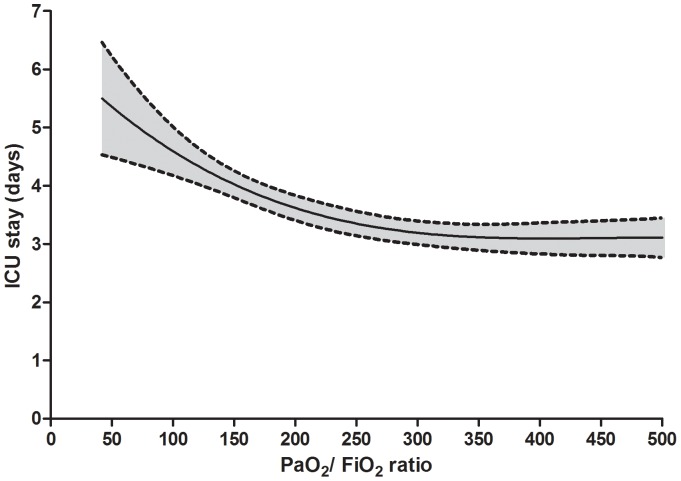
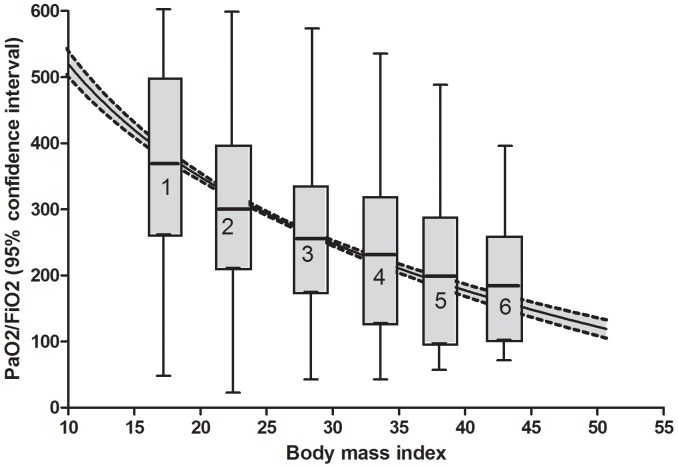
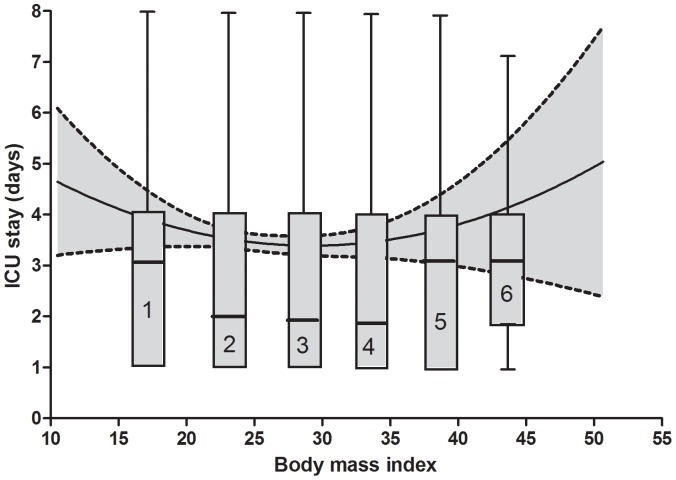
Measurements and main results: According to the body mass index, patients were attributed to six classes, and obesity was defined as a body mass index >30. POH was defined as a PaO2/FiO2 ratio <200 at the arrival in the intensive care unit. Postoperative hypoxia was detected in 1,536 patients (30.6%). Obesity was an independent risk factor for postoperative hypoxia (odds ratio 2.4, 95% confidence interval 2.05-2.78, P = 0.001) and postoperative hypoxia was a determinant of intensive care unit length of stay. There is a significant inverse correlation between body mass index and PaO2/FiO2 ratio, with the risk of postoperative hypoxia increasing by 1.7 folds per each incremental body mass index class. The relationship between body mass index and intensive care unit length of stay is U-shaped, with longer intensive care unit stay in underweight patients and moderate-morbid obese patients.
Conclusions: Obese patients are at higher risk for postoperative hypoxia, but this leads to a prolonged intensive care unit stay only for moderate-morbid obese patients. Obese patients are partially protected against the deleterious effects of hemodilution and transfusions. Underweight patients present the "paradox" of a better lung gas exchange but a longer intensive care unit stay. This is probably due to a higher severity of their cardiac disease.
Conflict of interest statement
Figures
References
-
- Szeles TF, Yoshinaga EM, Alencar W, Brudniewski M, Ferreira FS, et al. (2008) Hypoxemia after myocardial revascularization: analysis of risk factors. Rev Bras Anesthesiol 58: 124–136. - PubMed
-
- Ng CS, Wan S, Yim APC, Arifi AA (2002) Pulmonary dysfunction after cardiac surgery. Chest 121: 1269–1277. - PubMed
-
- Apostolakis E, Filos KS, Koletsis E, Dougenis D (2010) Lung dysfunction following cardiopulmonary bypass. J Card Surg 25: 47–55. - PubMed
-
- Ranucci M, Mazzucco A, Pessotto R, Grillone G, Casati V, et al. (1999) Heparin-coated circuits for high-risk patients: a multicenter, prospective, randomized trial. Ann Thorac Surg 67: 994–1000. - PubMed
Publication types
MeSH terms
LinkOut - more resources
Full Text Sources
Other Literature Sources
Medical
