


BRAF and NRAS mutations are heterogeneous and not mutually exclusive in nodular melanoma
- PMID: 24710085
- PMCID: PMC4482453
- DOI: 10.1097/PAI.0000000000000071
BRAF and NRAS mutations are heterogeneous and not mutually exclusive in nodular melanoma
Abstract
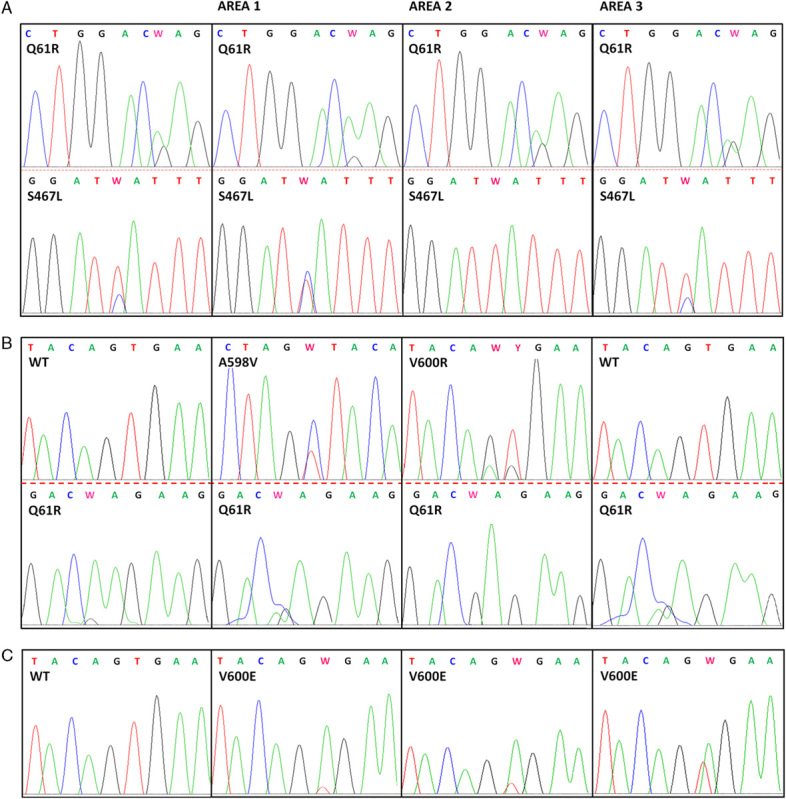
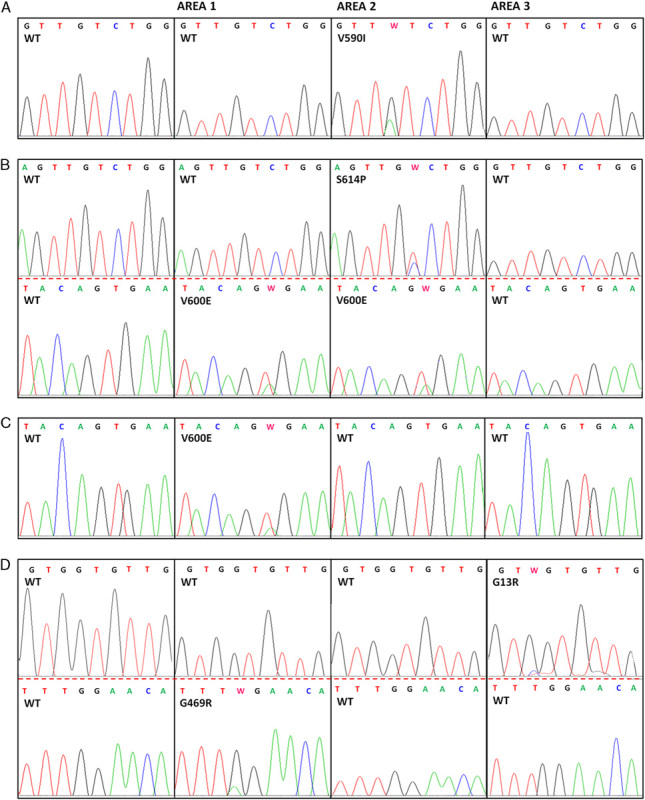
Inhibitors of RAF inhibit the MAPK pathway that plays an important role in the development and progression of those melanoma carrying the V600E BRAF mutation, but there's a subset of such patients who do not respond to the therapy. Various mechanisms of drug resistance have been proposed which include the clonal heterogeneity of the tumor. We have studied a population of nodular melanoma to investigate the intratumor and intertumor heterogeneity by Laser Capture Microdissection (LCM) analysis. Our results showed that BRAF and NRAS mutations were detected in 47% and 33% of nodular melanoma, respectively, and that there is a discrepancy in mutational pattern of tumoral sample because in the 36% of patients a different mutation, in at least 1 area of the tumor, was found by LCM analysis, giving evidence of the presence of different clonal cells populations. Moreover, we found that mutations in BRAF and NRAS are not mutually exclusive because they were simultaneously present in the same tumor specimens and we observed that when the 2 different mutations were present one is a high-frequency mutation and the other is a low-frequency mutation. This was more evident in lymphonodal metastasis that resulted from wild type to mutational analysis, but showed different mutations following LCM analysis. Therefore, we believed that, when primary tumoral sample results negative to mutational analysis, if it is possible, metastases should be investigated to verify the presence of mutations. Generally, it should be searched for other mutations, in addition to BRAF V600E, so as to better understand the mechanism of drug resistance.
Conflict of interest statement
The authors declare no conflict of interest.
Figures
Comment in
-
BRAF and NRAS Mutations are Not Mutually Exclusive in Melanoma and in Single Melanoma Cells.Appl Immunohistochem Mol Morphol. 2016 Mar;24(3):e14-5. doi: 10.1097/PAI.0000000000000217. Appl Immunohistochem Mol Morphol. 2016. PMID: 26317309 No abstract available.
References
-
- Nestle FO, Halpern AC.Bolognia JL, Jorizzo JL, Rapini RP. Melanoma. Dermatology. 2008;22nd edSpain: Mosby;1745–1771.
-
- Menzies SW, Moloney FJ, Byth K, et al. Dermoscopic evaluation of nodular melanoma. JAMA Dermatol. 2013;149:699–709. - PubMed
-
- Saldanha G, Potter L, Daforno P, et al. Cutaneous melanoma subtypes show different BRAF and NRAS mutation frequencies. Clin Cancer Res. 2006;12:4499–4505. - PubMed
-
- Lee JH, Choi JW, Kim YS. Frequencies of BRAF and NRAS mutations are different in histological types and sites of origin of cutaneous melanoma: a meta-analysis. Br J Dermatol. 2011;164:776–784. - PubMed
-
- Sullivan RJ, Flaherty KT. Resistance to BRAF-target therapy in melanoma. Eur J Cancer. 2013;49:1297–1304. - PubMed
Publication types
MeSH terms
Substances
LinkOut - more resources
Full Text Sources
Medical
Research Materials
Miscellaneous
