


5-Aminosalicylates reduce the risk of colorectal neoplasia in patients with ulcerative colitis: an updated meta-analysis
- PMID: 24710620
- PMCID: PMC3978022
- DOI: 10.1371/journal.pone.0094208
5-Aminosalicylates reduce the risk of colorectal neoplasia in patients with ulcerative colitis: an updated meta-analysis
Abstract
Background: Although the chemopreventive effect of 5-aminosalicylates on patients with ulcerative colitis has been extensively studied, the results remain controversial. This updated review included more recent studies and evaluated the effectiveness of 5-aminosalicylates use on colorectal neoplasia prevention in patients with ulcerative colitis.
Methods: Up to July 2013, we searched Medline, Embase, Web of Science, Cochrane CENTRAL, and SinoMed of China for all relevant observational studies (case-control and cohort) about the effect of 5-aminosalicylates on the risk of colorectal neoplasia among patients with ulcerative colitis. The Newcastle-Ottawa Scale was used to assess the quality of studies. Adjusted odds ratios (ORs) were extracted from each study. A random-effects model was used to generate pooled ORs and 95% confidence intervals (95%CI). Publication bias and heterogeneity were assessed.
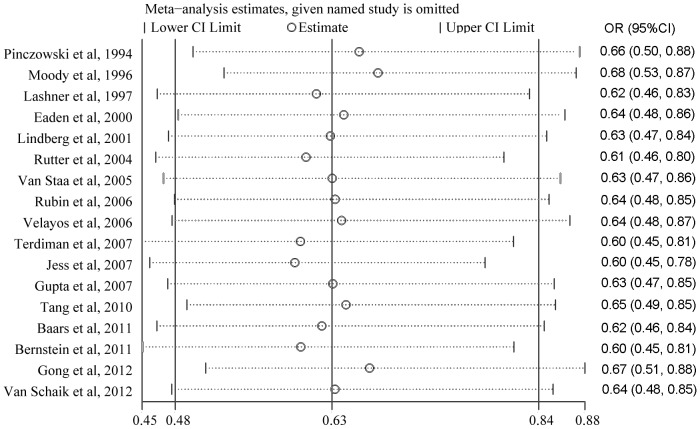
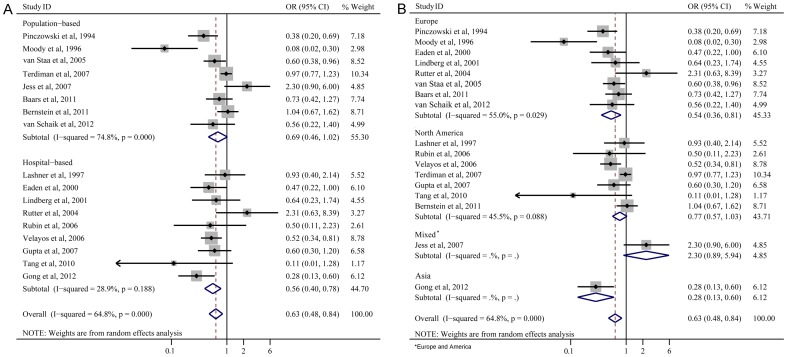
Results: Seventeen studies containing 1,508 cases of colorectal neoplasia and a total of 20,193 subjects published from 1994 to 2012 were analyzed. 5-aminosalicylates use was associated with a reduced risk of colorectal neoplasia in patients with ulcerative colitis (OR 0.63; 95%CI 0.48-0.84). Pooled OR of a higher average daily dose of 5-aminosalicylates (sulfasalazine ≥ 2.0 g/d, mesalamine ≥ 1.2 g/d) was 0.51 [0.35-0.75]. Pooled OR of 5-aminosalicylates use in patients with extensive ulcerative colitis was 1.00 [0.53-1.89].
Conclusion: Our pooled results indicated that 5-aminosalicylates use was associated with a reduced risk of colorectal neoplasia in patients with ulcerative colitis, especially in the cases with a higher average daily dose of 5-aminosalicylates use. However, the chemopreventive benefit of 5-aminosalicylates use in patients with extensive ulcerative colitis was limited.
Conflict of interest statement
Figures





References
-
- Jess T, Rungoe C, Peyrin-Biroulet L (2010) Risk of colorectal cancer in patients with ulcerative colitis: a meta-analysis of population-based cohort studies. Clin Gastroenterol Hepatol 10: 639–645. - PubMed
-
- Collins PD, Mpofu C, Watson AJ, Rhodes JM (2006) Strategies for detecting colon cancer and/or dysplasia in patients with inflammatory bowel disease. Cochrane Database Syst Rev 19: CD000279. - PubMed
-
- Subramanian V, Logan RF (2011) Chemoprevention of colorectal cancer in inflammatory bowel disease. Best Pract Res Clin Gastroenterol 25: 593–606. - PubMed
-
- Velayos FS, Terdiman JP, Walsh JM (2005) Effect of 5-aminosalicylate use on colorectal cancer and dysplasia risk: a systematic review and meta-analysis of observational studies. Am J Gastroenterol 100: 1345–1353. - PubMed
-
- Rubin DT, LoSavio A, Yadron N, Huo D, Hanauer SB (2006) Aminosalicylate therapy in the prevention of dysplasia and colorectal cancer in ulcerative colitis. Clin Gastroenterol Hepatol 4: 1346–1350. - PubMed
Publication types
MeSH terms
Substances
LinkOut - more resources
Full Text Sources
Other Literature Sources
Medical
