. 2014 Sep;5(3):199-207.
doi: 10.1007/s13539-014-0140-3. Epub 2014 Apr 8.

Anabolic exercise in haemodialysis patients: a randomised controlled pilot study

Affiliations

Anabolic exercise in haemodialysis patients: a randomised controlled pilot study

Danielle L Kirkman et al. J Cachexia Sarcopenia Muscle. 2014 Sep.

Abstract

Background: The anabolic response to progressive resistance exercise training (PRET) in haemodialysis patients is unclear. This pilot efficacy study aimed to determine whether high-intensity intradialytic PRET could reverse atrophy and consequently improve strength and physical function in haemodialysis patients. A second aim was to compare any anabolic response to that of healthy participants completing the same program.

Methods: In a single blind controlled study, 23 haemodialysis patients and 9 healthy individuals were randomly allocated to PRET or an attention control (SHAM) group. PRET completed high-intensity exercise leg extensions using novel equipment. SHAM completed low-intensity lower body stretching activities using ultra light resistance bands. Exercises were completed thrice weekly for 12 weeks, during dialysis in the haemodialysis patients. Outcomes included knee extensor muscle volume by magnetic resonance imaging, knee extensor strength by isometric dynamometer and lower body tests of physical function. Data were analysed by a per protocol method using between-group comparisons.

Results: PRET elicited a statistically and clinically significant anabolic response in haemodialysis patients (PRET-SHAM, mean difference [95 % CI]: 193[63 to 324] cm(3)) that was very similar to the response in healthy participants (PRET-SHAM, 169[-41 to 379] cm(3)). PRET increased strength in both haemodialysis patients and healthy participants. In contrast, PRET only enhanced lower body functional capacity in the healthy participants.

Conclusions: Intradialytic PRET elicited a normal anabolic and strength response in haemodialysis patients. The lack of a change in functional capacity was surprising and warrants further investigation.


Figures
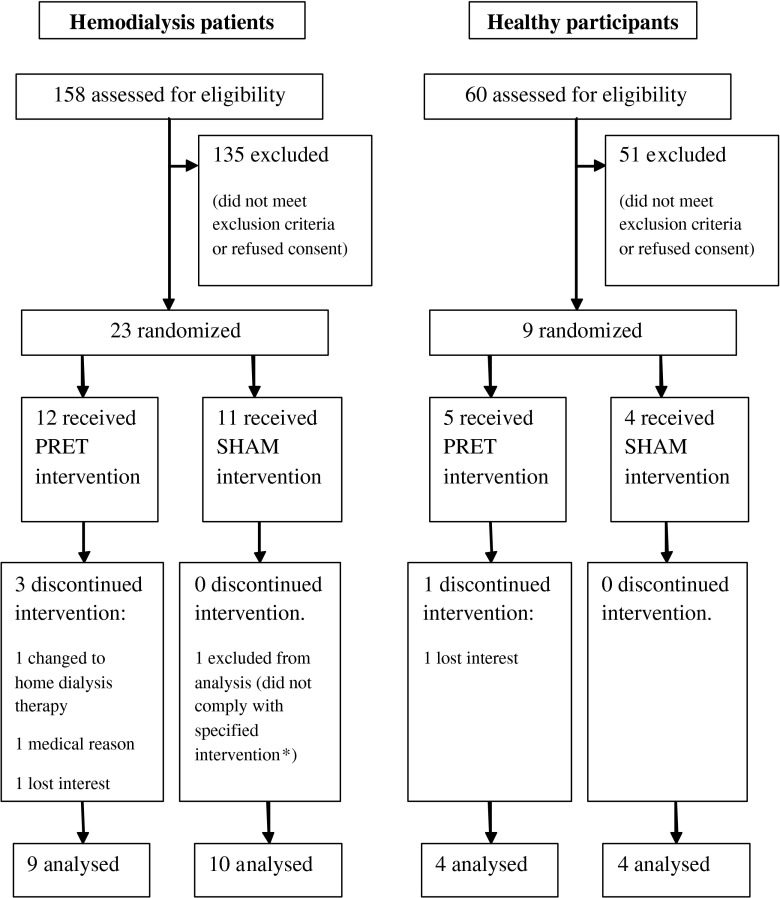
Fig. 1
Fig. 1
Trial profile: PRET progressive resistance exercise training, SHAM attention control. * completed additional exercise
Fig. 2
Fig. 2
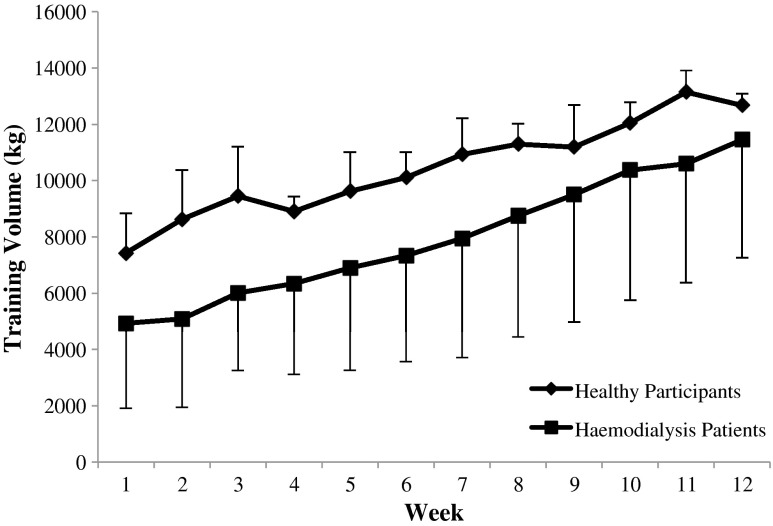
Training volume in progressive resistance exercise training groups over the 12-week intervention period. Training volume increased from week 1 to 12 similarly in both haemodialysis patients and healthy controls, as evidenced by a significant main effect of time by analysis of variance (p = 0.03), a non-significant group × time interaction (p = 0.3) and a non-significant main effect of group (p = 0.2)
Fig. 3
Fig. 3
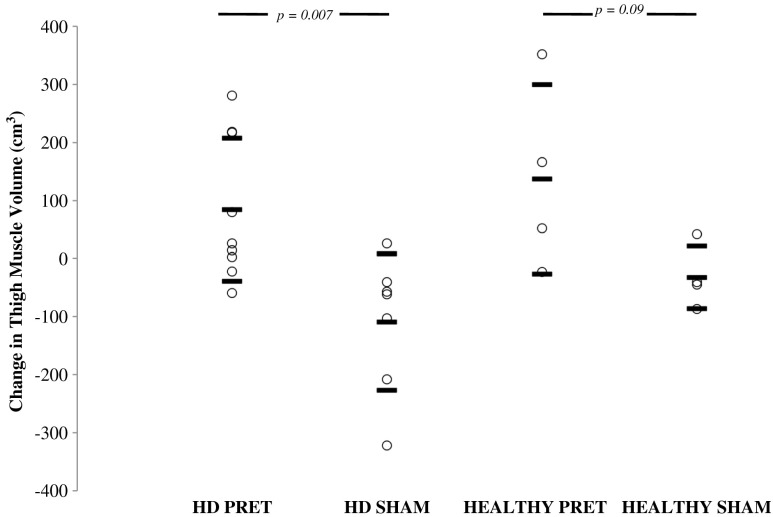
Changes in absolute thigh muscle volume by magnetic resonance imaging over the 12-week intervention period. HD haemodialysis patients, PRET progressive resistance training, SHAM attention control. PRET elicited a similar anabolic response in haemodialysis patients and healthy participants, as evidenced by significant independent t tests between PRET and SHAM groups and moderate to large effect sizes
Fig. 4
Fig. 4
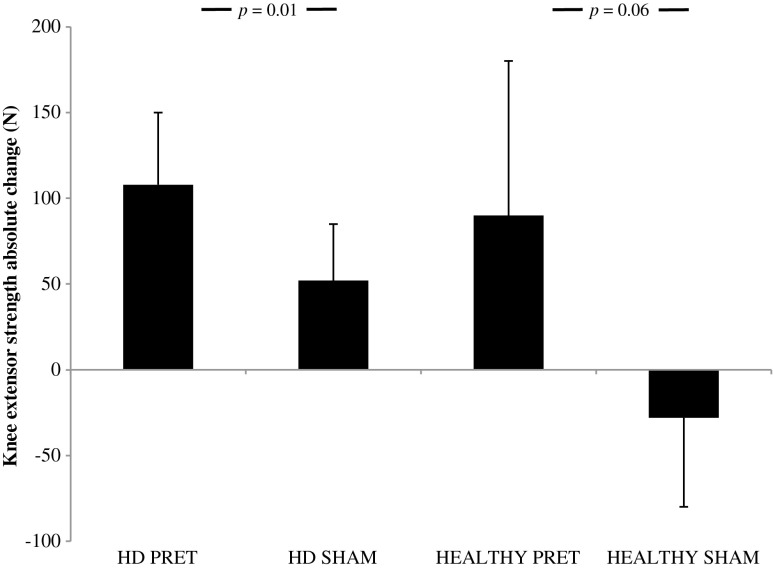
Isometric knee extensor strength absolute change over the 12-week intervention period. HD haemodialysis patients, PRET progressive resistance training. PRET elicited a similar strength response in haemodialysis patients and healthy participants, as evidenced by a significant independent t tests between PRET and SHAM groups and moderate to large effect sizes

References

    1. Sakkas GK, Ball D, Mercer TH, Sargeant AJ, Tolfrey K, Naish PF. Atrophy of non-locomotor muscle in patients with end-stage renal failure. Nephrol Dial Transplant. 2003;18:2074–81. - PubMed
    1. Johansen KL, Shubert T, Doyle J, Soher B, Sakkas GK, Kent-Braun JA. Muscle atrophy in patients receiving hemodialysis: effects on muscle strength, muscle quality, and physical function. Kidney Int. 2003;63:291–7. doi: 10.1046/j.1523-1755.2003.00704.x. - DOI - PubMed
    1. Macdonald JH, Phanish MK, Marcora SM, Jibani M, Bloodworth LLO, Holly JMP, et al. Muscle insulin-like growth factor status, body composition, and functional capacity in hemodialysis patients. J Ren Nutr. 2004;14:248–52. doi: 10.1016/j.jrn.2004.08.001. - DOI - PubMed
    1. Workeneh BT, Mitch WE. Review of muscle wasting associated with chronic kidney disease. Am J Clin Nutr. 2010;91:1128S–32. doi: 10.3945/ajcn.2010.28608B. - DOI - PubMed
    1. Mak RH, Ikizler TA, Kovesdy CP, Raj DS, Stenvinkel P, Kalantar-Zadeh K. Wasting in chronic kidney disease (vol 2, pg 9, 2011) J Cachexia Sarcopenia Muscle. 2011;2:119. doi: 10.1007/s13539-011-0026-6. - DOI - PMC - PubMed

LinkOut - more resources