


Bayesian inference for an emerging arboreal epidemic in the presence of control
- PMID: 24711393
- PMCID: PMC4035939
- DOI: 10.1073/pnas.1310997111
Bayesian inference for an emerging arboreal epidemic in the presence of control
Abstract
The spread of Huanglongbing through citrus groves is used as a case study for modeling an emerging epidemic in the presence of a control. Specifically, the spread of the disease is modeled as a susceptible-exposed-infectious-detected-removed epidemic, where the exposure and infectious times are not observed, detection times are censored, removal times are known, and the disease is spreading through a heterogeneous host population with trees of different age and susceptibility. We show that it is possible to characterize the disease transmission process under these conditions. Two innovations in our work are (i) accounting for control measures via time dependence of the infectious process and (ii) including seasonal and host age effects in the model of the latent period. By estimating parameters in different subregions of a large commercially cultivated orchard, we establish a temporal pattern of invasion, host age dependence of the dispersal parameters, and a close to linear relationship between primary and secondary infectious rates. The model can be used to simulate Huanglongbing epidemics to assess economic costs and potential benefits of putative control scenarios.
Keywords: dispersal kernel; spatiotemporal model; stochastic model.
Conflict of interest statement
The authors declare no conflict of interest.
Figures
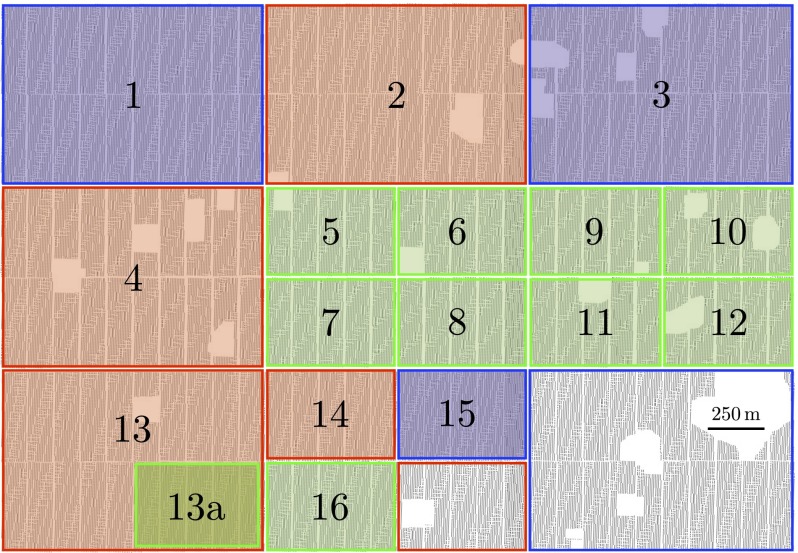
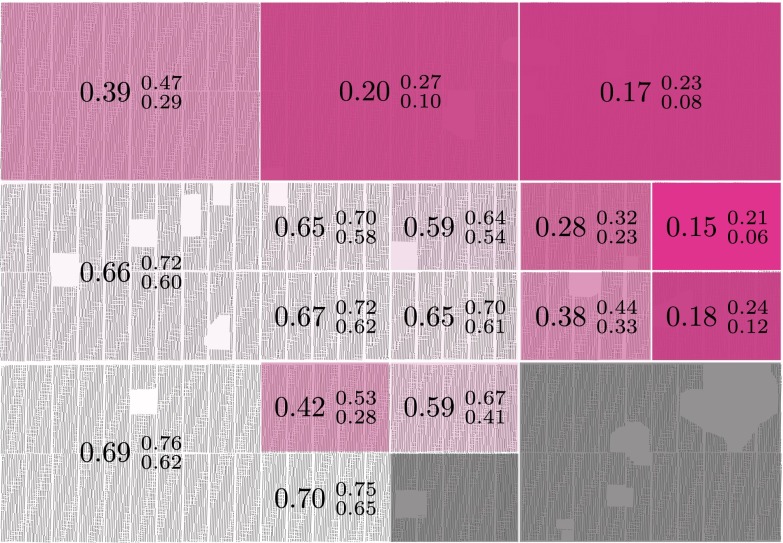
 and the smaller numbers give the 95% credible interval. The transparency of the pink shading is linearly proportional to the mean value of
  .
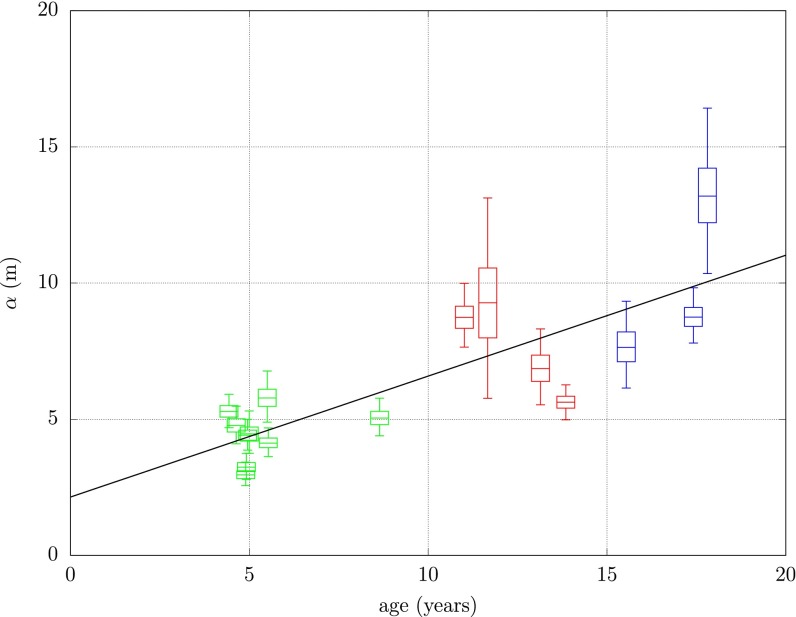
.
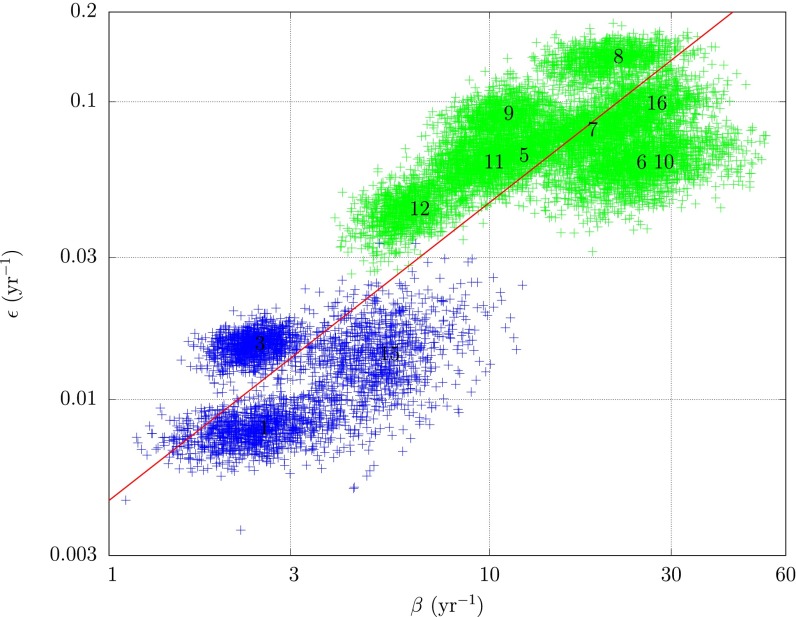
 is roughly constant across subregions.
References
-
- Gibson GJ, et al. Bayesian estimation for percolation models of disease spread in plant populations. Stat Comput. 2006;16(4):391–402.
-
- Cook A, Marion G, Butler A, Gibson G. Bayesian inference for the spatio-temporal invasion of alien species. Bull Math Biol. 2007;69(6):2005–2025. - PubMed
-
- Kadoya T, Washitani I. Predicting the rate of range expansion of an invasive alien bumblebee (Bombus terrestris) using a stochastic spatio-temporal model. Biol Conserv. 2010;143(5):1228–1235.
-
- Meentemeyer RK, et al. Epidemiological modeling of invasion in heterogeneous landscapes: Spread of sudden oak death in California (1990–2030) Ecosphere. 2011;2(2):a17.
Publication types
MeSH terms
Grants and funding
LinkOut - more resources
Full Text Sources
Other Literature Sources
