


Angiotensin-(1-7) recruits muscle microvasculature and enhances insulin's metabolic action via mas receptor
- PMID: 24711523
- PMCID: PMC4030711
- DOI: 10.1161/HYPERTENSIONAHA.113.03025
Angiotensin-(1-7) recruits muscle microvasculature and enhances insulin's metabolic action via mas receptor
Abstract
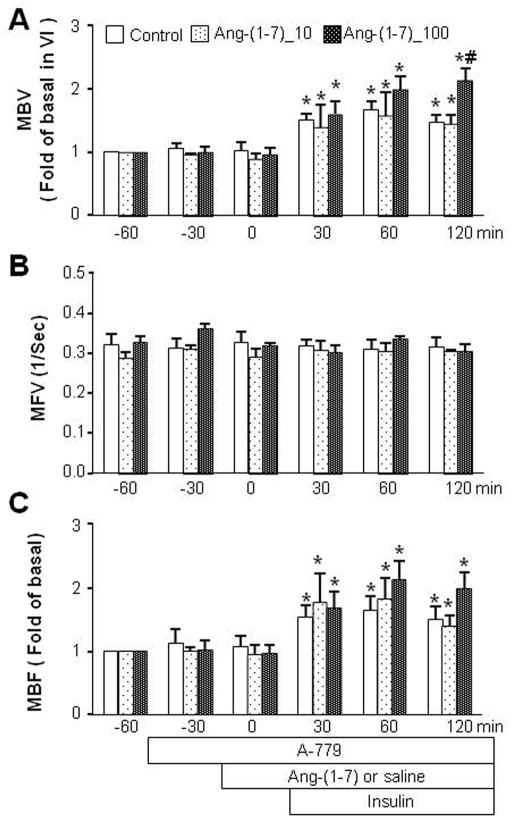
Angiotensin-(1-7) [Ang-(1-7)], an endogenous ligand for the G protein-coupled receptor Mas, exerts both vasodilatory and insulin-sensitizing effects. In skeletal muscle, relaxation of precapillary arterioles recruits microvasculature and increases the endothelial surface area available for nutrient and hormone exchanges. To assess whether Ang-(1-7) recruits microvasculature and enhances insulin action in muscle, overnight-fasted adult rats received an intravenous infusion of Ang-(1-7) (0, 10, or 100 ng/kg per minute) for 150 minutes with or without a simultaneous infusion of the Mas inhibitor A-779 and a superimposition of a euglycemic insulin clamp (3 mU/kg per minute) from 30 to 150 minutes. Hind limb muscle microvascular blood volume, microvascular flow velocity, and microvascular blood flow were determined. Myographic changes in tension were measured on preconstricted distal saphenous artery. Ang-(1-7) dose-dependently relaxed the saphenous artery (P<0.05) ex vivo. This effect was potentiated by insulin (P<0.01) and abolished by either endothelium denudement or Mas inhibition. Systemic infusion of Ang-(1-7) rapidly increased muscle microvascular blood volume and microvascular blood flow (P<0.05, each) without altering microvascular flow velocity. Insulin infusion alone increased muscle microvascular blood volume by 60% to 70% (P<0.05). Adding insulin to the Ang-(1-7) infusion further increased muscle microvascular blood volume and microvascular blood flow (≈2.5 fold; P<0.01). These were associated with a significant increase in insulin-mediated glucose disposal and muscle protein kinase B and extracellular signal-regulated kinase 1/2 phosphorylation. A-779 pretreatment blunted the microvascular and insulin-sensitizing effects of Ang-(1-7). We conclude that Ang-(1-7) by activating Mas recruits muscle microvasculature and enhances the metabolic action of insulin. These effects may contribute to the cardiovascular protective responses associated with Mas activation and explain the insulin-sensitizing action of Ang-(1-7).
Keywords: angiotensins; endothelial cells; microvasculature; muscles.
Conflict of interest statement
We declare no conflict of interest in this study.
Figures




References
-
- Vincent MA, Clerk LH, Lindner JR, Klibanov AL, Clark MG, Rattigan S, Barrett EJ. Microvascular recruitment is an early insulin effect that regulates skeletal muscle glucose uptake in vivo. Diabetes. 2004;53:1418–1423. - PubMed
-
- Clark MG, Wallis MG, Barrett EJ, Vincent MA, Richards SM, Clerk LH, Rattigan S. Blood flow and muscle metabolism: A focus on insulin action. Am J Physiol Endocrinol Metab. 2003;284:E241–258. - PubMed
-
- Carey RM, Siragy HM. Newly recognized components of the renin-angiotensin system: Potential roles in cardiovascular and renal regulation. Endocr Rev. 2003;24:261–271. - PubMed
Publication types
MeSH terms
Substances
Grants and funding
LinkOut - more resources
Full Text Sources
Other Literature Sources
Medical
Research Materials
Miscellaneous
