


Once a Treg, always a Treg?
- PMID: 24712466
- PMCID: PMC4008876
- DOI: 10.1111/imr.12173
Once a Treg, always a Treg?
Abstract
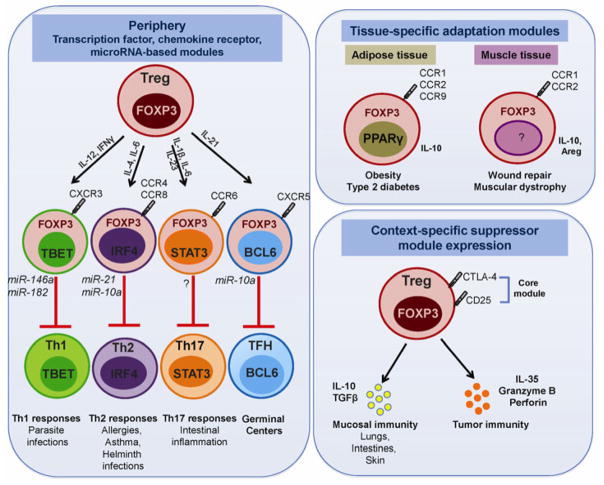
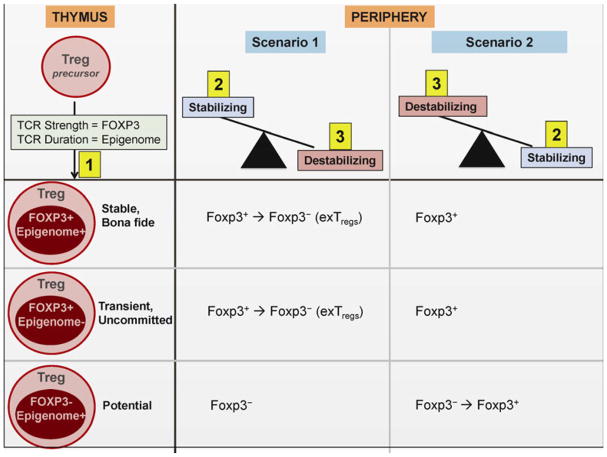
Regulatory T cells (Tregs) prevail as a specialized cell lineage that has a central role in the dominant control of immunological tolerance and maintenance of immune homeostasis. Thymus-derived Tregs (tTregs) and their peripherally induced counterparts (pTregs) are imprinted with unique Forkhead box protein 3 (Foxp3)-dependent and independent transcriptional and epigenetic characteristics that bestows on them the ability to suppress disparate immunological and non-immunological challenges. Thus, unidirectional commitment and the predominant stability of this regulatory lineage is essential for their unwavering and robust suppressor function and has clinical implications for the use of Tregs as cellular therapy for various immune pathologies. However, recent studies have revealed considerable heterogeneity or plasticity in the Treg lineage, acquisition of alternative effector or hybrid fates, and promotion rather than suppression of inflammation in extreme contexts. In addition, the absolute stability of Tregs under all circumstances has been questioned. Since these observations challenge the safety and efficacy of human Treg therapy, the issue of Treg stability versus plasticity continues to be enthusiastically debated. In this review, we assess our current understanding of the defining features of Foxp3(+) Tregs, the intrinsic and extrinsic cues that guide development and commitment to the Treg lineage, and the phenotypic and functional heterogeneity that shapes the plasticity and stability of this critical regulatory population in inflammatory contexts.
Keywords: Foxp3; epigenetics; heterogeneity; plasticity; regulatory T cells; stability.
© 2014 John Wiley & Sons A/S. Published by John Wiley & Sons Ltd.
Conflict of interest statement
The authors have no conflicts of interest to declare.
Figures
References
-
- Starr TK, Jameson SC, Hogquist KA. Positive and negative selection of T cells. Annu Rev Immunol. 2003;21:139–176. - PubMed
Publication types
MeSH terms
Substances
Grants and funding
LinkOut - more resources
Full Text Sources
Other Literature Sources
