


Twenty-four hour total and dietary fat oxidation in lean, obese and reduced-obese adults with and without a bout of exercise
- PMID: 24714529
- PMCID: PMC3979741
- DOI: 10.1371/journal.pone.0094181
Twenty-four hour total and dietary fat oxidation in lean, obese and reduced-obese adults with and without a bout of exercise
Abstract
Background: It has been hypothesized that obese and reduced-obese individuals have decreased oxidative capacity, which contributes to weight gain and regain. Recent data have challenged this concept.
Objective: To determine (1) whether total and dietary fat oxidation are decreased in obese and reduced-obese adults compared to lean but increase in response to an acute exercise bout and (2) whether regular physical activity attenuates these metabolic alterations.
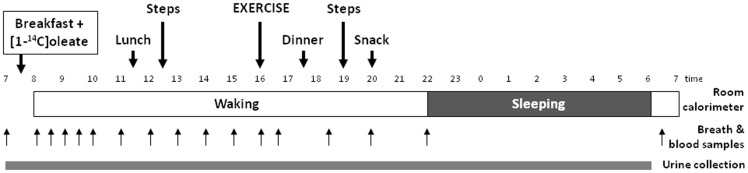
Design: We measured 24-hr total (whole-room calorimetry) and dietary fat (14C-oleate) oxidation in Sedentary Lean (BMI = 21.5±1.6; n = 10), Sedentary Obese (BMI = 33.6±2.5; n = 9), Sedentary Reduced-Obese (RED-SED; BMI = 26.9±3.7; n = 7) and in Physically Active Reduced-Obese (RED-EX; BMI = 27.3±2.8; n = 12) men and women with or without an acute exercise bout where energy expended during exercise was not replaced.
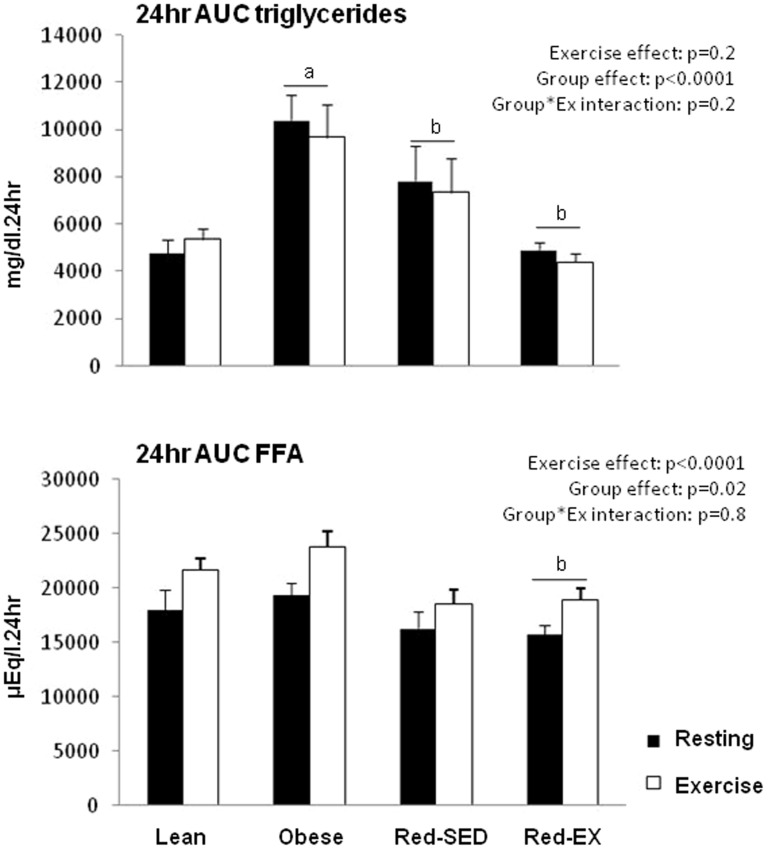
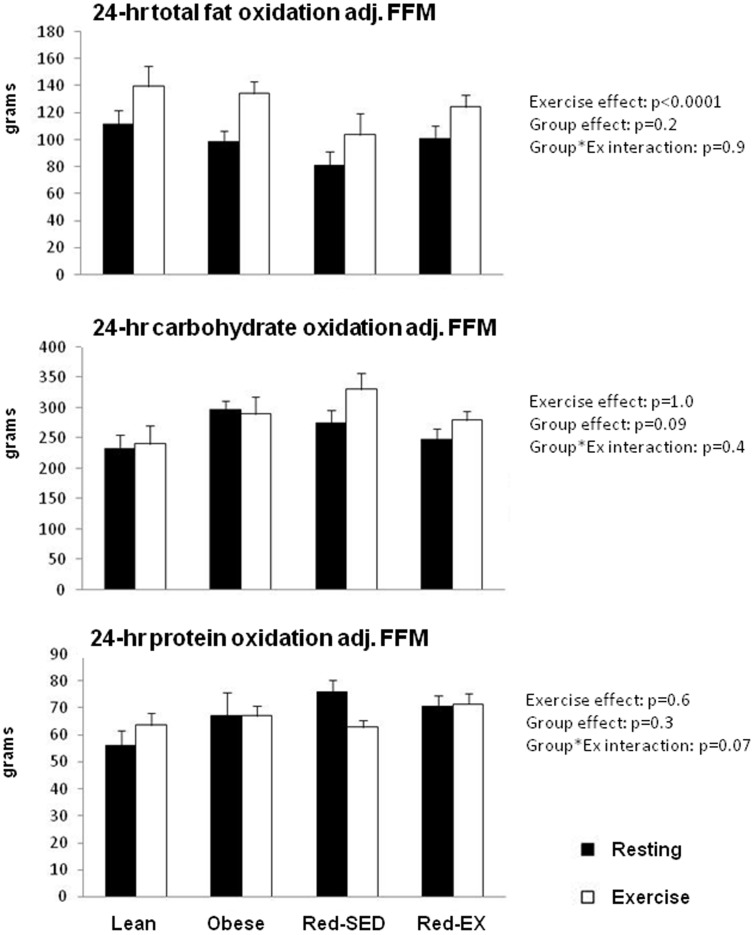
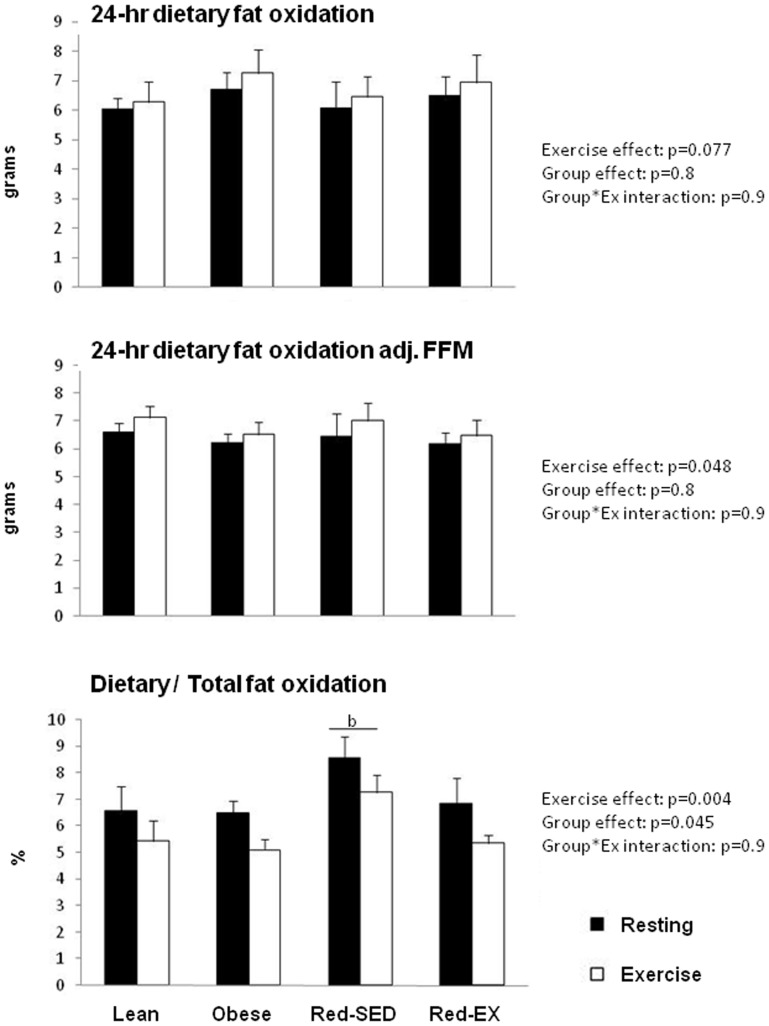
Results: Although Red-SED and Red-EX had a similar level of fatness, aerobic capacity and metabolic profiles were better in Red-EX only compared to Obese subjects. No significant between-group differences were seen in 24-hr respiratory quotient (RQ, Lean: 0.831±0.044, Obese: 0.852±0.023, Red-SED: 0.864±0.037, Red-EX: 0.842±0.039), total and dietary fat oxidation. A single bout of exercise increased total (+27.8%, p<0.0001) and dietary (+6.6%, p = 0.048) fat oxidation across groups. Although exercise did not impact RQ during the day, it decreased RQ during sleep (p = 0.01) in all groups. Red-EX oxidized more fat overnight than Red-SED subjects under both resting (p = 0.036) and negative energy balance (p = 0.003) conditions, even after adjustment for fat-free mass.
Conclusion: Obese and reduced-obese individuals oxidize as much fat as lean both under eucaloric and negative energy balance conditions, which does not support the hypothesis of reduced oxidative capacity in these groups. Reduced-obese individuals who exercise regularly have markers of metabolic health similar to those seen in lean adults. Both the acute and chronic effects of exercise were primarily observed at night suggesting an important role of sleep in the regulation of lipid metabolism.
Conflict of interest statement
Figures

References
-
- Li Z, Maglione M, Tu W, Mojica W, Arterburn D, et al. (2005) Meta-analysis: pharmacologic treatment of obesity. Ann Intern Med 142: 532–546. - PubMed
-
- Maggard MA, Shugarman LR, Suttorp M, Maglione M, Sugerman HJ, et al. (2005) Meta-analysis: surgical treatment of obesity. Ann Intern Med 142: 547–559. - PubMed
-
- Wadden TA, Butryn ML (2003) Behavioral treatment of obesity. Endocrinol Metab Clin North Am 32: : 981–1003, x. - PubMed
-
- Weiss EC, Galuska DA, Kettel Khan L, Gillespie C, Serdula MK (2007) Weight regain in U.S. adults who experienced substantial weight loss, 1999-2002. Am J Prev Med 33: 34–40. - PubMed
-
- Anderson JW, Konz EC, Frederich RC, Wood CL (2001) Long-term weight-loss maintenance: a meta-analysis of US studies. Am J Clin Nutr 74: 579–584. - PubMed
Publication types
MeSH terms
Substances
Grants and funding
LinkOut - more resources
Full Text Sources
Other Literature Sources
Medical
